9O1P | pdb_00009o1p

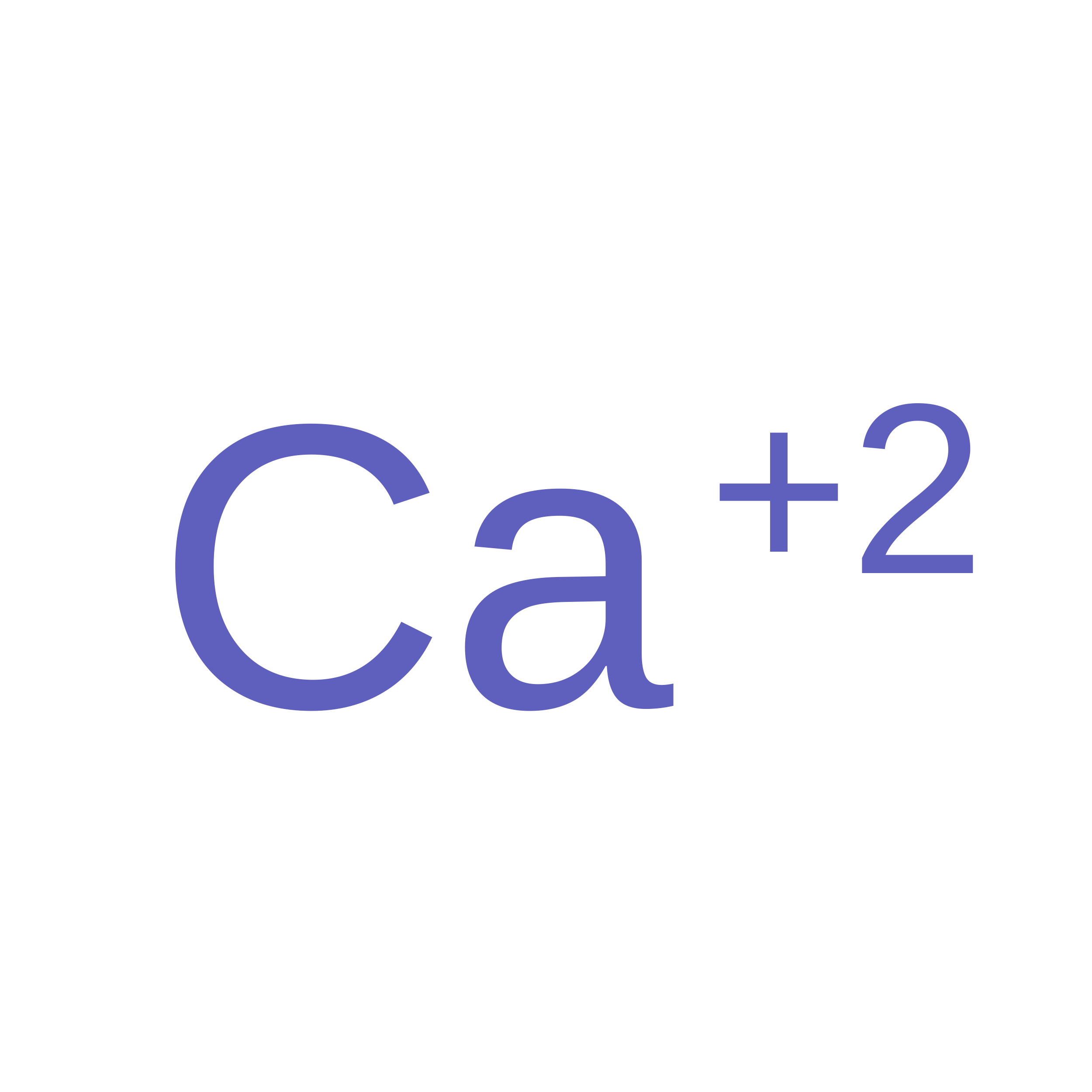
TMEM16F D409G mutant in liposomes in the presence of Ca2+ (closed state)

  • Classification: LIPID TRANSPORT
  • Organism(s): Mus musculus
  • Expression System: Homo sapiens
  • Mutation(s): Yes 

  • Deposited: 2025-04-03 Released: 2026-05-06 
  • Deposition Author(s): Feng, Z., Accardi, A.
  • Funding Organization(s): National Institutes of Health/National Institute of General Medical Sciences (NIH/NIGMS)

Experimental Data Snapshot

  • Method: ELECTRON MICROSCOPY
  • Resolution: 3.48 Å
  • Aggregation State: PARTICLE 
  • Reconstruction Method: SINGLE PARTICLE 

Starting Model: experimental
View more details

wwPDB Validation 3D Report Full Report

Validation slider image for 9O1P

This is version 1.1 of the entry. See complete history

Literature

Calcium dependent activation of the TMEM16F scramblase and ion channel.

Feng, Z.Alvarenga, O.E.Di Zanni, E.Lee, S.Khelashvili, G.Accardi, A.

(2026) Nat Struct Mol Biol 33: 664-676

  • DOI: https://doi.org/10.1038/s41594-026-01789-5
  • Primary Citation Related Structures: 
    9O1I, 9O1L, 9O1M, 9O1N, 9O1O, 9O1P, 9O1Q

  • PubMed Abstract: 

    The ubiquitous transmembrane protein 16F (TMEM16F) Ca 2+ -activated channel and scramblase catalyzes phosphatidylserine externalization to enable blood coagulation, membrane fusion and brain immune surveillance. Despite its importance, the molecular mechanisms underlying TMEM16F activation remain poorly understood. Here, we obtained high-resolution cryo-electron microscopy structures of TMEM16F active in liposomes. In high-activity conditions, TMEM16F adopts two conformations, the canonical Ca 2+ -bound closed state and one where the upward rotation of the cytosolic domain leads to an X-shaped groove that forms a transmembrane pore and locally thins the membrane. Using mutagenesis, functional assays and molecular dynamics simulations, we show that the X-shaped groove is active and mediates nonselective ion flux and lipid scrambling through distinct pathways; ions move within the protein-delimited pore, whereas lipids skirt the X-shaped groove. Our findings provide a complete picture of TMEM16F Ca 2+ -dependent gating and demonstrate that imaging membrane proteins in a native-like environment can allow capturing otherwise inaccessible active states.


  • Organizational Affiliation
    • Department of Anesthesiology, Weill Cornell Medical College, Anesthesiology, New York, NY, USA.

Macromolecule Content 

  • Total Structure Weight: 212.86 kDa 
  • Atom Count: 11,714 
  • Modeled Residue Count: 1,432 
  • Deposited Residue Count: 1,822 
  • Unique protein chains: 1

Macromolecules

Find similar proteins by:|  3D Structure
Entity ID: 1
MoleculeChains  Sequence LengthOrganismDetailsImage
Anoctamin-6
A, B
911Mus musculusMutation(s): 1 
Gene Names: Ano6Tmem16f
UniProt & NIH Common Fund Data Resources
Find proteins for Q6P9J9 (Mus musculus)
Explore Q6P9J9 
Go to UniProtKB:  Q6P9J9
IMPC:  MGI:2145890
Entity Groups
Sequence Clusters30% Identity50% Identity70% Identity90% Identity95% Identity100% Identity
UniProt GroupQ6P9J9
Sequence Annotations
Expand
Reference Sequence

Experimental Data & Validation

Experimental Data

  • Method: ELECTRON MICROSCOPY
  • Resolution: 3.48 Å
  • Aggregation State: PARTICLE 
  • Reconstruction Method: SINGLE PARTICLE 
EM Software:
TaskSoftware PackageVersion
MODEL REFINEMENTPHENIX1.20.1_4487:

Structure Validation

View Full Validation Report


Entry History 

& Funding Information

Deposition Data


Funding OrganizationLocationGrant Number
National Institutes of Health/National Institute of General Medical Sciences (NIH/NIGMS)United StatesR35GM152012

Revision History  (Full details and data files)

  • Version 1.0: 2026-05-06
    Type: Initial release
  • Version 1.1: 2026-05-13
    Changes: Data collection, Database references