Download Mendeley
Structural basis of active state coupling of metabotropic glutamate receptor 8 to beta-arrestins.
Marx, D.C., Huynh, K., Gonzalez-Hernandez, A.J., Strauss, A., Rico, C., Gallo, P.N., Sharghi Moshtaghin, S., Arefin, A., Broichhagen, J., Eliezer, D., Khelashvili, G., Levitz, J.(2026) Nat Commun 17
- PubMed: 42722693 Search on PubMedSearch on PubMed Central
- DOI: https://doi.org/10.1038/s41467-026-77556-3
- Primary Citation Related Structures:
9N8Y, 9N8Z, 9Y1M, 9Y1N - PubMed Abstract:
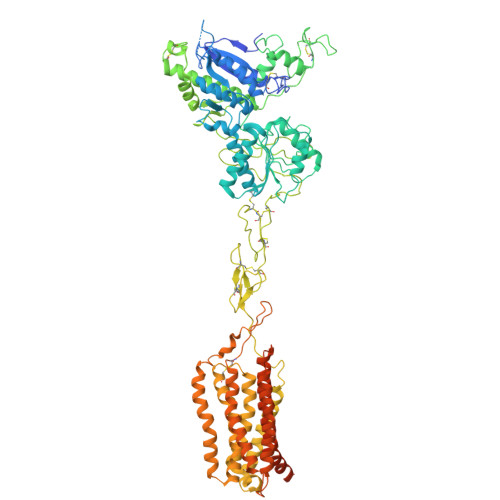
Metabotropic glutamate receptors (mGluRs) are prototypical, dimeric family C G protein-coupled receptors (GPCR) that perform crucial modulatory roles throughout the nervous system. While mGluR activation and signaling through G proteins has been studied extensively, how these receptors interact with and are desensitized by β-arrestins (β-arrs) is not well understood. Here, we use an integrative biophysical and structural approach to probe the coupling of mGluR8 and β-arrs. Using negative stain electron microscopy (EM), we identify tail- and core-bound orientations and stoichiometries of mGluR8/β-arr complexes. Cryo-EM structures of mGluR8 alone or bound to either G proteins or β-arr1 reveal mGluR8 active states with transducer-specific differences. The mGluR8/β-arr structure shows a distinct complex orientation compared to other GPCR/β-arr structures which supports a steric mechanism of mGluR desensitization involving interactions with both subunits and the lipid bilayer. Coupling of mGluR8 to β-arr1 in an active-like conformation is verified by live-cell and single molecule FRET analysis. Finally, molecular dynamics simulations further define the positioning and dynamics of mGluR8-bound β-arr1 and the importance of critical mGluR8 residues for stabilizing β-arr1 complexes. Together, our data provide a framework for agonist-driven family C GPCR/β-arr coupling.
- Department of Biochemistry and Biophysics, Weill Cornell Medicine, New York, NY, USA.
Organizational Affiliation: