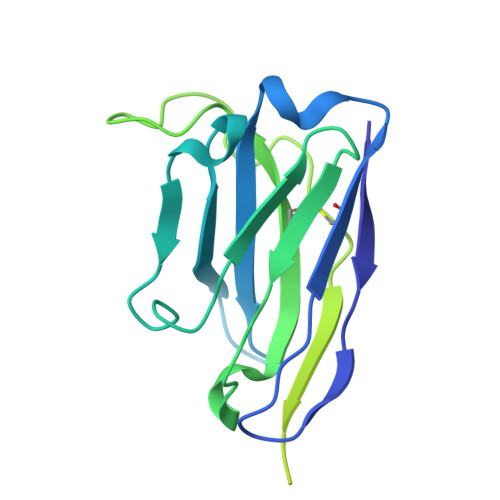
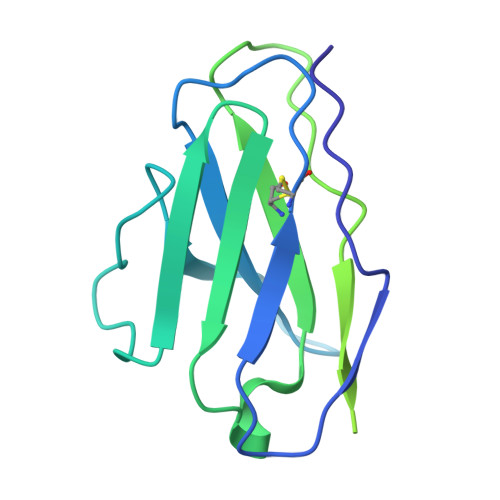
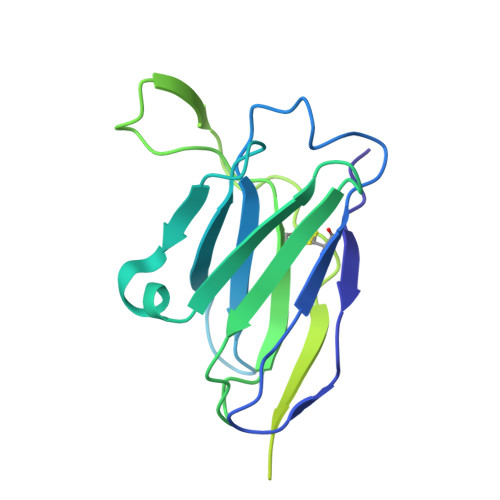
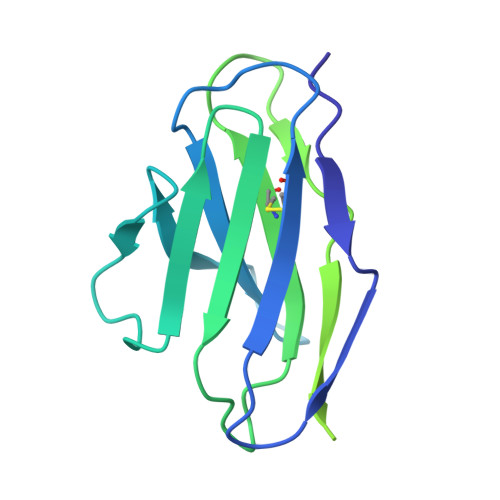
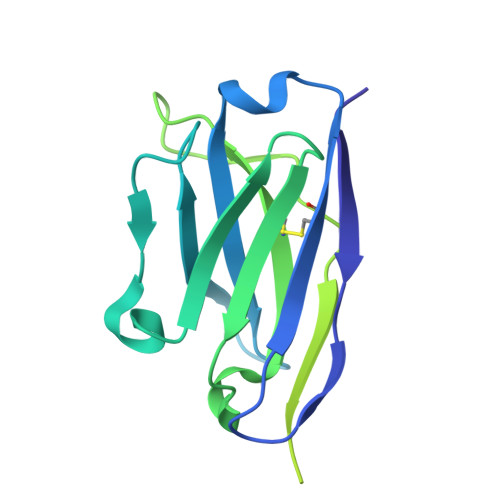
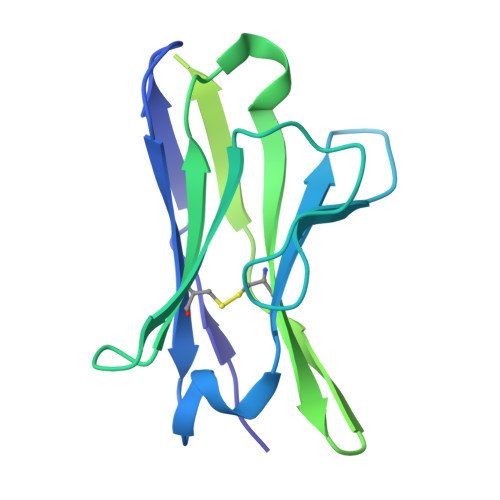
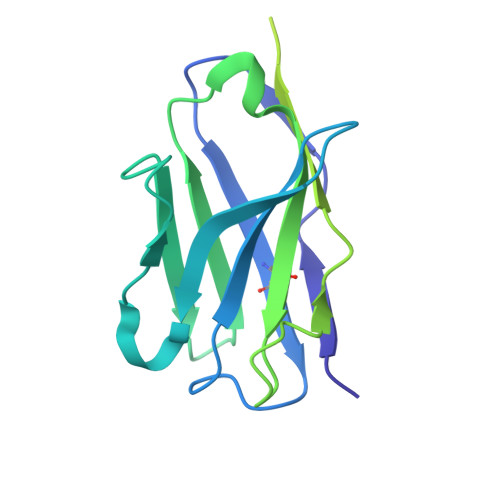
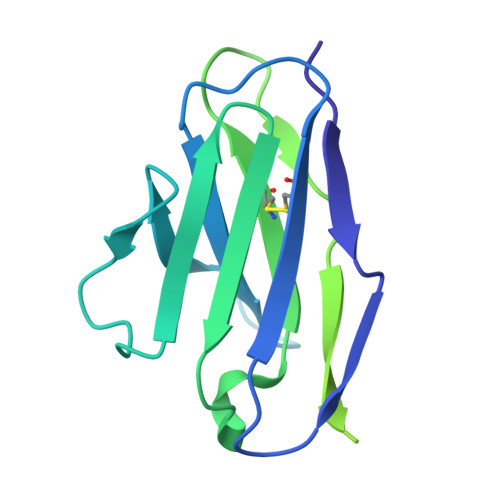
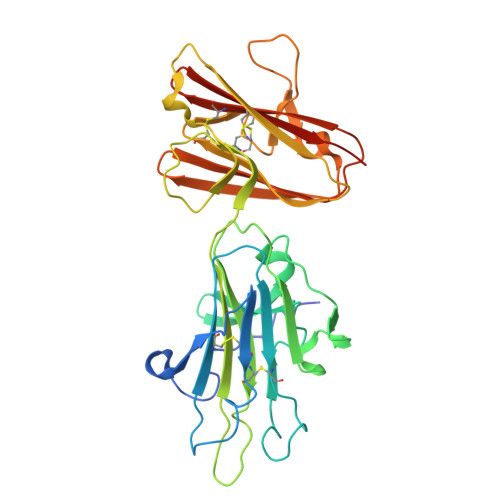
9N8J | pdb_00009n8j

Stabilized tandem antigen chimera of Pfs230 and Pfs48/45 bound by potent mAbs


Experimental Data Snapshot

  • Method: ELECTRON MICROSCOPY
  • Resolution: 3.22 Å
  • Aggregation State: PARTICLE 
  • Reconstruction Method: SINGLE PARTICLE 

Starting Model: experimental
View more details

wwPDB Validation 3D Report Full Report

Validation slider image for 9N8J

This is version 1.1 of the entry. See complete history

Literature

A stabilized tandem antigen chimera that elicits potent malaria transmission-reducing activity.

Ivanochko, D.Miura, K.Hailemariam, S.Ravichandran, R.Song, Y.Huang, W.C.Stoter, R.Teelen, K.van Gemert, G.J.Leaf, E.M.Chan, S.Men, C.Semesi, A.Shiu, C.MacGill, R.S.Long, C.A.Jore, M.M.King, N.P.Lovell, J.F.Julien, J.P.

(2026) Nat Commun 17

  • DOI: https://doi.org/10.1038/s41467-026-68761-1
  • Primary Citation Related Structures: 
    9N8I, 9N8J, 9N8N

  • PubMed Abstract: 

    Malaria parasite transmission remains a barrier to elimination since asymptomatic individuals sustain the infectious reservoir. Transmission-blocking vaccine (TBV) candidates targeting Plasmodium falciparum (Pf) gametocyte surface proteins Pfs230 and Pfs48/45 have shown promise in clinical trials. Several vaccine candidates have been developed for these antigens, yet it is unclear which elicit the most robust and durable transmission-blocking responses. From structure-function relationships of monoclonal antibodies in complex with both antigens, we report the development of a stabilized tandem antigen chimera (STAC), which presents the most potent epitopes from Pfs230 domain 1 (Pfs230-D1) and Pfs48/45 domain 3 (Pfs48/45-D3) in a single construct, while masking non-functional epitopes using an engineered pseudo-native domain disposition. Iterative structure-guided optimization improved antigen yields and stability, while nanoparticle-based multimerization enhanced the functional transmission-reducing activity elicited by the immunogen in female mice. Immunizations with STAC genetically conjugated to self-assembling protein nanoparticles elicited antibodies with potent transmission-reducing activity comparable or superior to the multimerized Pfs230-D1 and Pfs48/45-D3. These findings establish STAC as a promising next-generation TBV candidate to disrupt malaria transmission and accelerate elimination efforts. More broadly, our results support the engineering of highly ordered and stable multi-domain antigens in a single protein as a strategy for the cost-efficient development of multi-component vaccines.


  • Organizational Affiliation
    • Program in Molecular Medicine, The Hospital for Sick Children Research Institute, 686 Bay Street, Toronto, ON, M5G 0A4, Canada.

Macromolecule Content 

  • Total Structure Weight: 226.75 kDa 
  • Atom Count: 9,512 
  • Modeled Residue Count: 1,226 
  • Deposited Residue Count: 2,087 
  • Unique protein chains: 9

Macromolecules

Find similar proteins by:|  3D Structure
Entity ID: 1
MoleculeChains  Sequence LengthOrganismDetailsImage
RUPA-97 Fab Heavy chainA [auth B]227Homo sapiensMutation(s): 0 
Find similar proteins by:|  3D Structure
Entity ID: 2
MoleculeChains  Sequence LengthOrganismDetailsImage
RUPA-97 Fab Kappa chainB [auth C]215Homo sapiensMutation(s): 0 
Find similar proteins by:|  3D Structure
Entity ID: 3
MoleculeChains  Sequence LengthOrganismDetailsImage
RUPA-44 Fab Heavy chainC [auth D]230Homo sapiensMutation(s): 0 
Find similar proteins by:|  3D Structure
Entity ID: 4
MoleculeChains  Sequence LengthOrganismDetailsImage
RUPA-44 Fab Kappa chainD [auth E]214Homo sapiensMutation(s): 0 
Find similar proteins by:|  3D Structure
Entity ID: 5
MoleculeChains  Sequence LengthOrganismDetailsImage
TB31F Fab Heavy chainE [auth F]222RattusMutation(s): 0 
Find similar proteins by:|  3D Structure
Entity ID: 6
MoleculeChains  Sequence LengthOrganismDetailsImage
TB31F Fab Lambda chainF [auth G]216RattusMutation(s): 0 
Find similar proteins by:|  3D Structure
Entity ID: 7
MoleculeChains  Sequence LengthOrganismDetailsImage
LMIV230-01 Fab Heavy chainG [auth H]221Homo sapiensMutation(s): 0 
Find similar proteins by:|  3D Structure
Entity ID: 8
MoleculeChains  Sequence LengthOrganismDetailsImage
LMIV230-01 Fab Kappa chainH [auth I]215Homo sapiensMutation(s): 0 
Find similar proteins by:|  3D Structure
Entity ID: 9
MoleculeChains  Sequence LengthOrganismDetailsImage
Gametocyte surface protein P230,Gametocyte surface protein P45/48I [auth X]327Plasmodium falciparumMutation(s): 0 
Gene Names: PFS230PF230S230PF3D7_0209000PF45/48PFS45-48PFS45/48PF13_0247PF3D7_1346700
UniProt
Find proteins for P68874 (Plasmodium falciparum (isolate 3D7))
Explore P68874 
Go to UniProtKB:  P68874
Find proteins for Q8I6T1 (Plasmodium falciparum (isolate 3D7))
Explore Q8I6T1 
Go to UniProtKB:  Q8I6T1
Entity Groups
Sequence Clusters30% Identity50% Identity70% Identity90% Identity95% Identity100% Identity
UniProt GroupsP68874Q8I6T1
Sequence Annotations
Expand
Reference Sequence

Oligosaccharides

Help  
Entity ID: 10
MoleculeChains Length2D Diagram GlycosylationD Interactions
alpha-L-fucopyranose-(1-6)-2-acetamido-2-deoxy-beta-D-glucopyranoseJ [auth A]2N-Glycosylation
Glycosylation Resources
GlyTouCan: G86851RC
GlyCosmos: G86851RC
GlyGen: G86851RC

Experimental Data & Validation

Experimental Data

  • Method: ELECTRON MICROSCOPY
  • Resolution: 3.22 Å
  • Aggregation State: PARTICLE 
  • Reconstruction Method: SINGLE PARTICLE 
EM Software:
TaskSoftware PackageVersion
MODEL REFINEMENTPHENIX
MODEL REFINEMENTCoot
RECONSTRUCTIONcryoSPARCv4.5.2

Structure Validation

View Full Validation Report


Entry History 

& Funding Information

Deposition Data


Funding OrganizationLocationGrant Number
Bill & Melinda Gates FoundationUnited States-Gates Foundation (INV-008866 and OPP1156262) -National Institutes of Health grant (1R01AI148557-01A1) -Canadian Institutes for Health Research grant (428410)
National Institutes of Health/National Institute Of Allergy and Infectious Diseases (NIH/NIAID)United States1R01AI148557-01A1
Canadian Institutes of Health Research (CIHR)Canada428410

Revision History  (Full details and data files)

  • Version 1.0: 2026-02-04
    Type: Initial release
  • Version 1.1: 2026-06-10
    Changes: Data collection, Database references