9MVS | pdb_00009mvs

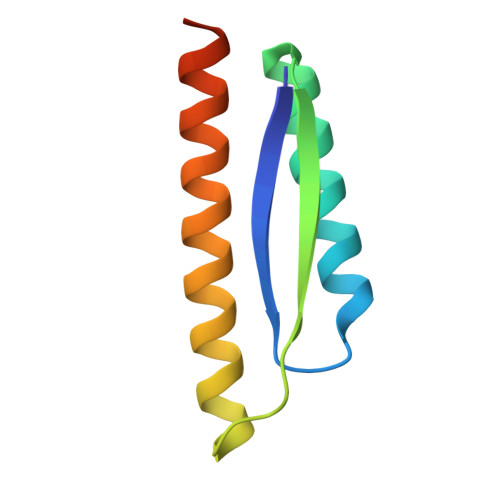
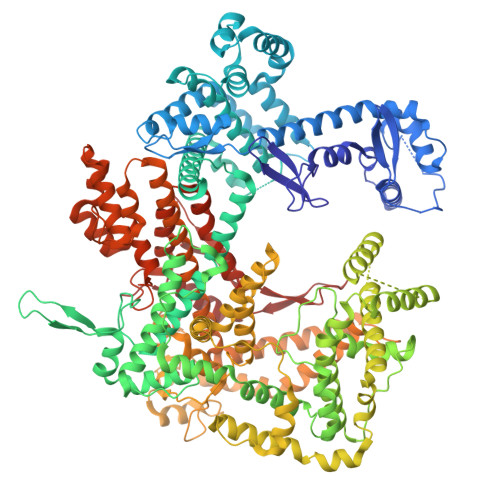
Activated Leptotrichia buccalis (Lbu) CRISPR-Cas13a bound to AI-designed anti-CRISPR AIcrVIA1


Experimental Data Snapshot

  • Method: ELECTRON MICROSCOPY
  • Resolution: 3.43 Å
  • Aggregation State: PARTICLE 
  • Reconstruction Method: SINGLE PARTICLE 

Starting Models: experimental
View more details

wwPDB Validation 3D Report Full Report

Validation slider image for 9MVS

This is version 1.1 of the entry. See complete history

Literature

De novo design of potent CRISPR-Cas13 inhibitors.

Taveneau, C.Chai, H.X.D'Silva, J.Bamert, R.S.Chen, H.Hayes, B.K.Calvert, R.W.Purcell, J.Curwen, D.J.Munder, F.Martin, L.L.Barr, J.J.Rosenbluh, J.Fareh, M.Grinter, R.Knott, G.J.

(2026) Nat Chem Biol 

  • DOI: https://doi.org/10.1038/s41589-025-02136-3
  • Primary Citation Related Structures: 
    9MVR, 9MVS

  • PubMed Abstract: 

    CRISPR-Cas systems are transformative tools for gene editing that can be tuned or controlled by anti-CRISPRs (Acrs)-phage-derived inhibitors that regulate CRISPR-Cas activity. However, Acrs that can inhibit biotechnologically relevant CRISPR systems are relatively rare and challenging to discover. To overcome this limitation, we describe a highly successful and rapid approach that leverages de novo protein design to develop new-to-nature proteins for controlling CRISPR-Cas activity. Here, using Leptotrichia buccalis CRISPR-Cas13a as a representative example, we demonstrate that Acrs designed using artificial intelligence (AIcrs) are capable of highly potent and specific inhibition of CRISPR-Cas13a nuclease activity. We present a comprehensive workflow for design validation and demonstrate AIcr functionality in controlling CRISPR-Cas13 activity in bacterial and human cells. The ability to design bespoke inhibitors of Cas effectors will contribute to the ongoing development of CRISPR-Cas tools in diverse applications across research, medicine, agriculture and microbiology.


  • Organizational Affiliation
    • Department of Biochemistry and Molecular Biology, Biomedicine Discovery Institute, Monash University, Clayton, Victoria, Australia. cyntia.taveneau@monash.edu.

Macromolecule Content 

  • Total Structure Weight: 174.95 kDa 
  • Atom Count: 11,346 
  • Modeled Residue Count: 1,261 
  • Deposited Residue Count: 1,327 
  • Unique protein chains: 2
  • Unique nucleic acid chains: 2

Macromolecules


Find similar proteins by:|  3D Structure
Entity ID: 1
MoleculeChains  Sequence LengthOrganismDetailsImage
AIcrVIA1A [auth B]83synthetic constructMutation(s): 0 
Find similar proteins by:|  3D Structure
Entity ID: 2
MoleculeChains  Sequence LengthOrganismDetailsImage
CRISPR-associated endoribonuclease Cas13aB [auth A]1,162Leptotrichia buccalisMutation(s): 0 
Gene Names: cas13ac2c2Lebu_1799
EC: 3.1
UniProt
Find proteins for C7NBY4 (Leptotrichia buccalis (strain ATCC 14201 / DSM 1135 / JCM 12969 / NCTC 10249 / C-1013-b))
Explore C7NBY4 
Go to UniProtKB:  C7NBY4
Entity Groups
Sequence Clusters30% Identity50% Identity70% Identity90% Identity95% Identity100% Identity
UniProt GroupC7NBY4
Sequence Annotations
Expand
Reference Sequence
Find similar nucleic acids by:  (by identity cutoff) 
Entity ID: 3
MoleculeChains LengthOrganismImage
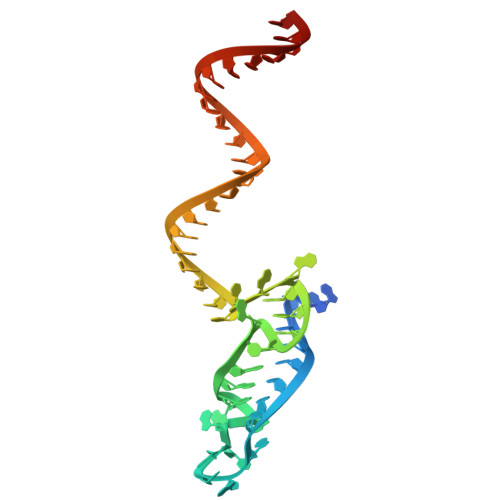
crRNA56Leptotrichia buccalis
Sequence Annotations
Expand
Reference Sequence
Find similar nucleic acids by:  (by identity cutoff) 
Entity ID: 4
MoleculeChains LengthOrganismImage
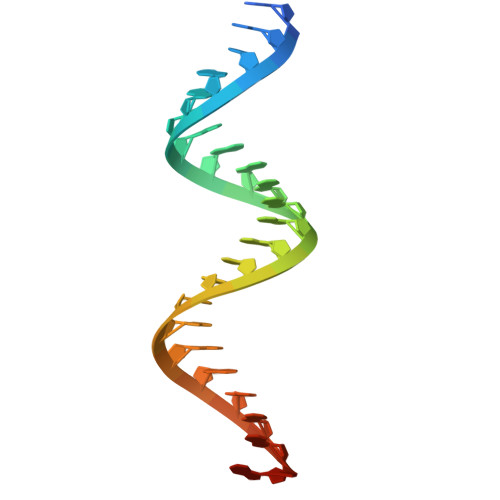
Guide complementary activator RNA (aRNA)26synthetic construct
Sequence Annotations
Expand
Reference Sequence

Experimental Data & Validation

Experimental Data

  • Method: ELECTRON MICROSCOPY
  • Resolution: 3.43 Å
  • Aggregation State: PARTICLE 
  • Reconstruction Method: SINGLE PARTICLE 
EM Software:
TaskSoftware PackageVersion
RECONSTRUCTIONCoot0.9.4
RECONSTRUCTIONPHENIX1.18.2
MODEL REFINEMENTPHENIX1.18.2

Structure Validation

View Full Validation Report


Entry History 

& Funding Information

Deposition Data


Funding OrganizationLocationGrant Number
Other privateAustraliaSMRF2021-276

Revision History  (Full details and data files)

  • Version 1.0: 2026-02-25
    Type: Initial release
  • Version 1.1: 2026-04-29
    Changes: Data collection, Database references