9MQI | pdb_00009mqi

Inactive Mu-Opioid Receptor with Nb6M, NabFab, and isoquinuclidine compound #020_E1


Experimental Data Snapshot

  • Method: ELECTRON MICROSCOPY
  • Resolution: 3.30 Å
  • Aggregation State: PARTICLE 
  • Reconstruction Method: SINGLE PARTICLE 

wwPDB Validation 3D Report Full Report

Validation slider image for 9MQI

This is version 1.0 of the entry. See complete history

Literature

Docking 14 million virtual isoquinuclidines against the mu and kappa opioid receptors reveals dual antagonists-inverse agonists with reduced withdrawal effects.

Vigneron, S.F.Ohno, S.Braz, J.Kim, J.Y.Kweon, O.S.Webb, C.Billesbolle, C.Bhardwaj, K.Irwin, J.Manglik, A.Basbaum, A.I.Ellman, J.A.Shoichet, B.K.

(2025) bioRxiv 

  • DOI: https://doi.org/10.1101/2025.01.09.632033
  • Primary Citation Related Structures: 
    9MQH, 9MQI, 9MQJ, 9MQK, 9MQL

  • PubMed Abstract: 

    Large library docking of tangible molecules has revealed potent ligands across many targets. While make-on-demand libraries now exceed 75 billion enumerated molecules, their synthetic routes are dominated by a few reaction types, reducing diversity and inevitably leaving many interesting bioactive-like chemotypes unexplored. Here, we investigate the large-scale enumeration and targeted docking of isoquinuclidines. These "natural-product-like" molecules are rare in the current libraries and are functionally congested, making them interesting as receptor probes. Using a modular, four-component reaction scheme, we built and docked a virtual library of over 14.6 million isoquinuclidines against both the μ- and κ -opioid receptors (MOR and KOR, respectively). Synthesis and experimental testing of 18 prioritized compounds found nine ligands with low μM affinities. Structure-based optimization revealed low- and sub-nM antagonists and inverse agonists targeting both receptors. Cryo-electron microscopy (cryoEM) structures illuminate the origins of activity on each target. In mouse behavioral studies, a potent member of the series with joint MOR-antagonist and KOR-inverse-agonist activity reversed morphine-induced analgesia, phenocopying the MOR-selective anti-overdose agent naloxone. Encouragingly, the new molecule induced less severe opioid-induced withdrawal symptoms compared to naloxone during withdrawal precipitation, and did not induce conditioned-place aversion, likely reflecting a reduction of dysphoria due to the compound's KOR-inverse agonism. The strengths and weaknesses of bespoke library docking, and of docking for opioid receptor polypharmacology, will be considered.


  • Organizational Affiliation
    • Department of Pharmaceutical Chemistry, University of California, San Francisco.

Macromolecule Content 

  • Total Structure Weight: 109.84 kDa 
  • Atom Count: 5,654 
  • Modeled Residue Count: 785 
  • Deposited Residue Count: 996 
  • Unique protein chains: 4

Macromolecules

Find similar proteins by:|  3D Structure
Entity ID: 1
MoleculeChains  Sequence LengthOrganismDetailsImage
Mu-type opioid receptor411Homo sapiensMutation(s): 0 
Gene Names: OPRM1MOR1
UniProt & NIH Common Fund Data Resources
Find proteins for P35372 (Homo sapiens)
Explore P35372 
Go to UniProtKB:  P35372
PHAROS:  P35372
GTEx:  ENSG00000112038 
Entity Groups
Sequence Clusters30% Identity50% Identity70% Identity90% Identity95% Identity100% Identity
UniProt GroupP35372
Sequence Annotations
Expand
Reference Sequence
Find similar proteins by:|  3D Structure
Entity ID: 2
MoleculeChains  Sequence LengthOrganismDetailsImage
Nanobody 6MB [auth C]131synthetic constructMutation(s): 0 
Find similar proteins by:|  3D Structure
Entity ID: 3
MoleculeChains  Sequence LengthOrganismDetailsImage
NabFab Heavy ChainC [auth H]239synthetic constructMutation(s): 0 
Find similar proteins by:|  3D Structure
Entity ID: 4
MoleculeChains  Sequence LengthOrganismDetailsImage
NabFab Light ChainD [auth L]215synthetic constructMutation(s): 0 

Small Molecules

Ligands 1 Unique
IDChains Name / Formula / InChI Key2D Diagram3D Interactions
A1BNM
(Subject of Investigation/LOI)

Query on A1BNM


Download:Ideal Coordinates CCD File
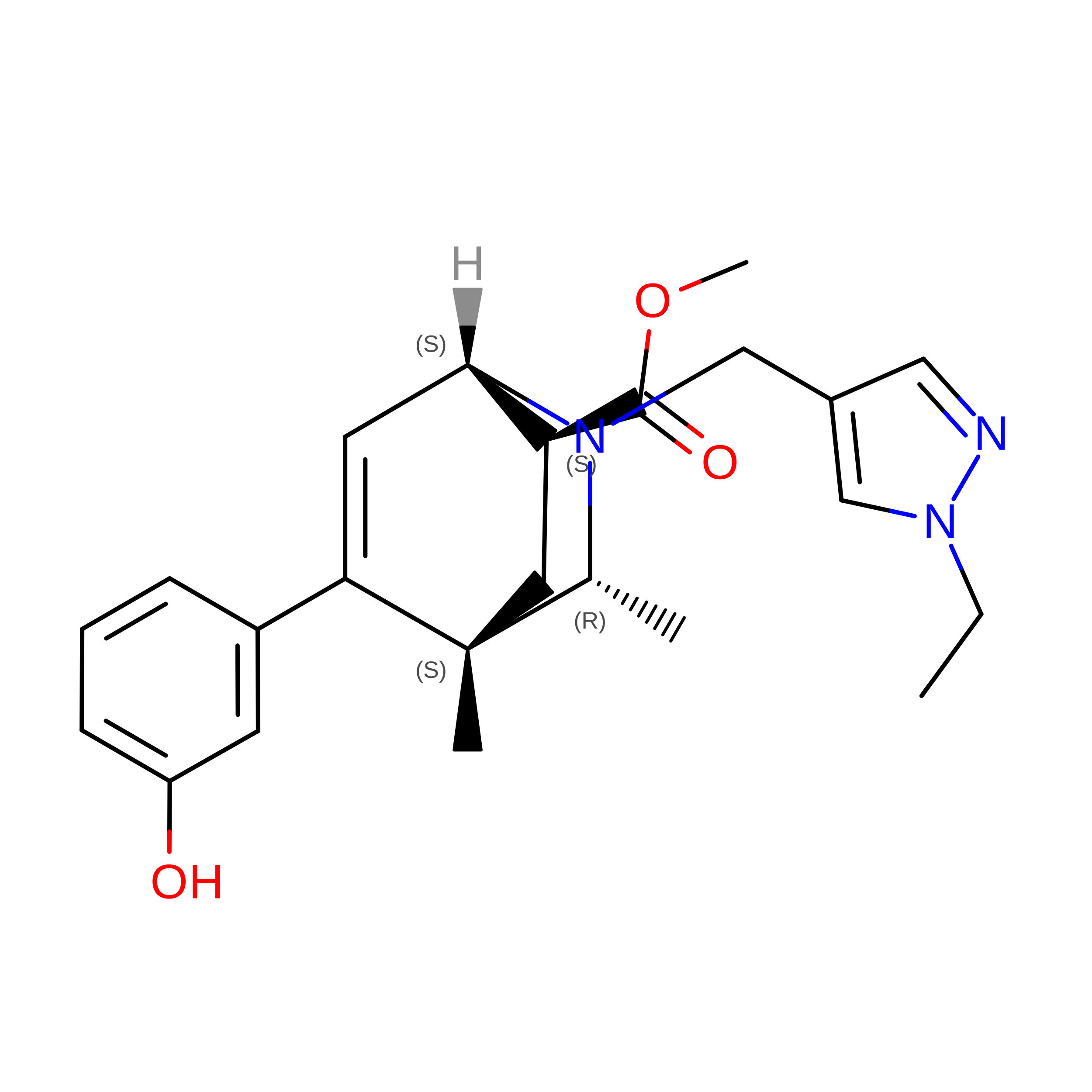
E [auth A]methyl (1S,3R,4S,6S,8M)-2-[(1-ethyl-1H-pyrazol-4-yl)methyl]-8-(3-hydroxyphenyl)-3,4-dimethyl-2-azabicyclo[2.2.2]oct-7-ene-6-carboxylate
C23 H29 N3 O3
UYTUIDYFDZPUBD-LQIDWMMKSA-N

Experimental Data & Validation

Experimental Data

  • Method: ELECTRON MICROSCOPY
  • Resolution: 3.30 Å
  • Aggregation State: PARTICLE 
  • Reconstruction Method: SINGLE PARTICLE 
EM Software:
TaskSoftware PackageVersion
MODEL REFINEMENTPHENIX1.21.1_5286:

Structure Validation

View Full Validation Report


Entry History 

& Funding Information

Deposition Data


Funding OrganizationLocationGrant Number
Defense Advanced Research Projects Agency (DARPA)United StatesHR0011-19-2-0020
National Institutes of Health/National Institute of General Medical Sciences (NIH/NIGMS)United StatesR35GM122481
National Institutes of Health/National Institute of General Medical Sciences (NIH/NIGMS)United StatesR35GM122473

Revision History  (Full details and data files)

  • Version 1.0: 2025-02-12
    Type: Initial release