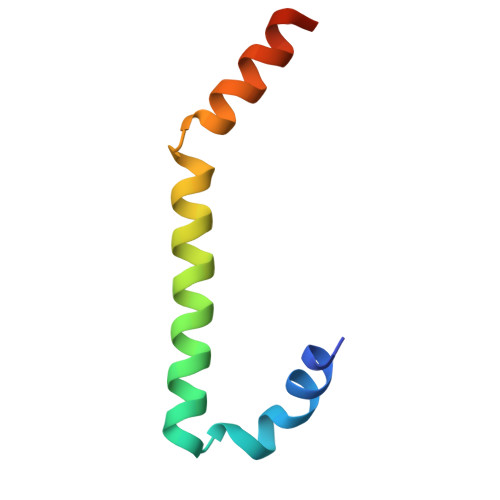
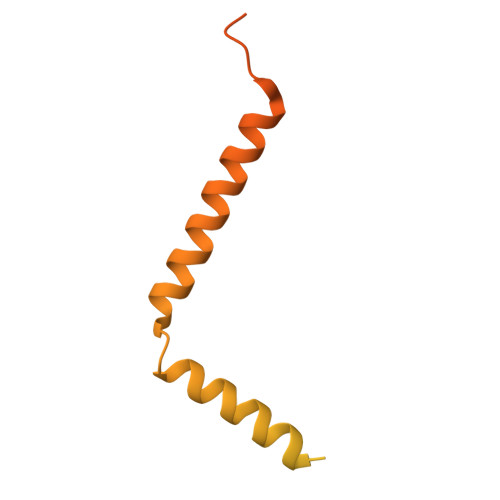
9MIY | pdb_00009miy

Focused reconstruction of the transmembrane region of the Lassa virus spike complex


Experimental Data Snapshot

  • Method: ELECTRON MICROSCOPY
  • Resolution: 2.72 Å
  • Aggregation State: PARTICLE 
  • Reconstruction Method: SINGLE PARTICLE 

wwPDB Validation 3D Report Full Report

Validation slider image for 9MIY

This is version 1.2 of the entry. See complete history

Literature

pH-induced conformational changes and inhibition of the Lassa virus spike complex.

Katz, M.Cohen-Dvashi, H.Borni, S.Ruedas, J.Henkel, G.McCormack, K.Diskin, R.

(2025) Cell Host Microbe 33: 1577-1588.e7

  • DOI: https://doi.org/10.1016/j.chom.2025.07.020
  • Primary Citation Related Structures: 
    9MHE, 9MIV, 9MIY, 9MJ1, 9MJ2, 9R8U

  • PubMed Abstract: 

    Lassa virus (LASV) is a devastating human pathogen with no vaccines and limited therapeutics. The LASV class-I spike complex engages target cells via binding its primary host receptor, matriglycan, followed by macropinocytosis and binding of its secondary receptor, lysosomal-associated membrane protein 1 (LAMP1), to trigger virus fusion. This process occurs across multiple pH-dependent steps, but the molecular events remain largely unknown. Through high-resolution structures, we study the pH-induced conformational changes of the spike preceding membrane fusion. We reveal pH-sensitive metal coordination sites that control the integrity of the spike's native state, elucidate a reorganization of the spike's transmembrane region, and provide a mechanism for dissociation from its primary receptor. Using the entry inhibitor ARN-75039, we validate our findings and establish the molecular basis for the binding and function of this investigational drug. These data define the molecular basis for the cell entry of LASV and will promote efforts in combating this virus and potentially related viral pathogens.


  • Organizational Affiliation
    • Department of Chemical and Structural Biology, Weizmann Institute of Science, 7610001 Rehovot, Israel.

Macromolecule Content 

  • Total Structure Weight: 99.35 kDa 
  • Atom Count: 2,388 
  • Modeled Residue Count: 303 
  • Deposited Residue Count: 870 
  • Unique protein chains: 2

Macromolecules

Find similar proteins by:|  3D Structure
Entity ID: 1
MoleculeChains  Sequence LengthOrganismDetailsImage
Pre-glycoprotein polyprotein GP complexA,
E [auth B],
F [auth C]
58Lassa virus JosiahMutation(s): 0 
Gene Names: GPCGP-C
UniProt
Find proteins for P08669 (Lassa virus (strain Mouse/Sierra Leone/Josiah/1976))
Explore P08669 
Go to UniProtKB:  P08669
Entity Groups
Sequence Clusters30% Identity50% Identity70% Identity90% Identity95% Identity100% Identity
UniProt GroupP08669
Sequence Annotations
Expand
Reference Sequence
Find similar proteins by:|  3D Structure
Entity ID: 2
MoleculeChains  Sequence LengthOrganismDetailsImage
Glycoprotein G2B [auth b],
C [auth a],
D [auth c]
232Lassa virus JosiahMutation(s): 0 
Gene Names: GPCGP-C
UniProt
Find proteins for P08669 (Lassa virus (strain Mouse/Sierra Leone/Josiah/1976))
Explore P08669 
Go to UniProtKB:  P08669
Entity Groups
Sequence Clusters30% Identity50% Identity70% Identity90% Identity95% Identity100% Identity
UniProt GroupP08669
Sequence Annotations
Expand
Reference Sequence

Experimental Data & Validation

Experimental Data

  • Method: ELECTRON MICROSCOPY
  • Resolution: 2.72 Å
  • Aggregation State: PARTICLE 
  • Reconstruction Method: SINGLE PARTICLE 
EM Software:
TaskSoftware PackageVersion
MODEL REFINEMENTPHENIXdev_5278

Structure Validation

View Full Validation Report


Entry History 

& Funding Information

Deposition Data


Funding OrganizationLocationGrant Number
Not funded--

Revision History  (Full details and data files)

  • Version 1.0: 2025-08-27
    Type: Initial release
  • Version 1.1: 2025-09-17
    Changes: Data collection, Database references
  • Version 1.2: 2025-09-24
    Changes: Data collection, Database references