9M1R | pdb_00009m1r

Cryo-EM structure of AKG bound OXGR1-Gq complex


Experimental Data Snapshot

  • Method: ELECTRON MICROSCOPY
  • Resolution: 2.66 Å
  • Aggregation State: PARTICLE 
  • Reconstruction Method: SINGLE PARTICLE 

wwPDB Validation 3D Report Full Report

Validation slider image for 9M1R

This is version 1.0 of the entry. See complete history

Literature

Molecular architecture of OXGR1 reveals an evolutionary conserved mechanisms for metabolite surveillance.

Zhang, X.Lu, Y.He, X.Guo, S.Li, C.Wang, Y.Gao, Y.Yao, J.Yuan, Q.Tang, Y.Hu, J.Hu, W.Luo, Z.Wu, K.Wang, Y.Yin, W.Xie, X.Xu, H.E.Liu, H.

(2026) EMBO J 

  • DOI: https://doi.org/10.1038/s44318-026-00823-y
  • Primary Citation Related Structures: 
    26XH, 9M1R, 9M1S, 9M1U, 9UXN, 9UXO, 9UXP, 9UXQ

  • PubMed Abstract: 

    The ability of cells to sense and respond to metabolic signals is fundamental to life, yet the molecular mechanisms underlying metabolite surveillance remain incompletely understood. Here, we elucidate the structural basis of metabolite recognition by OXGR1, a G Protein-Coupled Receptor (GPCR) that senses key intermediates in the tricarboxylic acid (TCA) cycle. Using cryo-electron microscopy, we determined cryo-EM structures of OXGR1 bound to α-ketoglutarate (AKG), itaconate (ITA), and structurally related metabolites succinate (SUC) and maleate (MA). These structures reveal a positively charged binding pocket and an extensive hydrogen-bond network that mediate selective recognition of dicarboxylic acids. In addition, we identify a distinct arrangement of hydrophobic residues that modulates ligand potency and selectivity. Mutational analysis and molecular dynamics simulations further demonstrate that noncanonical micro-switch motifs, including FRY and NLxxY, are essential for ligand recognition and receptor activation. Comparative structural and evolutionary analyses indicate that these mechanisms are conserved across species, underscoring the critical role of OXGR1 in maintaining metabolic homeostasis. Together, our findings define a mechanistic framework for metabolite sensing by OXGR1 and provide a framework for therapeutic modulation of metabolic and inflammatory diseases.


  • Organizational Affiliation
    • School of Chinese Materia Medica, Nanjing University of Chinese Medicine, Nanjing, China.

Macromolecule Content 

  • Total Structure Weight: 158.14 kDa 
  • Atom Count: 9,870 
  • Modeled Residue Count: 1,264 
  • Deposited Residue Count: 1,416 
  • Unique protein chains: 6

Macromolecules

Find similar proteins by:|  3D Structure
Entity ID: 1
MoleculeChains  Sequence LengthOrganismDetailsImage
Guanine nucleotide-binding protein G(I)/G(S)/G(T) subunit beta-1A [auth B]338Homo sapiensMutation(s): 0 
Gene Names: GNB1
UniProt & NIH Common Fund Data Resources
Find proteins for P62873 (Homo sapiens)
Explore P62873 
Go to UniProtKB:  P62873
PHAROS:  P62873
GTEx:  ENSG00000078369 
Entity Groups
Sequence Clusters30% Identity50% Identity70% Identity90% Identity95% Identity100% Identity
UniProt GroupP62873
Sequence Annotations
Expand
Reference Sequence
Find similar proteins by:|  3D Structure
Entity ID: 2
MoleculeChains  Sequence LengthOrganismDetailsImage
fusion protein of Guanine nucleotide-binding protein G(i) subunit alpha-1 and Guanine nucleotide-binding protein G(q) subunit alpha-qB [auth A]361Homo sapiensMutation(s): 0 
Find similar proteins by:|  3D Structure
Entity ID: 3
MoleculeChains  Sequence LengthOrganismDetailsImage
scFv16C [auth S]247Mus musculusMutation(s): 0 
Find similar proteins by:|  3D Structure
Entity ID: 4
MoleculeChains  Sequence LengthOrganismDetailsImage
Guanine nucleotide-binding protein G(I)/G(S)/G(O) subunit gamma-2D [auth G]57Homo sapiensMutation(s): 0 
Gene Names: GNG2
UniProt & NIH Common Fund Data Resources
Find proteins for P59768 (Homo sapiens)
Explore P59768 
Go to UniProtKB:  P59768
PHAROS:  P59768
GTEx:  ENSG00000186469 
Entity Groups
Sequence Clusters30% Identity50% Identity70% Identity90% Identity95% Identity100% Identity
UniProt GroupP59768
Sequence Annotations
Expand
Reference Sequence
Find similar proteins by:|  3D Structure
Entity ID: 5
MoleculeChains  Sequence LengthOrganismDetailsImage
Nb35E [auth N]127Lama glamaMutation(s): 0 
Find similar proteins by:|  3D Structure
Entity ID: 6
MoleculeChains  Sequence LengthOrganismDetailsImage
2-oxoglutarate receptor 1F [auth R]286Homo sapiensMutation(s): 0 
Gene Names: OXGR1GPR80GPR99P2RY15P2Y15
UniProt & NIH Common Fund Data Resources
Find proteins for Q96P68 (Homo sapiens)
Explore Q96P68 
Go to UniProtKB:  Q96P68
PHAROS:  Q96P68
GTEx:  ENSG00000165621 
Entity Groups
Sequence Clusters30% Identity50% Identity70% Identity90% Identity95% Identity100% Identity
UniProt GroupQ96P68
Sequence Annotations
Expand
Reference Sequence

Small Molecules

Ligands 1 Unique
IDChains Name / Formula / InChI Key2D Diagram3D Interactions
AKG
(Subject of Investigation/LOI)

Query on AKG


Download:Ideal Coordinates CCD File
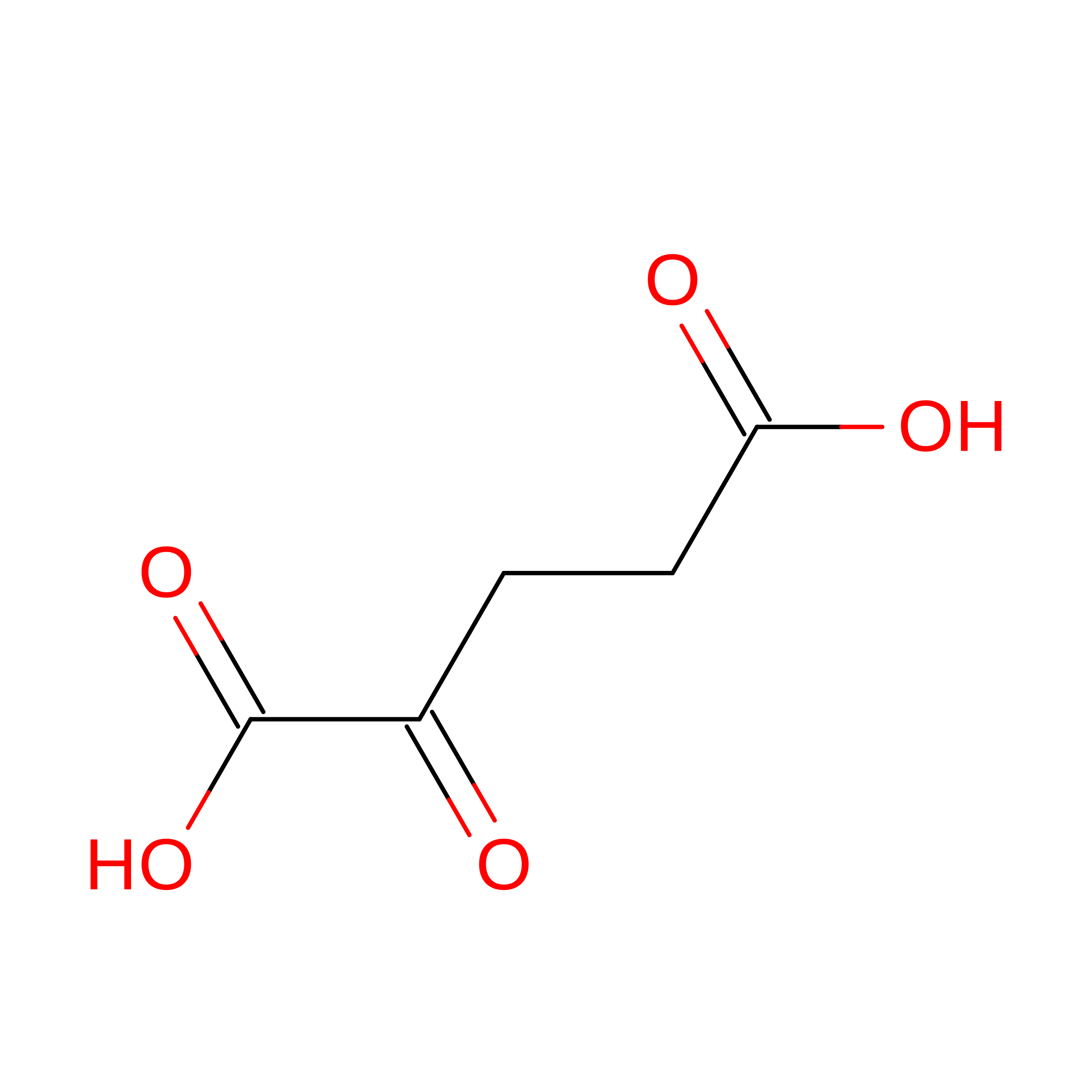
G [auth R]2-OXOGLUTARIC ACID
C5 H6 O5
KPGXRSRHYNQIFN-UHFFFAOYSA-N

Experimental Data & Validation

Experimental Data

  • Method: ELECTRON MICROSCOPY
  • Resolution: 2.66 Å
  • Aggregation State: PARTICLE 
  • Reconstruction Method: SINGLE PARTICLE 
EM Software:
TaskSoftware PackageVersion
MODEL REFINEMENTPHENIX1.20.1_4487

Structure Validation

View Full Validation Report


Entry History 

& Funding Information

Deposition Data


Funding OrganizationLocationGrant Number
National Natural Science Foundation of China (NSFC)China--

Revision History  (Full details and data files)

  • Version 1.0: 2026-06-17
    Type: Initial release