9LQ4 | pdb_00009lq4

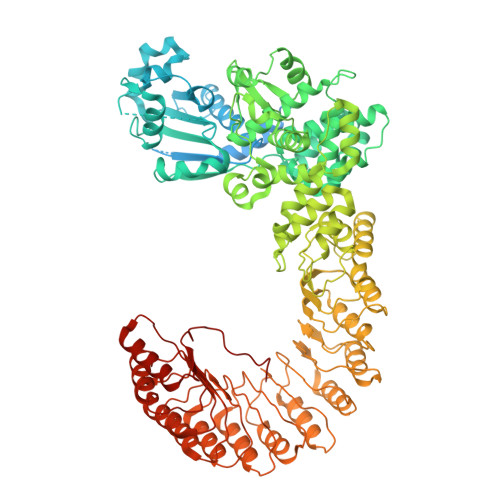
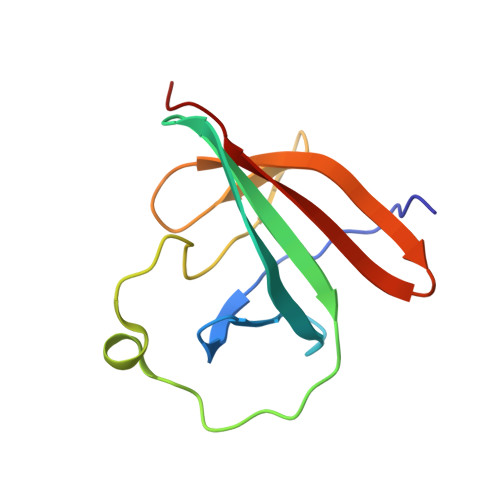
Structure of the human monomeric NLRP7-TCL1A complex


Experimental Data Snapshot

  • Method: ELECTRON MICROSCOPY
  • Resolution: 4.12 Å
  • Aggregation State: PARTICLE 
  • Reconstruction Method: SINGLE PARTICLE 

wwPDB Validation 3D Report Full Report

Validation slider image for 9LQ4

This is version 1.1 of the entry. See complete history

Literature

TCL1A mediates DNA methylation defects in recurrent hydatidiform mole with NLRP7 pathogenic variants.

Gao, Z.Liu, Q.Li, L.Hu, T.Lu, X.Wu, Y.Qin, D.Wang, X.Gu, C.Li, J.Xu, C.Zhou, D.Zhou, F.Bai, Y.Kang, X.Liu, J.Deng, D.Li, L.

(2026) Nat Commun 17

  • DOI: https://doi.org/10.1038/s41467-026-69744-y
  • Primary Citation Related Structures: 
    9LQ2, 9LQ4

  • PubMed Abstract: 

    Pathogenic variants in NLRP7, implicated in 55% of recurrent hydatidiform mole characterized by hypomethylation at maternally methylated imprinted regions, are proposed to disrupt de novo DNA methylation in human oocytes. However, the precise mechanism remains unclear. Here, we identify TCL1A, a DNMT3A inhibitor, as an endogenous NLRP7-interacting partner. The cryo-EM structure of the NLRP7-TCL1A complex reveals its fundamental architecture. Comprehensive analysis demonstrates that the majority of recurrent hydatidiform mole-causing NLRP7 variants impair its interaction with TCL1A. Mechanistically, NLRP7 potentially safeguards oocyte methylome by sequestering TCL1A in the cytoplasm, thereby preventing its nuclear entry and subsequent suppression of DNMT3A-mediated de novo methylation. Combining in silico predictions and interaction analysis, we identify L766R as a pathogenic variant. These findings propose a cytoplasmic regulatory mechanism governing nuclear DNA methylation, explaining the hypomethylation pathogenesis in NLRP7 variant-associated recurrent hydatidiform mole.


  • Organizational Affiliation
    • Department of Obstetrics and Gynecology, Center for Reproductive Medicine; Guangdong Provincial Key Laboratory of Major Obstetric Diseases; Guangdong Provincial Clinical Research Center for Obstetrics and Gynecology; Guangdong-Hong Kong-Macao Greater Bay Area Higher Education Joint Laboratory of Maternal-Fetal Medicine; Key Laboratory for Reproductive Medicine of Guangdong Province; The Third Affiliated Hospital, Guangzhou Medical University, Guangzhou, China.

Macromolecule Content 

  • Total Structure Weight: 143.79 kDa 
  • Atom Count: 8,494 
  • Modeled Residue Count: 1,061 
  • Deposited Residue Count: 1,249 
  • Unique protein chains: 2

Macromolecules

Find similar proteins by:|  3D Structure
Entity ID: 1
MoleculeChains  Sequence LengthOrganismDetailsImage
Isoform 3 of NACHT, LRR and PYD domains-containing protein 71,037Homo sapiensMutation(s): 0 
Gene Names: NLRP7NALP7NOD12PYPAF3
UniProt & NIH Common Fund Data Resources
Find proteins for Q8WX94 (Homo sapiens)
Explore Q8WX94 
Go to UniProtKB:  Q8WX94
PHAROS:  Q8WX94
GTEx:  ENSG00000167634 
Entity Groups
Sequence Clusters30% Identity50% Identity70% Identity90% Identity95% Identity100% Identity
UniProt GroupQ8WX94
Sequence Annotations
Expand
Reference Sequence
Find similar proteins by:|  3D Structure
Entity ID: 2
MoleculeChains  Sequence LengthOrganismDetailsImage
T-cell leukemia/lymphoma protein 1AB [auth F],
C [auth G]
106Homo sapiensMutation(s): 0 
Gene Names: TCL1ATCL1
UniProt & NIH Common Fund Data Resources
Find proteins for P56279 (Homo sapiens)
Explore P56279 
Go to UniProtKB:  P56279
PHAROS:  P56279
GTEx:  ENSG00000100721 
Entity Groups
Sequence Clusters30% Identity50% Identity70% Identity90% Identity95% Identity100% Identity
UniProt GroupP56279
Sequence Annotations
Expand
Reference Sequence

Experimental Data & Validation

Experimental Data

  • Method: ELECTRON MICROSCOPY
  • Resolution: 4.12 Å
  • Aggregation State: PARTICLE 
  • Reconstruction Method: SINGLE PARTICLE 
EM Software:
TaskSoftware PackageVersion
MODEL REFINEMENTPHENIX

Structure Validation

View Full Validation Report


Entry History 

& Funding Information

Deposition Data


Funding OrganizationLocationGrant Number
National Natural Science Foundation of China (NSFC)China--

Revision History  (Full details and data files)

  • Version 1.0: 2025-12-10
    Type: Initial release
  • Version 1.1: 2026-04-15
    Changes: Data collection, Database references