Download Mendeley
The plastidial PHS1-DPE1 complex drives efficient malto-oligosaccharides synthesis in rice starch metabolism.
Liu, J., Wu, X., He, H., Yang, X., Hu, Y., Zhang, F., Fan, R., Wang, X., Yang, S., Xiong, L., Zhang, D., Yin, P., Guo, J., Liu, Z., Yan, J.(2026) Nat Commun 17
- PubMed: 42069819 Search on PubMedSearch on PubMed Central
- DOI: https://doi.org/10.1038/s41467-026-72738-5
- Primary Citation Related Structures:
9LPW, 9LPZ, 9M80 - PubMed Abstract:
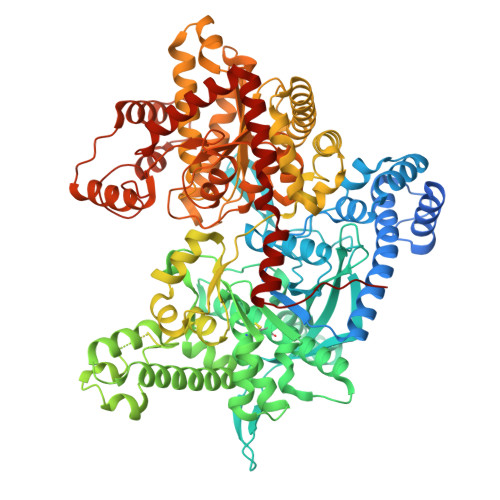
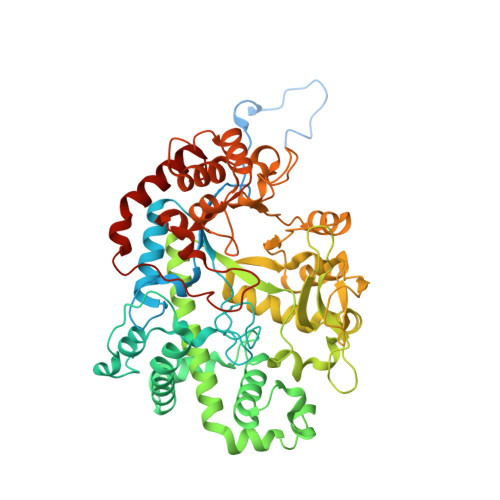
Starch serves as a vital energy reserve in plants. During its biosynthesis, malto-oligosaccharides (MOS) are essential primers. One of the key pathways for MOS production involves plastidial α-glucan phosphorylase (PHS1/Pho1) and disproportionating enzyme (DPE1). However, the functional relationship between these enzymes is unclear. Here, we demonstrate that rice PHS1 and DPE1 assemble into a multimeric complex. Cryo-EM structures of the PHS1-DPE1 complex reveal an assembly mechanism and suggest a potential substrate tunnel. Biochemical assays show the complex dramatically enhances catalytic efficiency over individual enzymes. Single-molecule fluorescence resonance energy transfer (smFRET) visualizes conformational dynamics, enabling rapid substrate transfer between the enzymes. We further identify the unique L80 loop in PHS1 as a potential regulator. Its deletion reduces catalytic efficiency and prolongs conformational state lifetimes during substrate transfer, thereby reducing the production of longer MOSs. Our findings establish that the PHS1-DPE1 complex facilitates efficient MOS primer synthesis through efficient substrate transfer or diffusion between the two enzymes, providing mechanistic insight into a critical step of starch biosynthesis with agronomic implications.
- National Key Laboratory of Crop Genetic Improvement, College of Bio-X, Hubei Hongshan Laboratory, Huazhong Agricultural University, Wuhan, China.
Organizational Affiliation: