Download Mendeley
Structural assembly of maize CRY-GL2 photosignaling complex provides insights into its regulatory role in cuticular wax biosynthesis.
Liu, Y., Zhao, Z., Zhang, X., Hao, Y., Feng, F., Chen, Y., Wang, J., Ma, M., Li, J., Yu, F., Liu, H., Zhang, P.(2025) Sci Adv 11: eadz0136-eadz0136
- PubMed: 41337597 Search on PubMedSearch on PubMed Central
- DOI: https://doi.org/10.1126/sciadv.adz0136
- Primary Citation Related Structures:
9LPG - PubMed Abstract:
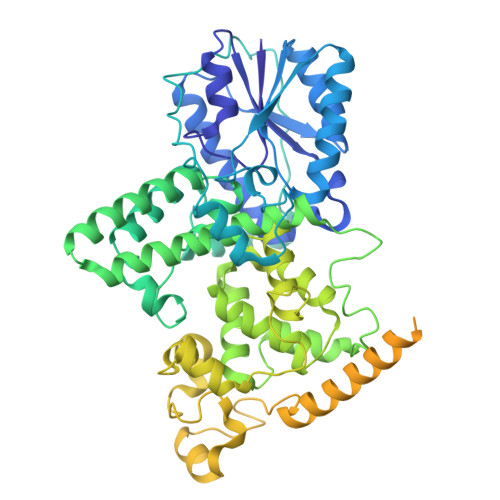
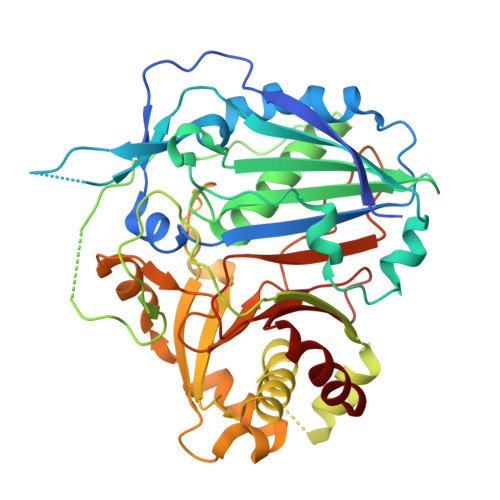
Plant cryptochromes (CRYs) are blue-light photoreceptors regulating physiological processes via oligomerization-dependent interaction with effectors. However, the structural basis for photoactivated CRY-effector assembly remains elusive. Here, we report the crystal structure of an active maize CRY1c photolyase homology region in complex with GLOSSY2 (ZmGL2), a BAHD acyltransferase family protein that could form an enzyme complex with ECERIFERUM6 (ZmCER6) and direct very-long-chain fatty acid elongation in cuticular wax biosynthesis. Light-activated CRY1c forms a homotetrameric scaffold. Each protomer binds one ZmGL2 molecule via conformational changes, forming a 4:4 hetero-octameric photosignaling complex. Structural alignment shows 78% overlap between the GL2-binding interfaces in the ZmCRY1c-ZmGL2 and ZmCER6-ZmGL2 complexes. Biochemically, CRY1c dose-dependently inhibits ZmCER6-ZmGL2 enzyme activity, unveiling a light-dependent regulatory switch modulating very-long-chain fatty acid elongation efficiency. Our work establishes the atomic model for light-activated CRY-effector assembly and uncovers spatial competition between photoreceptor and metabolic enzyme complexes as a photoregulatory paradigm in wax biosynthesis.
- Key Laboratory of Plant Carbon Capture, CAS Center for Excellence in Molecular Plant Sciences, Institute of Plant Physiology and Ecology, Chinese Academy of Sciences, Shanghai, China.
Organizational Affiliation: