9LL0 | pdb_00009ll0

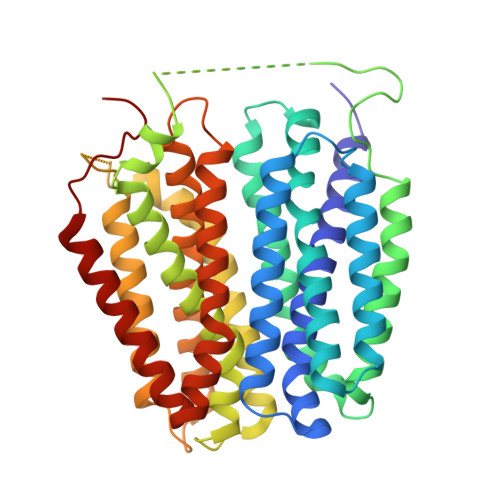
Cryo-EM structure of G6PT1 in complex with Glucose-6-phosphate


Experimental Data Snapshot

  • Method: ELECTRON MICROSCOPY
  • Resolution: 3.28 Å
  • Aggregation State: PARTICLE 
  • Reconstruction Method: SINGLE PARTICLE 

wwPDB Validation 3D Report Full Report

Validation slider image for 9LL0

This is version 1.1 of the entry. See complete history

Literature

Structural insight into the glucose-6-phosphate transport by G6PT1 and inhibition mechanism of CGA.

Chen, Q.Yuan, P.Li, R.Du, X.Yu, R.Zhao, Y.

(2026) Sci Adv 12: eadz8234-eadz8234

  • DOI: https://doi.org/10.1126/sciadv.adz8234
  • Primary Citation Related Structures: 
    9LL0, 9LL1, 9LNB, 9LVW

  • PubMed Abstract: 

    Human glucose-6-phosphate transporter 1 (G6PT1) is responsible for transporting glucose-6-phosphate (G6P) into the endoplasmic reticulum (ER), a crucial rate-limiting step in both glycogenolysis and gluconeogenesis. Complete and chronic dysfunction of G6PT1 can lead to the severe metabolic disorder GSD1b, whereas moderate and reversible inhibition contributes to diabetes treatment. We determined the structures of human G6PT1 in its apo state and in complex with the substrate G6P, cosubstrate phosphate, and the inhibitor chlorogenic acid (CGA). Captured in both lumen- and cytosol-facing conformations, these structures reveal the specific mechanism of phosphate-coupled G6P transport. In addition, the CGA-bound G6PT1 complex shows that CGA stabilizes the transporter in the cytosol-facing conformation, inhibiting it by competing with substrate binding and preventing conformational transitions, providing previously unreported insights into G6PT1 inhibition. Our findings provide a structural foundation for understanding the mechanisms of substrate recognition, transport, drug inhibition, and the pharmacology of G6PT1, paving the way to the rational design of potential therapeutic agents.


  • Organizational Affiliation
    • Key Laboratory of Biomacromolecules (CAS), National Laboratory of Biomacromolecules, CAS Center for Excellence in Biomacromolecules, Institute of Biophysics, Chinese Academy of Sciences, Beijing 100101, China.

Macromolecule Content 

  • Total Structure Weight: 45.7 kDa 
  • Atom Count: 3,069 
  • Modeled Residue Count: 399 
  • Deposited Residue Count: 420 
  • Unique protein chains: 1

Macromolecules

Find similar proteins by:|  3D Structure
Entity ID: 1
MoleculeChains  Sequence LengthOrganismDetailsImage
Glucose-6-phosphate exchanger SLC37A4420Homo sapiensMutation(s): 0 
Gene Names: SLC37A4G6PTG6PT1PRO0685TRG19
UniProt
Find proteins for O43826 (Homo sapiens)
Explore O43826 
Go to UniProtKB:  O43826
Entity Groups
Sequence Clusters30% Identity50% Identity70% Identity90% Identity95% Identity100% Identity
UniProt GroupO43826
Sequence Annotations
Expand
Reference Sequence

Small Molecules

Ligands 1 Unique
IDChains Name / Formula / InChI Key2D Diagram3D Interactions
BG6
(Subject of Investigation/LOI)

Query on BG6


Download:Ideal Coordinates CCD File
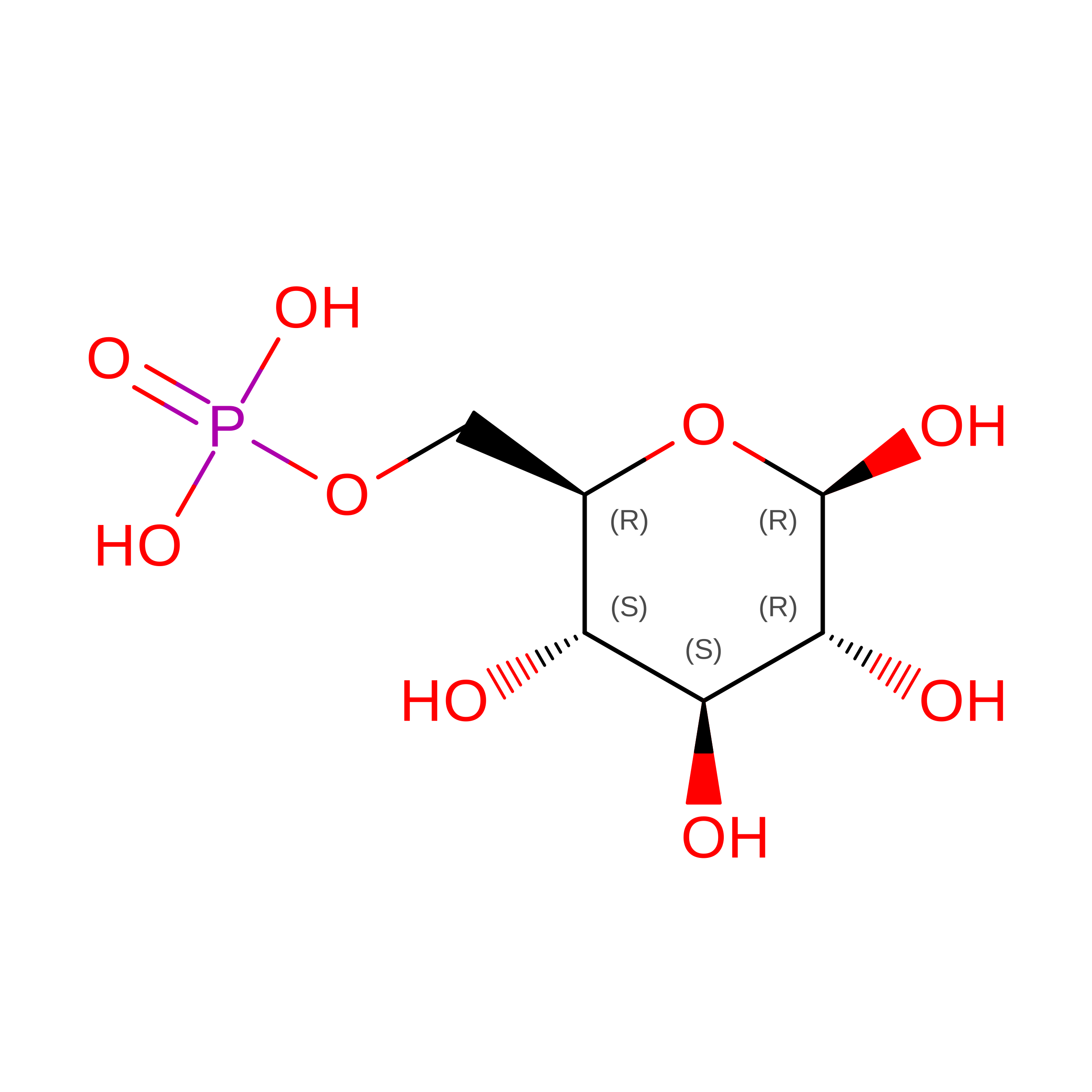
B [auth A]6-O-phosphono-beta-D-glucopyranose
C6 H13 O9 P
NBSCHQHZLSJFNQ-VFUOTHLCSA-N

Experimental Data & Validation

Experimental Data

  • Method: ELECTRON MICROSCOPY
  • Resolution: 3.28 Å
  • Aggregation State: PARTICLE 
  • Reconstruction Method: SINGLE PARTICLE 
EM Software:
TaskSoftware PackageVersion
MODEL REFINEMENTPHENIX1.20.1_4487

Structure Validation

View Full Validation Report


Entry History 

& Funding Information

Deposition Data


Funding OrganizationLocationGrant Number
National Natural Science Foundation of China (NSFC)China--

Revision History  (Full details and data files)

  • Version 1.0: 2025-12-31
    Type: Initial release
  • Version 1.1: 2026-07-22
    Changes: Data collection, Database references