Download Mendeley
Structural insight into IscB's RNA-lid-based inactivation mechanism.
Wang, F., Guo, R., Zhang, S., Cui, Y., Wang, J., Hu, T., Liu, K., Wang, Q., Liu, Y., Nam, K.H., Zhao, Z.W., Ji, Q., Xu, X., Wang, E., Zhu, Y., Yang, Y., Luo, M., Ma, P., Ma, S., Xu, C., Hu, C.(2026) Nat Struct Mol Biol 33: 603-614
- PubMed: 41882346 Search on PubMedSearch on PubMed Central
- DOI: https://doi.org/10.1038/s41594-026-01761-3
- Primary Citation Related Structures:
9LIQ, 9LIR, 9LIS, 9LJ4 - PubMed Abstract:
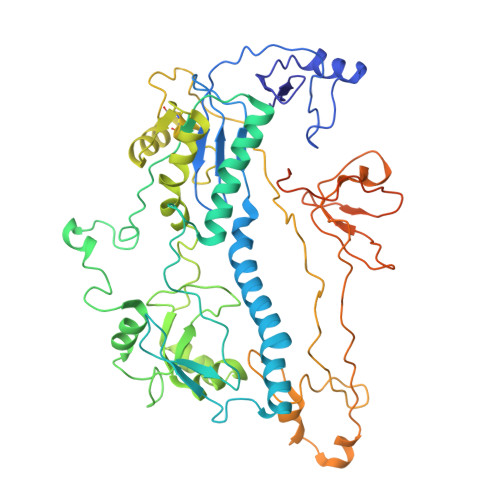
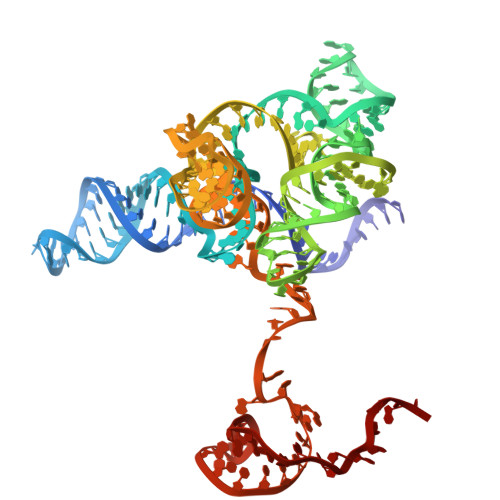
IscB, a compact Cas9 ancestor from the obligate mobile element guided activity system, has attracted growing interest as a programmable genome editor because of its small size and therapeutic delivery potential. Despite its promise, structural insights into IscB's regulation remain limited, with only a target-bound R-loop structure previously reported. Here, we present the structural trajectory of an engineered IscB, capturing its transition from a resting state to activation. Using cryo-electron microscopy, we resolve four high-resolution structures: the apo resting state, two intermediate complexes with 6-nt and 10-nt guide-target pairing and a fully paired 16-nt primed cleavage state. These structures uncover a dual inactivation mechanism mediated by RNA lids; the ωRNA lid blocks HNH domain access, while the guide RNA lid occludes the RuvC active site. As guide-target pairing progresses, the guide RNA undergoes a stepwise displacement, mimicking a 'car pedal' motion that triggers activation at 11-nt pairing. The HNH domain also contributes to R-loop stabilization through a positively charged R-wedge motif and undergoes a ~90° activation-driven rotation mediated by two hinge regions. In variants IscBHig1 and IscBHig2, engineering these hinge motifs to enhance conformational flexibility notably improved genome-editing efficiency in cells. In summary, our study reveals the molecular basis underlying IscB autoinhibition and activation, identifies previously uncharacterized regulatory features and establishes hinge elements as a target region for engineering compact, efficient genome editors.
- Department of Biological Sciences, Faculty of Science, National University of Singapore, Singapore, Singapore.
Organizational Affiliation: