Download Mendeley
Bioengineered protein nanocarrier facilitating siRNA escape from lysosomes for targeted RNAi therapy in glioblastoma.
Jin, Y., Zhang, B., Li, J., Guo, Z., Zhang, C., Chen, X., Ma, L., Wang, Z., Yang, H., Li, Y., Weng, Y., Huang, Y., Yan, X., Fan, K.(2025) Sci Adv 11: eadr9266-eadr9266
- PubMed: 39970222 Search on PubMedSearch on PubMed Central
- DOI: https://doi.org/10.1126/sciadv.adr9266
- Primary Citation Related Structures:
9KAY - PubMed Abstract:
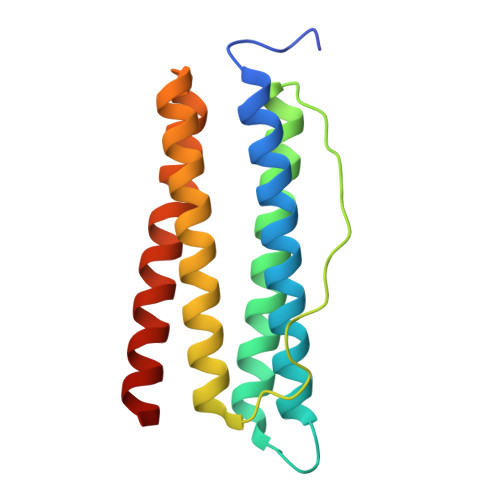
RNA interference (RNAi) represents a promising gene-specific therapy against tumors. However, its clinical translation is impeded by poor performance of lysosomal escape and tumor targeting. This challenge is especially prominent in glioblastoma (GBM) therapy, necessitating the penetration of the blood-brain barrier (BBB). Leveraging the intrinsic tumor-targeting and BBB traversing capability of human H-ferritin, we designed a series of ferritin variants with positively charged cavity and truncated carboxyl terminus, termed tHFn(+). These nanocarriers respond to weak acid and disassemble in endosomal compartments, exposing the internal positive charges to facilitate the lysosomal escape of loaded small interfering RNA (siRNA). Functioning as universal siRNA nanocarriers, tHFn(+) significantly enhanced the uptake of different siRNAs and suppressed gene expressions associated with GBM progression. Furthermore, tHFn(+) traversed the BBB and targeted glioma in vivo by binding to its receptors (e.g., transferrin receptor 1). tHFn(+)-delivered siRNAs exhibited exceptional therapeutic effects against glioma in vivo, advancing RNAi therapeutics beyond GBM for the treatment of various diseases.
- CAS Engineering Laboratory for Nanozyme, Key Laboratory of Biomacromolecules (CAS), CAS Center for Excellence in Biomacromolecules, Institute of Biophysics, Chinese Academy of Sciences, Beijing 100101, China.
Organizational Affiliation: