Download Mendeley
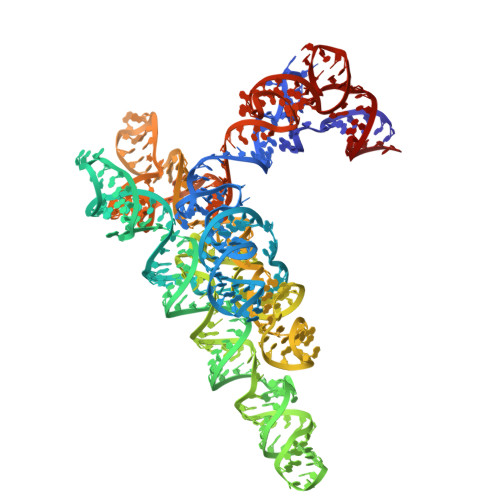
Self-splicing and cyclization mechanisms of the full-length Anabaena pre-tRNA.
Zhang, X., An, L., Yang, W., Yi, R., Liu, J., Li, S., Zhang, K.(2026) Nat Chem Biol 22: 948-959
- PubMed: 41981295 Search on PubMedSearch on PubMed Central
- DOI: https://doi.org/10.1038/s41589-026-02205-1
- Primary Citation Related Structures:
9K9G, 9K9H, 9K9J, 9K9K - PubMed Abstract:
Group I introns are catalytic RNAs capable of self-splicing and generating circular RNAs, processes central to RNA metabolism and biotechnology. Yet, full-length ribozyme structures containing entire exon sequences and the structural basis of postsplicing circularization have remained limited. Using cryo-electron microscopy, we resolved multiple conformational states of the full-length Anabaena tRNA(Leu) precursor, capturing key intermediates of splicing and cyclization. In the apo state, the exons preassemble into a mature tRNA-like conformation that promotes P1 helix formation. Transitions through the splicing states involve substantial rearrangements essential for catalysis. Unlike other group I introns, the Anabaena intron circularizes without sequence loss, using its guanosine-binding site as the catalytic center. Mutational analyses confirm that G37 reorientation and a conserved wobble receptor motif precisely position the circularization site, driving efficient cyclization even in engineered PIE systems. These findings uncover unique mechanisms of RNA catalysis and establish structure-based optimization for advancing RNA circularization technologies.
- Department of Urology, The First Affiliated Hospital of USTC, MOE Key Laboratory for Cellular Dynamics, Center for Advanced Interdisciplinary Science and Biomedicine of IHM, The RNA Institute, Division of Life Sciences and Medicine, University of Science and Technology of China, Hefei, China.
Organizational Affiliation: