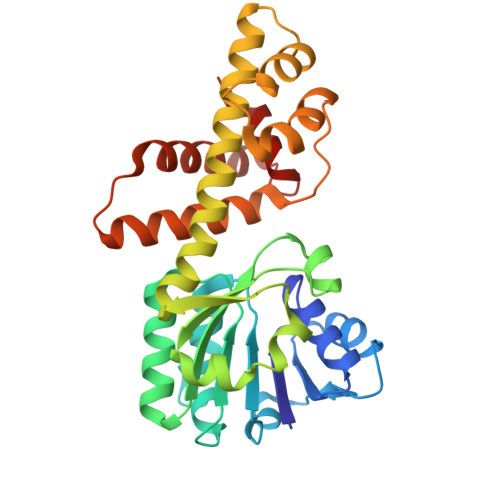
9K2J | pdb_00009k2j

X-ray crystal structure of 3-hydroxyisobutyrate dehydrogenase


Experimental Data Snapshot

  • Method: X-RAY DIFFRACTION
  • Resolution: 2.88 Å
  • R-Value Free: 
    0.240 (Depositor), 0.241 (DCC) 
  • R-Value Work: 
    0.204 (Depositor), 0.207 (DCC) 
  • R-Value Observed: 
    0.206 (Depositor) 

Starting Model: experimental
View more details

wwPDB Validation 3D Report Full Report

Validation slider image for 9K2J

Ligand Structure Quality Assessment 


This is version 1.0 of the entry. See complete history

Literature

Mirror substrates specificity of a 2, 3-dihydroxypropanesulfonate degrading enzyme in sulfate-reducing bacteria.

Ma, X.Wang, H.Liu, L.Dang, H.Tang, K.

(2025) Int J Biol Macromol 306: 141806-141806

  • DOI: https://doi.org/10.1016/j.ijbiomac.2025.141806
  • Primary Citation Related Structures: 
    9K2J

  • PubMed Abstract: 

    Ubiquitous R- and S-enantiomers of 2,3-dihydroxypropanesulfonate (DHPS), organic sulfur compounds produced by photosynthetic organisms, serve as common nutrient and energy sources for specific bacteria. While most known DHPS-degrading enzymes exhibit enantioselectivity, this study introduces a unique dehydrogenase, DhpA from the sulfate-reducing bacterium Desulfovibrio sp. DF1, capable of efficiently metabolizing both R- and S-DHPS to 3-sulfolactaldehyde (SLA). The crystal structure of DhpA reveals a conserved binding pocket that recognizes the sulfonate group of DHPS through interactions with Lys123, Ser174, and Asn175. The catalytic mechanism of the enzyme involves the oxidation of the C3-OH group of both enantiomers, facilitated by the Lys171. The mutation of Lys171 significantly diminishes activity, confirming its critical role in catalysis. Based on biochemical and genetic analyses, this study proposes a chiral DHPS degradation pathway in bacteria. This study reveals the unique enantiomeric selectivity of DhpA, expanding our understanding of the bacterial metabolism of chiral molecules.


  • Organizational Affiliation
    • State Key Laboratory of Marine Environmental Science, Fujian Key Laboratory of Marine Carbon Sequestration, College of Ocean and Earth Science, Xiamen University, Xiamen, China.

Macromolecule Content 

  • Total Structure Weight: 91 kDa 
  • Atom Count: 6,355 
  • Modeled Residue Count: 858 
  • Deposited Residue Count: 858 
  • Unique protein chains: 1

Macromolecules

Find similar proteins by:|  3D Structure
Entity ID: 1
MoleculeChains  Sequence LengthOrganismDetailsImage
3-hydroxyisobutyrate dehydrogenase
A, B, C
286Desulfovibrio sp.Mutation(s): 0 

Experimental Data & Validation

Experimental Data

  • Method: X-RAY DIFFRACTION
  • Resolution: 2.88 Å
  • R-Value Free:  0.240 (Depositor), 0.241 (DCC) 
  • R-Value Work:  0.204 (Depositor), 0.207 (DCC) 
  • R-Value Observed: 0.206 (Depositor) 
Space Group: I 41 2 2
Unit Cell:
Length ( Å )Angle ( ˚ )
a = 289.16α = 90
b = 289.16β = 90
c = 65.87γ = 90
Software Package:
Software NamePurpose
PHENIXrefinement
PHENIXmodel building
Aimlessdata scaling
PHASERphasing

Structure Validation

View Full Validation Report


Ligand Structure Quality Assessment 


Entry History 

& Funding Information

Deposition Data

  • Released Date: 2025-03-19 
  • Deposition Author(s): Tang, K.

Funding OrganizationLocationGrant Number
National Natural Science Foundation of China (NSFC)China42188102, 42141003, 42076160

Revision History  (Full details and data files)

  • Version 1.0: 2025-03-19
    Type: Initial release