9K0D | pdb_00009k0d

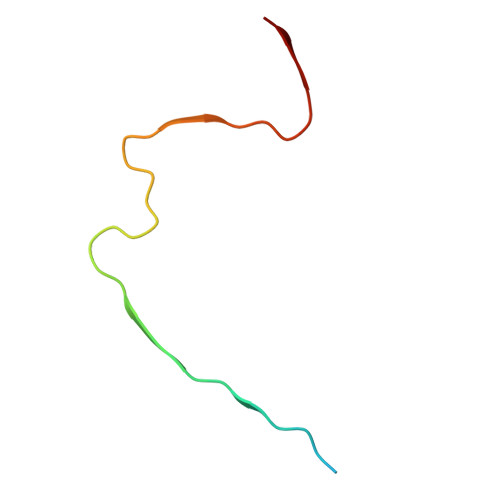
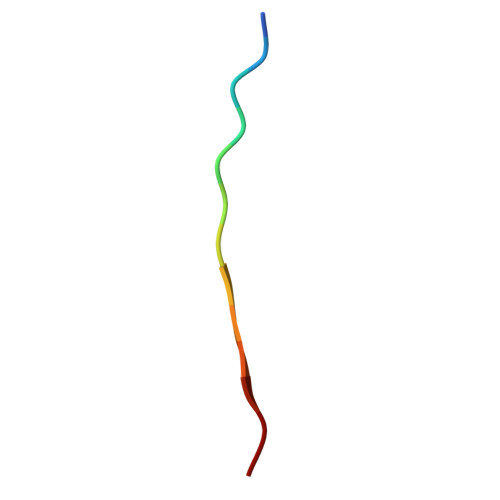
Cryo-EM structure of Amyloid-beta42-4b polymorph 1


Experimental Data Snapshot

  • Method: ELECTRON MICROSCOPY
  • Resolution: 2.60 Å
  • Aggregation State: FILAMENT 
  • Reconstruction Method: HELICAL 

wwPDB Validation 3D Report Full Report

Validation slider image for 9K0D

This is version 1.0 of the entry. See complete history

Literature

An O-glycopeptide participates in the formation of distinct A beta 42 fibril structures and attenuates A beta 42 neurotoxicity.

Wei, Q.Liu, D.Xia, W.Wang, F.Huang, L.Zhang, J.Wang, X.Xu, Z.He, C.Li, W.Shi, X.Wang, C.Liu, Y.Liu, C.Dong, S.

(2025) Nat Commun 16: 5815-5815

  • DOI: https://doi.org/10.1038/s41467-025-60978-w
  • Primary Citation Related Structures: 
    9K0D, 9K0E, 9K0F

  • PubMed Abstract: 

    The self-assembly of biomolecules through noncovalent interactions is critical in both physiological and pathological processes, as exemplified by the assembly of amyloid β peptide (Aβ) into oligomers or fibrils in Alzheimer's disease (AD). Developing molecules that can modulate this assembly process holds significant mechanistic and therapeutic potential. In this study, we identified glycopeptides as a class of protein aggregation modulators, showing that β-N-acetylgalactosamine (β-GalNAc)-modified Aβ 9-21 promotes Aβ 42 fibrillation while reducing its toxic oligomers. Using biochemical assays, cryo-EM, and molecular dynamics simulations, we demonstrated that β-GalNAc-modified Aβ 9-21 coassembles with Aβ 42 , forming unique fibril structures stabilized by both hydrophobic interactions and an organized hydrogen bond network facilitated by the glycopeptide. Importantly, β-GalNAc-modified Aβ 9-21 can alleviate the neurotoxicity of Aβ 42 in neuronal cells and an AD male mouse model. These findings underscore the potential of glycopeptides in regulating amyloid aggregation and provide structural insights for designing molecules targeting amyloid-related pathologies.


  • Organizational Affiliation
    • State Key Laboratory of Natural and Biomimetic Drugs, Peking University, Beijing, China.

Macromolecule Content 

  • Total Structure Weight: 63.71 kDa 
  • Atom Count: 2,874 
  • Modeled Residue Count: 390 
  • Deposited Residue Count: 582 
  • Unique protein chains: 2

Macromolecules

Find similar proteins by:|  3D Structure
Entity ID: 1
MoleculeChains  Sequence LengthOrganismDetailsImage
Amyloid-beta A4 protein42Homo sapiensMutation(s): 0 
UniProt
Find proteins for B4DMD5 (Homo sapiens)
Explore B4DMD5 
Go to UniProtKB:  B4DMD5
Entity Groups
Sequence Clusters30% Identity50% Identity70% Identity90% Identity95% Identity100% Identity
UniProt GroupB4DMD5
Sequence Annotations
Expand
Reference Sequence
Find similar proteins by:  Sequence   |   3D Structure  
Entity ID: 2
MoleculeChains  Sequence LengthOrganismDetailsImage
Amyloid-beta protein 4013Homo sapiensMutation(s): 0 
UniProt & NIH Common Fund Data Resources
Find proteins for P05067 (Homo sapiens)
Explore P05067 
Go to UniProtKB:  P05067
PHAROS:  P05067
GTEx:  ENSG00000142192 
Entity Groups
Sequence Clusters30% Identity50% Identity70% Identity90% Identity95% Identity100% Identity
UniProt GroupP05067
Sequence Annotations
Expand
Reference Sequence

Experimental Data & Validation

Experimental Data

  • Method: ELECTRON MICROSCOPY
  • Resolution: 2.60 Å
  • Aggregation State: FILAMENT 
  • Reconstruction Method: HELICAL 
EM Software:
TaskSoftware PackageVersion
MODEL REFINEMENTPHENIX1.15.2_3472:

Structure Validation

View Full Validation Report


Entry History 

& Funding Information

Deposition Data


Funding OrganizationLocationGrant Number
Not funded--

Revision History  (Full details and data files)

  • Version 1.0: 2025-08-06
    Type: Initial release