Download Mendeley
Structural insights into the assembly mechanism of the molecular bushing in the bacterial flagellar motor.
Yamaguchi, T., Minamino, T., Kato, T., Chevance, F.F.V., Hughes, K.T., Namba, K.(2026) Commun Biol
- PubMed: 42443432 Search on PubMed
- DOI: https://doi.org/10.1038/s42003-026-10640-y
- Primary Citation Related Structures:
9IYC, 9JQO - PubMed Abstract:
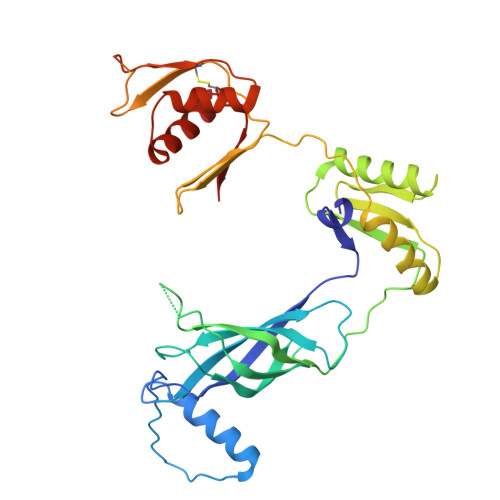
The LP-ring complex of the Salmonella flagellar motor acts as a bushing that supports high-speed rotation of the rod, which serves as a drive shaft. The L-ring, P-ring, and distal rod consist of FlgH, FlgI, and FlgG, respectively. LP-ring formation begins with P-ring assembly around the distal rod, where it remains firmly attached until the L-ring assembles above it. L-ring formation induces P-ring detachment, allowing the rod to freely rotate within the LP-ring, but this mechanism remains unclear. Here, we report the cryoEM structure of the P-ring assembled on a polyrod, an unusually elongated rod structure. The P-ring exhibits a slightly elliptical shape with a 2.7° tilt relative to the rod axis for its stable attachment. However, L-ring assembly on the P-ring causes steric clashes with the rod to induce P-ring detachment, allowing it to adopt a circular shape and complete the LP-ring as a functional bushing.
- Graduate School of Frontier Biosciences, The University of Osaka, Suita, Osaka, Japan.
Organizational Affiliation: