9IXV | pdb_00009ixv

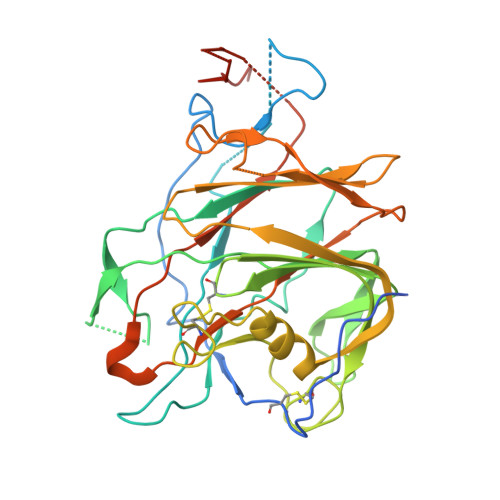
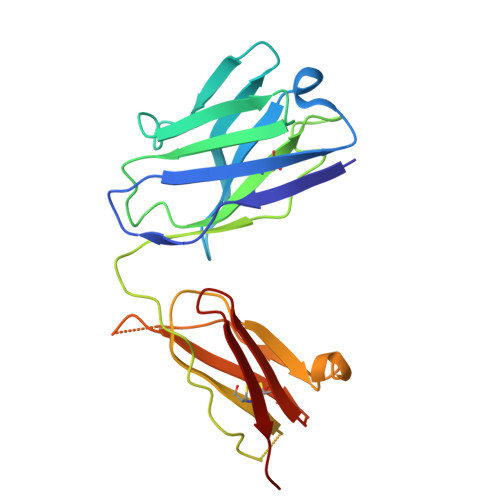
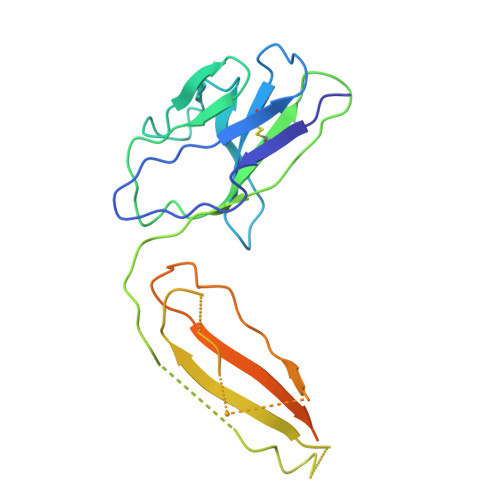
Cryo-EM structure of MERS-CoV S1-NTD bound with KNIH-88 Fab


Experimental Data Snapshot

  • Method: ELECTRON MICROSCOPY
  • Resolution: 3.11 Å
  • Aggregation State: PARTICLE 
  • Reconstruction Method: SINGLE PARTICLE 

Starting Models: experimental
View more details

wwPDB Validation 3D Report Full Report

Validation slider image for 9IXV

This is version 1.1 of the entry. See complete history. 

Literature

A Novel Antibody Against the Non-Receptor-Binding Domain Region of Middle East Respiratory Syndrome Coronavirus Spike Protein.

Lee, S.Y., Woo, H.M., Jeon, H., Kim, N., Kim, D.S., Park, C.K., Kim, H.J., Kim, K.C., Lee, J.Y., Park, K., Yoo, Y., Choi, K., Lee, H.

(2025) J Infect Dis 232: 982-992

  • DOI: https://doi.org/10.1093/infdis/jiaf202
  • Primary Citation Related Structures: 
    9IXV

  • PubMed Abstract: 

    The Middle East respiratory syndrome coronavirus (MERS-CoV) was first identified in 2012 and has since spread worldwide. To date, no vaccines or therapeutics against MERS-CoV have been approved for clinical use. The spike protein of MERS-CoV facilitates attachment and fusion with target cell membranes. Therefore, inhibiting S protein attachment represents a key therapeutic strategy for treating early MERS-CoV infection. Herein, we present 7 human neutralizing antibodies (KNIH-58, -68, -72, -78, -88, -90, and -95) against MERS-CoV. KNIH-58 and -68 bound to the receptor-binding subdomain (RBD) of the spike protein, while the other 5 monoclonal antibodies did not. KNIH-88, which targets the non-RBD region, exhibited potent neutralizing activities in vitro and in a transgenic mouse model, with similar results for KNIH-58. Structural analysis of KNIH-88 bound to the spike protein revealed novel epitopes in the non-RBD region. These findings may facilitate therapeutic and prophylactic antibody development against MERS-CoV.


  • Organizational Affiliation: 
    • Division of Emerging Virus and Vector Research, Center for Emerging Virus Research, Korea National Institute of Health, Korea Disease Control and Prevention Agency, Cheongju-si, Republic of Korea.

Macromolecule Content 

  • Total Structure Weight: 85.33 kDa 
  • Atom Count: 5,086 
  • Modeled Residue Count: 657 
  • Deposited Residue Count: 780 
  • Unique protein chains: 3

Macromolecules

Find similar proteins by:|  3D Structure
Entity ID: 1
MoleculeChains  Sequence LengthOrganismDetailsImage
Spike glycoprotein350Middle East respiratory syndrome-related coronavirusMutation(s): 0 
Gene Names: S, 3
UniProt
Find proteins for K9N5Q8 (Middle East respiratory syndrome-related coronavirus (isolate United Kingdom/H123990006/2012))
Explore K9N5Q8 
Go to UniProtKB:  K9N5Q8
Entity Groups
Sequence Clusters30% Identity50% Identity70% Identity90% Identity95% Identity100% Identity
UniProt GroupK9N5Q8
Sequence Annotations
Expand
Reference Sequence
Find similar proteins by:|  3D Structure
Entity ID: 2
MoleculeChains  Sequence LengthOrganismDetailsImage
Heavy chain from KNIH-88, monoclonal antibodyB [auth H]216Homo sapiensMutation(s): 0 
Entity Groups
Sequence Clusters30% Identity50% Identity70% Identity90% Identity95% Identity100% Identity
Sequence Annotations
Expand
Reference Sequence
Find similar proteins by:|  3D Structure
Entity ID: 3
MoleculeChains  Sequence LengthOrganismDetailsImage
Light chain from KNIH-88, monoclonal antibodyC [auth L]214Homo sapiensMutation(s): 0 
Entity Groups
Sequence Clusters30% Identity50% Identity70% Identity90% Identity95% Identity100% Identity
Sequence Annotations
Expand
Reference Sequence

Experimental Data & Validation

Experimental Data

  • Method: ELECTRON MICROSCOPY
  • Resolution: 3.11 Å
  • Aggregation State: PARTICLE 
  • Reconstruction Method: SINGLE PARTICLE 
EM Software:
TaskSoftware PackageVersion
MODEL REFINEMENTPHENIX1.20.1
MODEL REFINEMENTCoot0.9.8.92

Structure Validation

View Full Validation Report


Entry History 

& Funding Information

Deposition Data


Funding OrganizationLocationGrant Number
Not funded--

Revision History  (Full details and data files)

  • Version 1.0: 2025-04-30
    Type: Initial release
  • Version 1.1: 2025-10-29
    Changes: Data collection, Database references