9I43 | pdb_00009i43

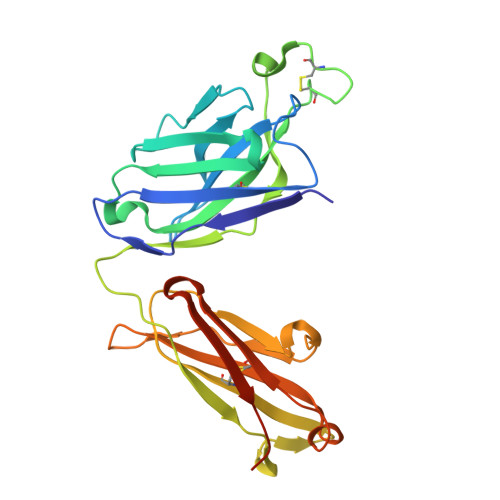
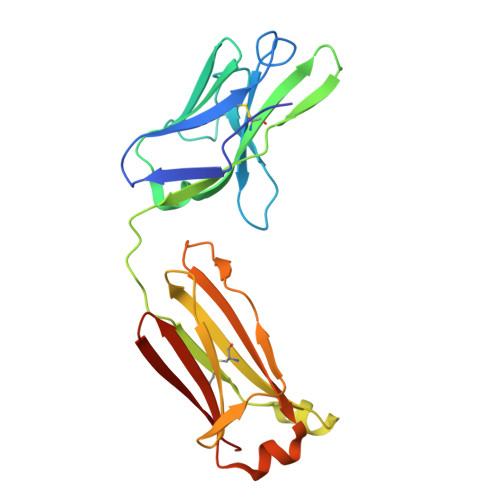
Structure of anti-EV71 human monoclonal antibody 16-2-9D Fab


Experimental Data Snapshot

  • Method: X-RAY DIFFRACTION
  • Resolution: 1.18 Å
  • R-Value Free: 
    0.176 (Depositor), 0.176 (DCC) 
  • R-Value Work: 
    0.145 (Depositor), 0.145 (DCC) 

Starting Model: experimental
View more details

wwPDB Validation 3D Report Full Report

Validation slider image for 9I43

Ligand Structure Quality Assessment 


This is version 1.2 of the entry. See complete history

Literature

Structural and functional mapping of protective human monoclonal antibodies against enterovirus A71.

Zhou, D.Kotecha, A.Kelly, J.T.Huang, P.N.Chen, Y.Y.Walter, T.S.Duyvesteyn, H.M.E.Owens, R.J.Ho, S.Y.Lin, T.Y.Fry, E.E.Ren, J.Huang, K.A.Stuart, D.I.

(2026) Sci Adv 12: eaee8217-eaee8217

  • DOI: https://doi.org/10.1126/sciadv.aee8217
  • Primary Citation Related Structures: 
    9I3W, 9I3Z, 9I40, 9I41, 9I42, 9I43, 9I45, 9I4B, 9I4C, 9I4D, 9I4E, 9RIG, 9RIH, 9RII, 9RIJ, 9RIK, 9RIL, 9RIM, 9RIN, 9RIO, 9RIP, 9RIQ, 9RIR, 9T6Z

  • PubMed Abstract: 

    EV-A71 has been responsible for recent severe HFMD outbreaks. We report structures for 12 potently neutralizing human anti-EV-A71 monoclonal antibody Fabs, alone and complexed with virus. Most recognize the native antigenic state with epitopes that span interfaces, together covering 85% of the capsid surface. The majority (8 of 12) bind the canyon, while the others cluster around the icosahedral two- and threefold axes. Blocking SCARB2 receptor binding likely contributes to neutralization for all, and a subset induces empty particles. A predominant gene family (IGHV4-39) does not dictate a common binding pose. Long CDR-H3 loops are frequently key to binding, especially at the canyon, suggesting that antigenicity data based on antibodies with shorter CDR3s (e.g., murine) may be misleading. This dataset reveals neutralization mechanisms for recently circulating EV-A71 genotypes, which will inform immunotherapies. We demonstrate synergy in vitro between canyon binding and both two- and threefold binding antibodies to increase neutralization potency.


  • Organizational Affiliation
    • College of Life Sciences, Zhejiang University, Hangzhou, China.

Macromolecule Content 

  • Total Structure Weight: 49.43 kDa 
  • Atom Count: 4,071 
  • Modeled Residue Count: 446 
  • Deposited Residue Count: 461 
  • Unique protein chains: 2

Macromolecules

Find similar proteins by:|  3D Structure
Entity ID: 1
MoleculeChains  Sequence LengthOrganismDetailsImage
heavy chainA [auth H]245Homo sapiensMutation(s): 0 
Find similar proteins by:|  3D Structure
Entity ID: 2
MoleculeChains  Sequence LengthOrganismDetailsImage
light chainB [auth L]216Homo sapiensMutation(s): 0 

Experimental Data & Validation

Experimental Data

  • Method: X-RAY DIFFRACTION
  • Resolution: 1.18 Å
  • R-Value Free:  0.176 (Depositor), 0.176 (DCC) 
  • R-Value Work:  0.145 (Depositor), 0.145 (DCC) 
Space Group: P 1 21 1
Unit Cell:
Length ( Å )Angle ( ˚ )
a = 47.743α = 90
b = 80.316β = 94.937
c = 57.489γ = 90
Software Package:
Software NamePurpose
REFMACrefinement
MOLREPphasing

Structure Validation

View Full Validation Report


Ligand Structure Quality Assessment 


Entry History 

& Funding Information

Deposition Data


Funding OrganizationLocationGrant Number
Medical Research Council (MRC, United Kingdom)United KingdomMR/N00065X/1
Wellcome TrustUnited Kingdom090532/Z/09/Z

Revision History  (Full details and data files)

  • Version 1.0: 2026-02-04
    Type: Initial release
  • Version 1.1: 2026-04-29
    Changes: Database references
  • Version 1.2: 2026-06-17
    Changes: Database references