Download Mendeley
Bottom-up reconstruction of synthetic pyrenoids provides insights into the mechanisms and evolution of carbon concentration by EPYC1 proteins.
Kuffner, A.M., Pommerenke, B., Kley, L., Ng, J.Z.Y., Prinz, S., Tinzl-Zechner, M., Schulz, L., Claus, P., Paczia, N., Chotel, T., Klose, M., Zarzycki, J., Hochberg, G.K.A., Erb, T.J.(2026) Nat Plants 12: 1622-1636
- PubMed: 42601498 Search on PubMedSearch on PubMed Central
- DOI: https://doi.org/10.1038/s41477-026-02349-x
- Primary Citation Related Structures:
9I26, 9I27, 9I28 - PubMed Abstract:
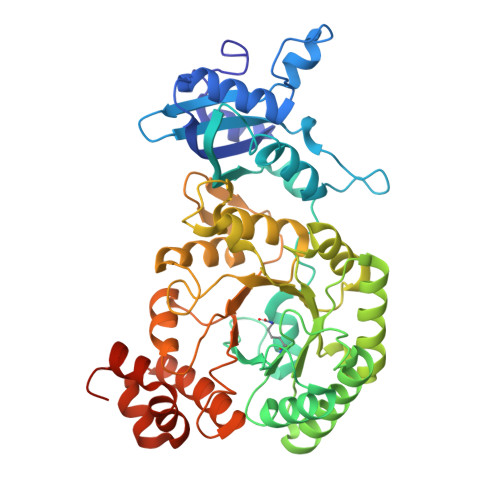
Membraneless organelles play essential roles in many cellular processes. In various photosynthetic organisms, they are a crucial part of CO 2 /carbon-concentrating mechanisms (CCMs) that increase photosynthetic productivity. One example is the pyrenoid in Chlamydomonas reinhardtii, a liquid-phase-separated organelle that localizes and improves CO 2 fixation via the intrinsically disordered protein essential pyrenoid component 1 (EPYC1 CR ). Modern-day pyrenoids are complex structures with an elaborate cellular architecture and dozens of components, raising the question of how they could have developed from simpler condensates. Here we develop a bottom-up approach to study the function of EPYC1s and explore their sequence-function space across phylogenetic diversity and evolution. We demonstrate that extant and ancestral EPYC1 sequences induce phase separation of Rubisco into synthetic pyrenoids with functional CCMs. Surprisingly, these CCMs are mainly based on enhanced carboxylation rates (rather than increased specificity), offering new insights into the construction, function and evolution of natural and synthetic pyrenoids.
- Research Group Sustainable Biocatalysis, Max Planck Institute for Multidisciplinary Sciences, Göttingen, Germany. andreas.kueffner@mpinat.mpg.de.
Organizational Affiliation: