9HUO | pdb_00009huo

A01 mAbs bound to cobratoxin at pH 5.5


Experimental Data Snapshot

  • Method: X-RAY DIFFRACTION
  • Resolution: 1.60 Å
  • R-Value Free: 
    0.225 (Depositor), 0.225 (DCC) 
  • R-Value Work: 
    0.183 (Depositor), 0.184 (DCC) 
  • R-Value Observed: 
    0.185 (Depositor) 

Starting Model: in silico
View more details

wwPDB Validation 3D Report Full Report

Validation slider image for 9HUO

This is version 1.0 of the entry. See complete history

Literature

Rational design of antibodies with pH-dependent antigen-binding properties using structural insights from broadly neutralizing antibodies against alpha-neurotoxins.

Wade, J.Strancar, N.Fernandez-Quintero, M.L.Siebenhaar, S.Jansen, T.Meier, E.P.W.Jenkins, T.P.Bjorn, S.P.Nguyen, G.T.T.Lomonte, B.Gutierrez, J.M.Sorensen, C.V.Loeffler, J.R.Paul, A.Tulika, T.Arnsdorf, J.Schoffelen, S.Lundquist, E.V.S.Sorensen, J.Ward, A.B.Voldborg, B.G.Bohn, M.F.Rivera-de-Torre, E.Morth, J.P.Laustsen, A.H.

(2025) MAbs 17: 2553624-2553624

  • DOI: https://doi.org/10.1080/19420862.2025.2553624
  • Primary Citation Related Structures: 
    9FYS, 9FYT, 9HUB, 9HUO, 9HXO

  • PubMed Abstract: 

    Antibodies that bind in a pH-dependent manner to their antigens show promise for enhanced neutralization potency and blocking capacity against extracellular targets. However, because the mechanisms governing pH-dependent antigen binding remain poorly understood, engineering approaches are often limited to incorporating histidine residues in the antibody complementarity-determining regions. Here, we use a panel of human monoclonal antibodies with neutralizing activity to long-chain α-neurotoxins (LNTxs) to investigate pH-dependent antigen binding. The antibodies vary in their light chains but have conserved histidine residues in their variable domains, allowing us to explore how other residues may affect pH dependence. Comparative structural and molecular dynamics studies between two antibodies with and without pH-dependent antigen-binding properties reveal that both antibodies neutralize LNTxs by mimicking LNTx-receptor interactions through their heavy chains. We hypothesize that part of the pH-dependency can be controlled by the light chain through modulation of water access to residues at the heavy-light-chain interface. We show that pH-dependent antigen-binding properties can be introduced into monoclonal antibodies through the substitution of selected residues at the heavy-light-chain interface. Specifically, we replaced tyrosine residues in the light chain with small polar and apolar amino acid residues in a structurally related anti-LNTx antibody with limited inherent pH-dependent antigen-binding properties, and found that these smaller substitutions enhanced pH-dependence more effectively than histidine substitutions alone. Our findings suggest a strategy for engineering pH-dependent antigen binding in antibodies that goes beyond the exclusive use of histidine doping.


  • Organizational Affiliation
    • Department of Biotechnology and Biomedicine, Technical University of Denmark, Denmark.

Macromolecule Content 

  • Total Structure Weight: 71.35 kDa 
  • Atom Count: 5,504 
  • Modeled Residue Count: 634 
  • Deposited Residue Count: 664 
  • Unique protein chains: 3

Macromolecules

Find similar proteins by:|  3D Structure
Entity ID: 1
MoleculeChains  Sequence LengthOrganismDetailsImage
Alpha-cobratoxinA,
D [auth B]
71Naja kaouthiaMutation(s): 0 
UniProt
Find proteins for P01391 (Naja kaouthia)
Explore P01391 
Go to UniProtKB:  P01391
Entity Groups
Sequence Clusters30% Identity50% Identity70% Identity90% Identity95% Identity100% Identity
UniProt GroupP01391
Sequence Annotations
Expand
Reference Sequence
Find similar proteins by:|  3D Structure
Entity ID: 2
MoleculeChains  Sequence LengthOrganismDetailsImage
light chainB [auth I],
E [auth C]
144Homo sapiensMutation(s): 0 
Find similar proteins by:|  3D Structure
Entity ID: 3
MoleculeChains  Sequence LengthOrganismDetailsImage
heavy chainC [auth M],
F [auth D]
117Homo sapiensMutation(s): 0 

Small Molecules

Ligands 5 Unique
IDChains Name / Formula / InChI Key2D Diagram3D Interactions
SO4

Query on SO4


Download:Ideal Coordinates CCD File
N [auth C]SULFATE ION
O4 S
QAOWNCQODCNURD-UHFFFAOYSA-L
GOL

Query on GOL


Download:Ideal Coordinates CCD File
G [auth A],
J [auth M],
K [auth B],
L [auth B],
O [auth D]
GLYCEROL
C3 H8 O3
PEDCQBHIVMGVHV-UHFFFAOYSA-N
K

Query on K


Download:Ideal Coordinates CCD File
I
POTASSIUM ION
K
NPYPAHLBTDXSSS-UHFFFAOYSA-N
CL

Query on CL


Download:Ideal Coordinates CCD File
H [auth A]CHLORIDE ION
Cl
VEXZGXHMUGYJMC-UHFFFAOYSA-M
NA

Query on NA


Download:Ideal Coordinates CCD File
M [auth C],
P [auth D]
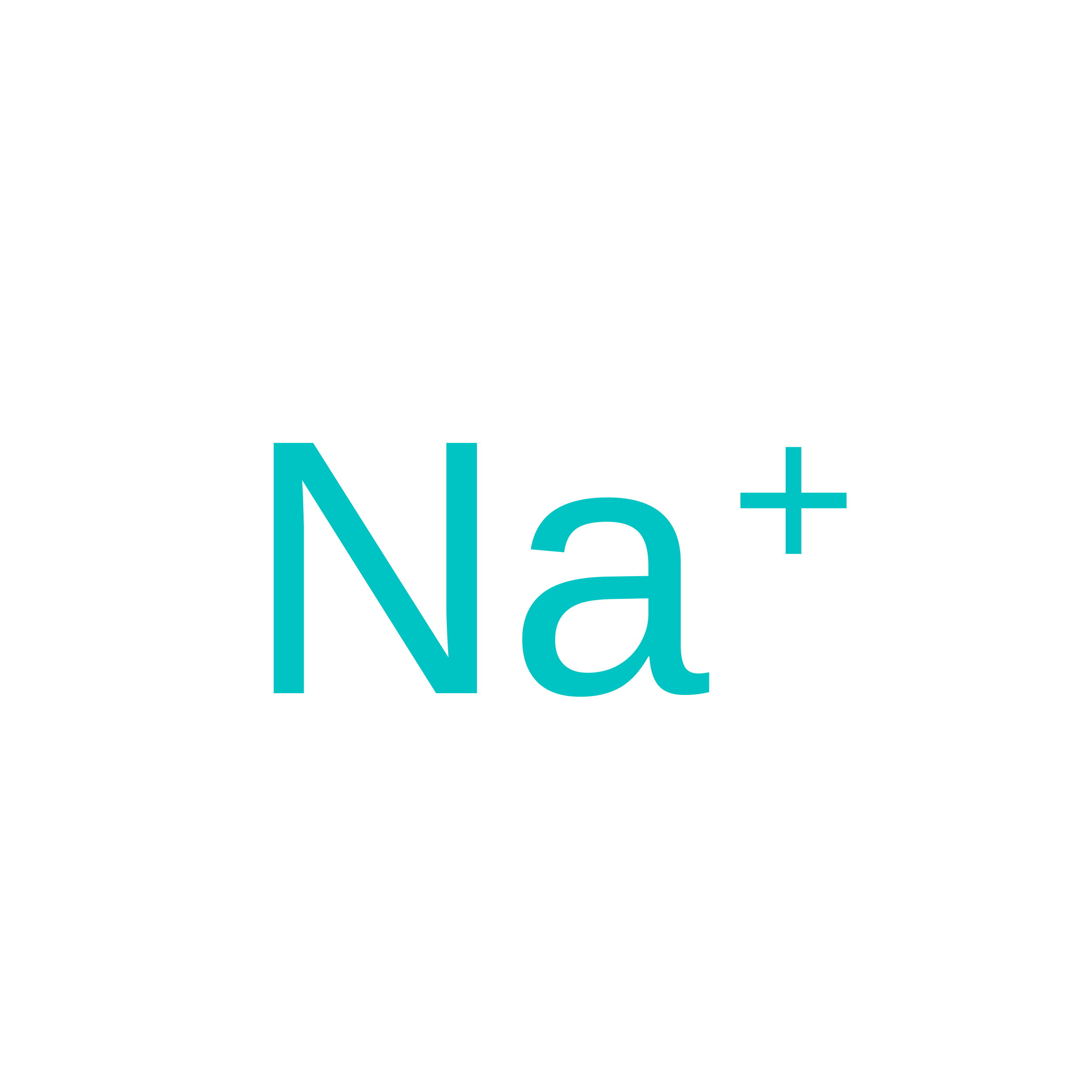
SODIUM ION
Na
FKNQFGJONOIPTF-UHFFFAOYSA-N

Experimental Data & Validation

Experimental Data

  • Method: X-RAY DIFFRACTION
  • Resolution: 1.60 Å
  • R-Value Free:  0.225 (Depositor), 0.225 (DCC) 
  • R-Value Work:  0.183 (Depositor), 0.184 (DCC) 
  • R-Value Observed: 0.185 (Depositor) 
Space Group: P 21 21 21
Unit Cell:
Length ( Å )Angle ( ˚ )
a = 76.87α = 90
b = 83.15β = 90
c = 98.34γ = 90
Software Package:
Software NamePurpose
PHENIXrefinement
xia2data reduction
DIALSdata scaling
PHASERphasing

Structure Validation

View Full Validation Report


Entry History 

& Funding Information

Deposition Data


Funding OrganizationLocationGrant Number
Novo Nordisk FoundationDenmarkNNF20SA0066621

Revision History  (Full details and data files)

  • Version 1.0: 2025-11-19
    Type: Initial release