9HU7 | pdb_00009hu7

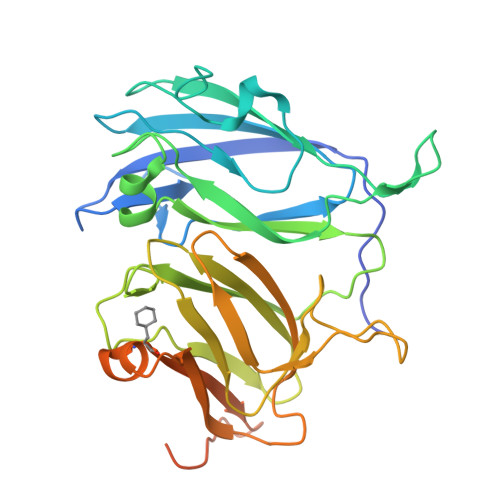
Mutant M298C6a of the small laccase (SLAC) from Streptomyces coelicolor


Experimental Data Snapshot

  • Method: X-RAY DIFFRACTION
  • Resolution: 3.51 Å
  • R-Value Free: 
    0.218 (Depositor), 0.218 (DCC) 
  • R-Value Work: 
    0.205 (Depositor), 0.205 (DCC) 
  • R-Value Observed: 
    0.205 (Depositor) 

Starting Model: in silico
View more details

wwPDB Validation 3D Report Full Report

Validation slider image for 9HU7

This is version 1.3 of the entry. See complete history

Literature

Hydrophobic tuning with non-canonical amino acids in a copper metalloenzyme.

Fischer, S.Natter Perdiguero, A.Lau, K.Deliz Liang, A.

(2026) Nat Chem 

  • DOI: https://doi.org/10.1038/s41557-026-02116-7
  • Primary Citation Related Structures: 
    9HU7

  • PubMed Abstract: 

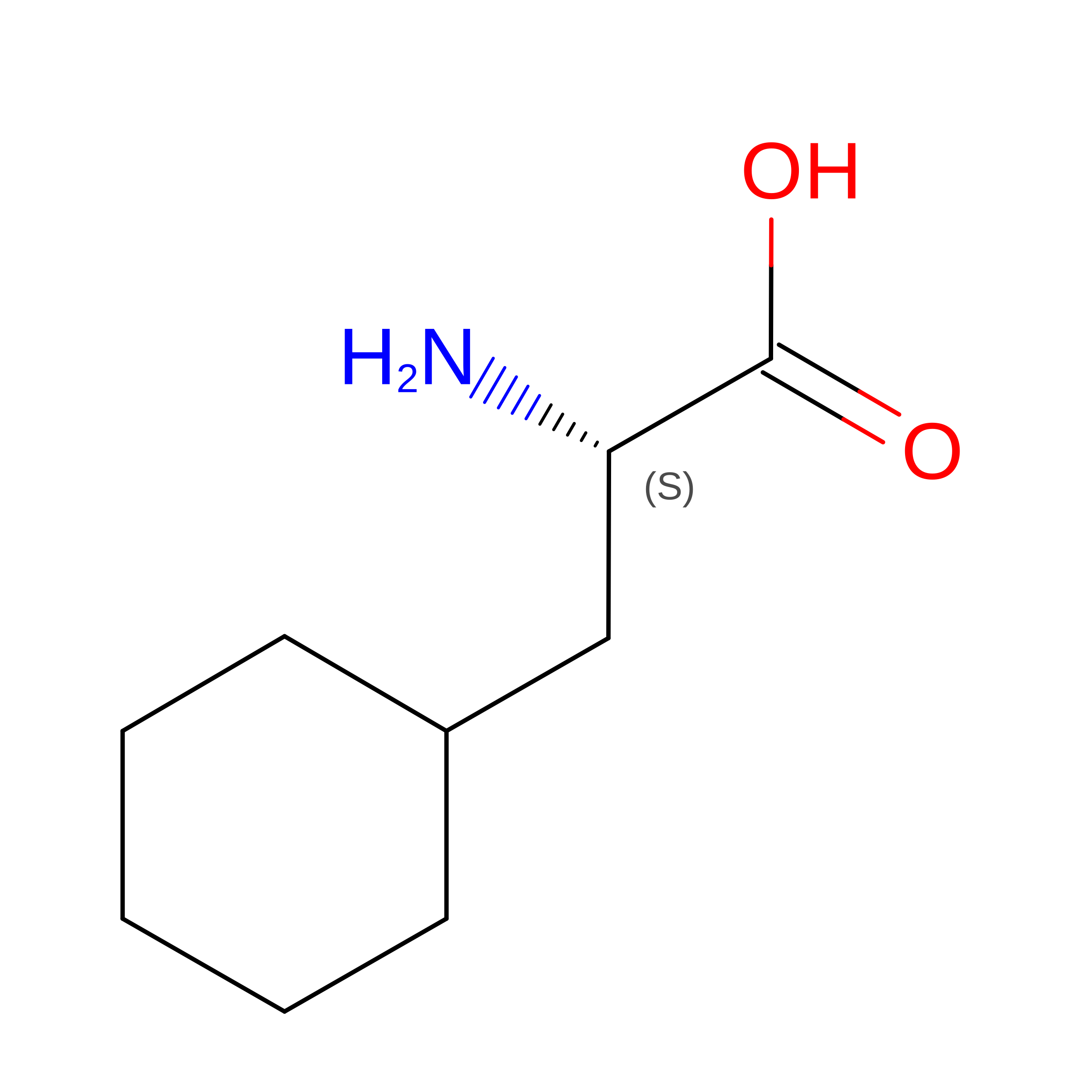
    Hydrophobicity controls many aspects of protein and enzyme function. Although hydrophobic tuning can be somewhat achieved with canonical amino acids, the incorporation of non-canonical amino acids further extends this ability to enable new and improved functionality. Here we engineer an aminoacyl-tRNA synthetase/tRNA pair for the site-specific genetic encoding of a set of bulky, hydrophobic amino acids, namely cyclopentylalanine, cyclohexylalanine and cycloheptylalanine. As a proof of concept, we demonstrate the utility of hydrophobic tuning based on non-canonical amino acids (ncAAs) to engineer a bacterial laccase, which is both a classical metalloenzyme and a high-value catalyst for industrial processes. The resulting mutations substantially improved the catalytic activity, particularly the turnover frequency and total turnover number. To understand this improved functionality, the redox potentials, electronic spectra and structure-function relationships were examined. Combining traditional directed evolution with ncAA-based engineering resulted in further improvements in catalysis, which were contextualized by analysing the changes imparted from these two methods.


  • Organizational Affiliation
    • Department of Chemistry, University of Zurich, Zurich, Switzerland.

Macromolecule Content 

  • Total Structure Weight: 35.4 kDa 
  • Atom Count: 2,149 
  • Modeled Residue Count: 277 
  • Deposited Residue Count: 322 
  • Unique protein chains: 1

Macromolecules

Find similar proteins by:|  3D Structure
Entity ID: 1
MoleculeChains  Sequence LengthOrganismDetailsImage
Copper oxidase322Streptomyces coelicolorMutation(s): 1 
Gene Names: SCO6712SC4C6.22
UniProt
Find proteins for Q9XAL8 (Streptomyces coelicolor (strain ATCC BAA-471 / A3(2) / M145))
Explore Q9XAL8 
Go to UniProtKB:  Q9XAL8
Entity Groups
Sequence Clusters30% Identity50% Identity70% Identity90% Identity95% Identity100% Identity
UniProt GroupQ9XAL8
Sequence Annotations
Expand
Reference Sequence

Experimental Data & Validation

Experimental Data

  • Method: X-RAY DIFFRACTION
  • Resolution: 3.51 Å
  • R-Value Free:  0.218 (Depositor), 0.218 (DCC) 
  • R-Value Work:  0.205 (Depositor), 0.205 (DCC) 
  • R-Value Observed: 0.205 (Depositor) 
Space Group: P 43 3 2
Unit Cell:
Length ( Å )Angle ( ˚ )
a = 178.755α = 90
b = 178.755β = 90
c = 178.755γ = 90
Software Package:
Software NamePurpose
PHENIXrefinement
autoPROCdata reduction
autoPROCdata scaling
PHASERphasing

Structure Validation

View Full Validation Report


Entry History 

& Funding Information

Deposition Data


Funding OrganizationLocationGrant Number
University of ZurichSwitzerland--

Revision History  (Full details and data files)

  • Version 1.0: 2026-01-14
    Type: Initial release
  • Version 1.1: 2026-03-25
    Changes: Database references
  • Version 1.2: 2026-04-15
    Changes: Database references
  • Version 1.3: 2026-04-22
    Changes: Database references