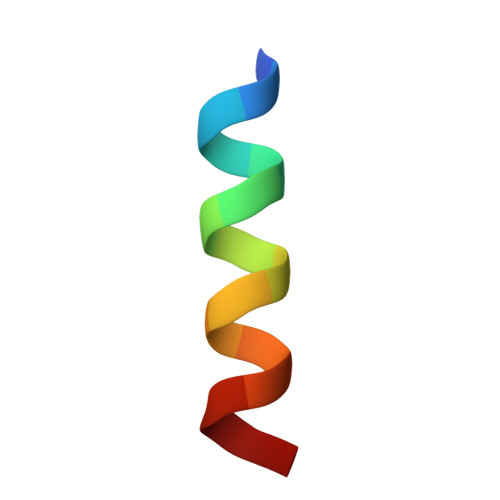
9HPP | pdb_00009hpp

Helical form of Citropin 1.3


Experimental Data Snapshot

  • Method: X-RAY DIFFRACTION
  • Resolution: 1.56 Å
  • R-Value Free: 
    0.323 (Depositor), 0.329 (DCC) 
  • R-Value Work: 
    0.284 (Depositor), 0.288 (DCC) 
  • R-Value Observed: 
    0.288 (Depositor) 

Starting Models: experimental
View more details

wwPDB Validation 3D Report Full Report

Validation slider image for 9HPP

This is version 1.1 of the entry. See complete history

Literature

Structural and Functional Versatility of the Amyloidogenic Non-Amidated Variant of the Antimicrobial Peptide Citropin 1.3.

Strati, F.Cali, M.P.Bloch, Y.Mostafavi, S.Monistrol, J.Golubev, A.Rayan, B.Gustavsson, E.Landau, M.

(2025) Adv Sci (Weinh) 12: e03997-e03997

  • DOI: https://doi.org/10.1002/advs.202503997
  • Primary Citation Related Structures: 
    9HGB, 9HGL, 9HGT, 9HI8, 9HID, 9HPP

  • PubMed Abstract: 

    Citropin 1.3 is an antimicrobial peptide secreted by the amphibian Litoria citropa (Southern bell frog). In this study, the structural and functional properties of its non-amidated form, which self-assembles into distinct fibrillar architectures, are investigated. Using cryogenic electron microscopy, X-ray crystallography, and fluorescence microscopy with model membranes and cells, diverse supramolecular structures, including canonical amyloid fibrils, multilayered nanotubes, and a novel mixed fibril type, are identified. In giant unilamellar vesicles, citropin 1.3 promoted membrane fusion and underwent lipid-induced phase separation. In mammalian cells, it permeabilized membranes, induced cell death, and colocalized with nucleic acids. These findings link antimicrobial activity to amyloid assembly and highlight the peptide's structural plasticity and potential biological functions, offering new insights into amyloid-based antimicrobial mechanisms.


  • Organizational Affiliation
    • CSSB Centre for Structural Systems Biology, Deutsches Elektronen-Synchrotron DESY, 22603, Hamburg, Germany.

Macromolecule Content 

  • Total Structure Weight: 3.26 kDa 
  • Atom Count: 248 
  • Modeled Residue Count: 32 
  • Deposited Residue Count: 32 
  • Unique protein chains: 1

Macromolecules

Find similar proteins by:  Sequence   |   3D Structure  
Entity ID: 1
MoleculeChains  Sequence LengthOrganismDetailsImage
Citropin-1.3
A, B
16Dryopsophus citropaMutation(s): 0 
UniProt
Find proteins for P81846 (Ranoidea citropa)
Explore P81846 
Go to UniProtKB:  P81846
Entity Groups
Sequence Clusters30% Identity50% Identity70% Identity90% Identity95% Identity100% Identity
UniProt GroupP81846
Sequence Annotations
Expand
Reference Sequence

Experimental Data & Validation

Experimental Data

  • Method: X-RAY DIFFRACTION
  • Resolution: 1.56 Å
  • R-Value Free:  0.323 (Depositor), 0.329 (DCC) 
  • R-Value Work:  0.284 (Depositor), 0.288 (DCC) 
  • R-Value Observed: 0.288 (Depositor) 
Space Group: P 41 3 2
Unit Cell:
Length ( Å )Angle ( ˚ )
a = 67.83α = 90
b = 67.83β = 90
c = 67.83γ = 90
Software Package:
Software NamePurpose
PHENIXrefinement
REFMACrefinement
XDSdata reduction
XDSdata scaling
PHASERphasing

Structure Validation

View Full Validation Report


Entry History 

& Funding Information

Deposition Data


Funding OrganizationLocationGrant Number
H2020 Marie Curie Actions of the European CommissionEuropean Union945405
Israel Science FoundationIsrael2111/20

Revision History  (Full details and data files)

  • Version 1.0: 2025-10-08
    Type: Initial release
  • Version 1.1: 2025-12-24
    Changes: Database references