9HMU | pdb_00009hmu

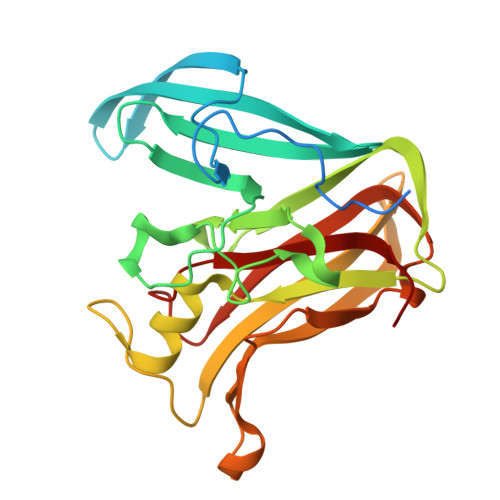
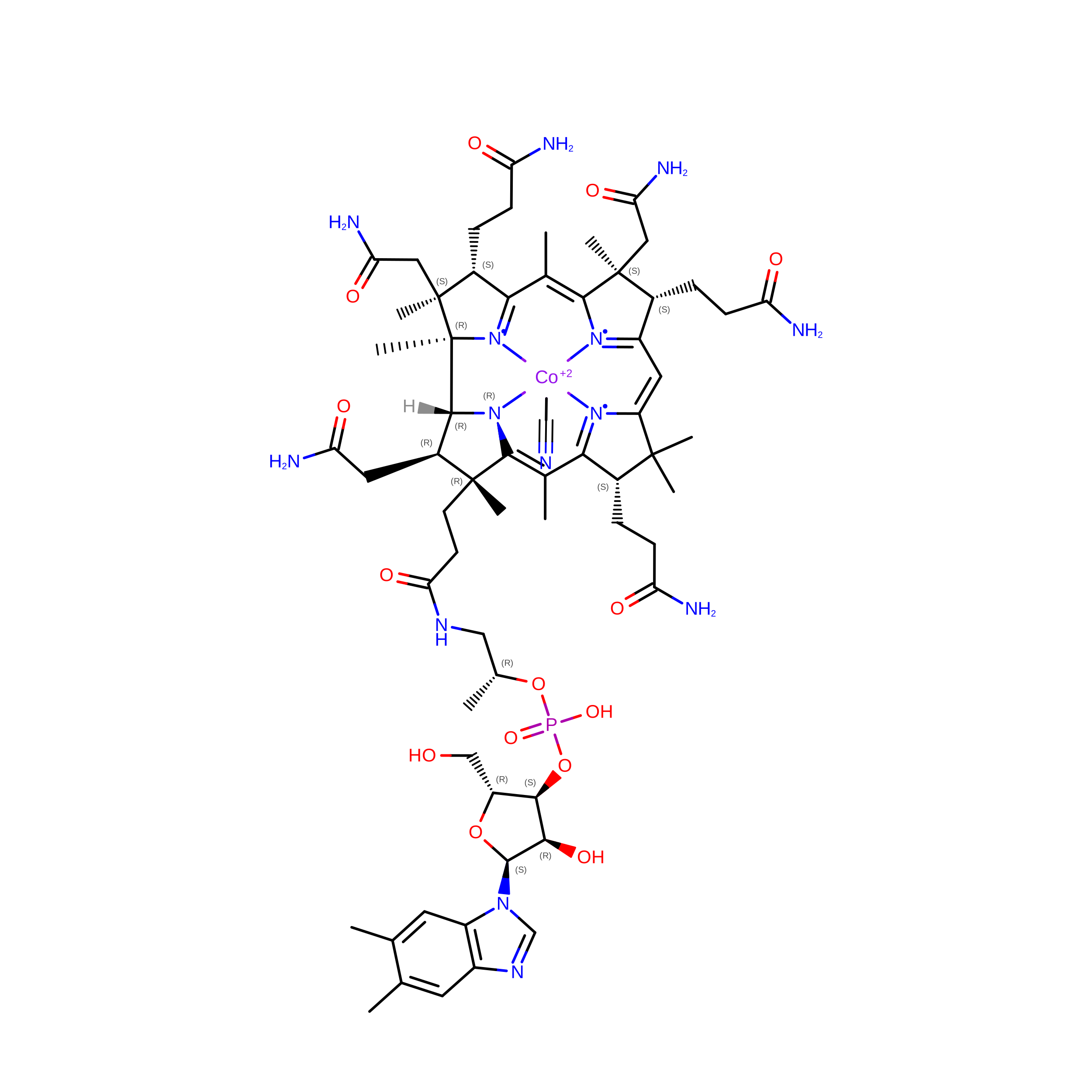
DUF4465 domain containing protein in complex with vitamin B12.


Experimental Data Snapshot

  • Method: X-RAY DIFFRACTION
  • Resolution: 1.85 Å
  • R-Value Free: 
    0.213 (Depositor), 0.214 (DCC) 
  • R-Value Work: 
    0.190 (Depositor), 0.190 (DCC) 

Starting Model: in silico
View more details

wwPDB Validation 3D Report Full Report

Validation slider image for 9HMU

Ligand Structure Quality Assessment 


This is version 2.0 of the entry. See complete history

Literature

Evolutionarily divergent DUF4465 domains have a common vitamin B 12 -binding function.

Clarke, C.Banasik, M.Juodeikis, R.Warren, M.J.Pickersgill, R.W.

(2026) FEBS Open Bio 16: 1537-1549

  • DOI: https://doi.org/10.1002/2211-5463.70231
  • Primary Citation Related Structures: 
    9HMU

  • PubMed Abstract: 

    The DUF4465 family (DUF, domain of unknown function) contains more than 1000 members distributed across eight bacterial clades with species from diverse microenvironments including various gut microbiomes, hydrothermal vents, and soil. In the gut commensal Bacteroides thetaiotaomicron (B. theta), DUF4465 containing proteins act as high-affinity B 12 -binding proteins that scavenge this cofactor to ensure bacterial survival. Such B 12 capture is essential for bacteria that have lost the ability to synthesize B 12 de novo. This raises the question of whether B 12 -binding is ubiquitous across this family of proteins. Here, we show that B 12 -binding is a recurrent function of eight distantly related members of the DUF4465 family. It is reasonable to conclude that B 12 -binding is a common function of most DUF4465 proteins. These results establish DUF4465 as a structurally conserved family of augmented β-jellyroll B 12 -binding proteins with widespread roles in microbial competition for this essential cofactor. Impact statement DUF4465 defines a widespread, structurally conserved bacterial cobalamin-binding domain and provides a promising scaffold for protein-based B 12 capture and purification.


  • Organizational Affiliation
    • School of Biological and Behavioural Sciences, Queen Mary University of London, UK.

Macromolecule Content 

  • Total Structure Weight: 85.03 kDa 
  • Atom Count: 6,073 
  • Modeled Residue Count: 670 
  • Deposited Residue Count: 750 
  • Unique protein chains: 1

Macromolecules

Find similar proteins by:|  3D Structure
Entity ID: 1
MoleculeChains  Sequence LengthOrganismDetailsImage
DUF4465 domain containing protein D5EK
A, B, C
250Coraliomargarita akajimensisMutation(s): 0 
Gene Names: Caka_1781
UniProt
Find proteins for D5EK51 (Coraliomargarita akajimensis (strain DSM 45221 / IAM 15411 / JCM 23193 / KCTC 12865 / 04OKA010-24))
Explore D5EK51 
Go to UniProtKB:  D5EK51
Entity Groups
Sequence Clusters30% Identity50% Identity70% Identity90% Identity95% Identity100% Identity
UniProt GroupD5EK51
Sequence Annotations
Expand
Reference Sequence

Experimental Data & Validation

Experimental Data

  • Method: X-RAY DIFFRACTION
  • Resolution: 1.85 Å
  • R-Value Free:  0.213 (Depositor), 0.214 (DCC) 
  • R-Value Work:  0.190 (Depositor), 0.190 (DCC) 
Space Group: P 32 2 1
Unit Cell:
Length ( Å )Angle ( ˚ )
a = 113.72α = 90
b = 113.72β = 90
c = 162.593γ = 120
Software Package:
Software NamePurpose
REFMACrefinement
XDSdata reduction
XDSdata scaling
PHASERphasing

Structure Validation

View Full Validation Report


Ligand Structure Quality Assessment 


Entry History 

& Funding Information

Deposition Data


Funding OrganizationLocationGrant Number
Biotechnology and Biological Sciences Research Council (BBSRC)United Kingdom--

Revision History  (Full details and data files)

  • Version 1.0: 2025-01-15
    Type: Initial release
  • Version 1.1: 2025-01-22
    Changes: Structure summary
  • Version 1.2: 2026-07-29
    Changes: Data collection, Database references
  • Version 2.0: 2026-08-12
    Type: Remediation
    Reason: Metalloprotein remediation
    Changes: Database references, Derived calculations, Non-polymer description