9H1J | pdb_00009h1j

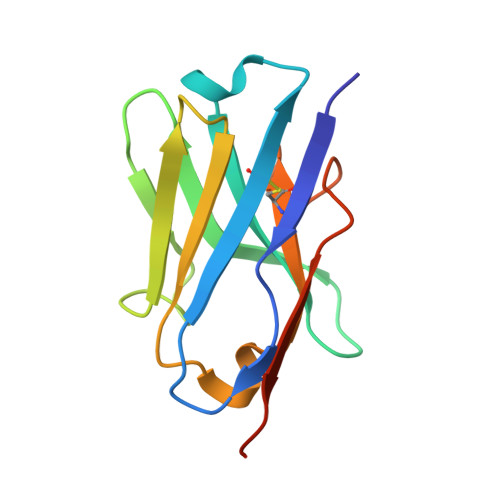
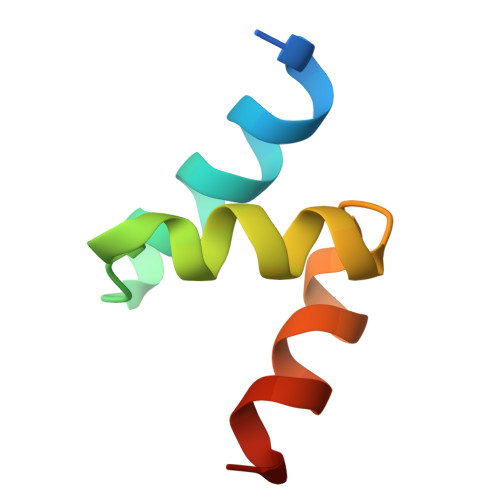
Crystal structure of the p62 UBA domain bound to VHH 6C10


Experimental Data Snapshot

  • Method: X-RAY DIFFRACTION
  • Resolution: 1.73 Å
  • R-Value Free: 
    0.247 (Depositor), 0.251 (DCC) 
  • R-Value Work: 
    0.214 (Depositor), 0.217 (DCC) 
  • R-Value Observed: 
    0.225 (Depositor) 

Starting Model: in silico
View more details

wwPDB Validation 3D Report Full Report

Validation slider image for 9H1J

This is version 1.1 of the entry. See complete history

Literature

Development of a p62 biodegrader for autophagy targeted degradation.

Thiel, Z.Marcellin, D.Manneville, C.Goretzki, B.Egger, L.Maher, R.Siccardi, N.Torres, L.Probst, A.Muller, C.S.George, N.Vogel, M.Sinterhauf, S.Lavoisier, A.Choi, J.Y.Forcellino, L.Landshammer, A.Hauck, P.Be, C.Villard, F.Gutmann, S.Meyer, M.Freuler, F.Hinniger, A.Fernandez, C.Chau, S.Patoor, M.Sansig, G.Mitchell, G.Nyfeler, B.

(2025) Nat Commun 16: 10858-10858

  • DOI: https://doi.org/10.1038/s41467-025-65868-9
  • Primary Citation Related Structures: 
    9H1J

  • PubMed Abstract: 

    Autophagy-based targeted degradation offers a powerful complement to proteasomal degradation leveraging the capacity and versatility of lysosomes to degrade complex cargo. However, it remains unclear which components of the autophagy-lysosomal pathway are most effective for targeted degradation. Here, we describe two orthogonal induced-proximity strategies to identify autophagy effectors capable of degrading organelles and soluble targets. Recruitment of autophagy cargo receptors, ATG8-like proteins, or the kinases ULK1 and TBK1 is sufficient to trigger mitophagy, while only autophagy cargo receptors capable of self-oligomerization degrade soluble cytosolic proteins. We further report a single-domain antibody against p62 and its use as a heterobifunctional degrader to clear mitochondria. Fusing the p62 single-domain antibody to PINK1 enables selective targeting of damaged mitochondria. Our study highlights the importance of avidity for targeted autophagy and suggests that autophagy cargo receptors are attractive entry points for the development of heterobifunctional degraders for organelles or protein aggregates.


  • Organizational Affiliation
    • Discovery Sciences, Biomedical Research, Novartis, Basel, Switzerland. zacharias.thiel@novartis.com.

Macromolecule Content 

  • Total Structure Weight: 75.73 kDa 
  • Atom Count: 5,524 
  • Modeled Residue Count: 643 
  • Deposited Residue Count: 688 
  • Unique protein chains: 2

Macromolecules

Find similar proteins by:|  3D Structure
Entity ID: 1
MoleculeChains  Sequence LengthOrganismDetailsImage
VHH 6C10
A, B, C, D
121Lama glamaMutation(s): 0 
Find similar proteins by:|  3D Structure
Entity ID: 2
MoleculeChains  Sequence LengthOrganismDetailsImage
Sequestosome-1
E, F, G, H
51Homo sapiensMutation(s): 0 
Gene Names: SQSTM1
UniProt & NIH Common Fund Data Resources
Find proteins for Q13501 (Homo sapiens)
Explore Q13501 
Go to UniProtKB:  Q13501
PHAROS:  Q13501
GTEx:  ENSG00000161011 
Entity Groups
Sequence Clusters30% Identity50% Identity70% Identity90% Identity95% Identity100% Identity
UniProt GroupQ13501
Sequence Annotations
Expand
Reference Sequence

Experimental Data & Validation

Experimental Data

  • Method: X-RAY DIFFRACTION
  • Resolution: 1.73 Å
  • R-Value Free:  0.247 (Depositor), 0.251 (DCC) 
  • R-Value Work:  0.214 (Depositor), 0.217 (DCC) 
  • R-Value Observed: 0.225 (Depositor) 
Space Group: P 1 21 1
Unit Cell:
Length ( Å )Angle ( ˚ )
a = 62.886α = 90
b = 73.613β = 90.219
c = 89.785γ = 90
Software Package:
Software NamePurpose
PHENIXrefinement
autoPROCdata reduction
Aimlessdata scaling
PHASERphasing

Structure Validation

View Full Validation Report


Entry History 

& Funding Information

Deposition Data


Funding OrganizationLocationGrant Number
Not funded--

Revision History  (Full details and data files)

  • Version 1.0: 2025-10-29
    Type: Initial release
  • Version 1.1: 2025-12-17
    Changes: Database references