9GBT | pdb_00009gbt

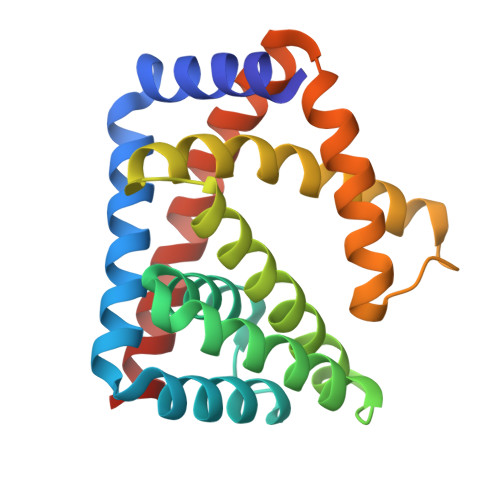
De novo designed retro-aldolase 13 (RAD13)


Experimental Data Snapshot

  • Method: X-RAY DIFFRACTION
  • Resolution: 2.43 Å
  • R-Value Free: 
    0.267 (Depositor), 0.266 (DCC) 
  • R-Value Work: 
    0.223 (Depositor), 0.221 (DCC) 
  • R-Value Observed: 
    0.226 (Depositor) 

Starting Model: in silico
View more details

wwPDB Validation 3D Report Full Report

Validation slider image for 9GBT

This is version 1.3 of the entry. See complete history

Literature

Computational enzyme design by catalytic motif scaffolding.

Braun, M.Tripp, A.Chakatok, M.Kaltenbrunner, S.Fischer, C.Stoll, D.Bijelic, A.Elaily, W.Totaro, M.G.Moser, M.Hoch, S.Y.Lechner, H.Rossi, F.Aleotti, M.Hall, M.Oberdorfer, G.

(2026) Nature 649: 237-245

  • DOI: https://doi.org/10.1038/s41586-025-09747-9
  • Primary Citation Related Structures: 
    9FW5, 9FW7, 9FWA, 9GBT, 9QDP, 9R7F

  • PubMed Abstract: 

    Enzymes find broad use as biocatalysts in industry and medicine owing to their exquisite selectivity, efficiency and mild reaction conditions. Custom-designed enzymes can produce tailor-made biocatalysts with potential applications that extend beyond natural reactions. However, current design methods require testing a large number of designs and mostly produce de novo enzymes with low catalytic activities 1-3 . As a result, they require costly experimental optimization and high-throughput screening to be industrially viable 4,5 . Here we present rotamer inverted fragment finder-diffusion (Riff-Diff), a hybrid machine learning and atomistic modelling strategy for scaffolding catalytic arrays in de novo proteins. We highlight the general applicability of Riff-Diff by designing enzymes for two mechanistically distinct chemical transformations, the retro-aldol reaction and the Morita-Baylis-Hillman reaction. We show that in both cases, it is possible to generate catalysts that exhibit activities rivalling those optimized by in vitro evolution, along with exquisite stereoselectivity. High-resolution structures of six of the designs revealed near-atomic active site design precision. The design strategy can, in principle, be applied to any catalytically competent amino acid array. These findings lay the basis for practical applicability of de novo protein catalysts in synthesis and describe fundamental principles of protein design and enzyme catalysis.


  • Organizational Affiliation
    • Institute of Biochemistry, Graz University of Technology, Graz, Austria.

Macromolecule Content 

  • Total Structure Weight: 45.66 kDa 
  • Atom Count: 3,204 
  • Modeled Residue Count: 400 
  • Deposited Residue Count: 404 
  • Unique protein chains: 1

Macromolecules

Find similar proteins by:|  3D Structure
Entity ID: 1
MoleculeChains  Sequence LengthOrganismDetailsImage
Retroaldolase 13 (RAD13)
A, B
202synthetic constructMutation(s): 0 

Small Molecules

Ligands 3 Unique
IDChains Name / Formula / InChI Key2D Diagram3D Interactions
GOL

Query on GOL


Download:Ideal Coordinates CCD File
E [auth A],
F [auth A],
H [auth A],
J [auth B],
K [auth B]
GLYCEROL
C3 H8 O3
PEDCQBHIVMGVHV-UHFFFAOYSA-N
ACT

Query on ACT


Download:Ideal Coordinates CCD File
C [auth A],
D [auth A],
G [auth A],
L [auth B]
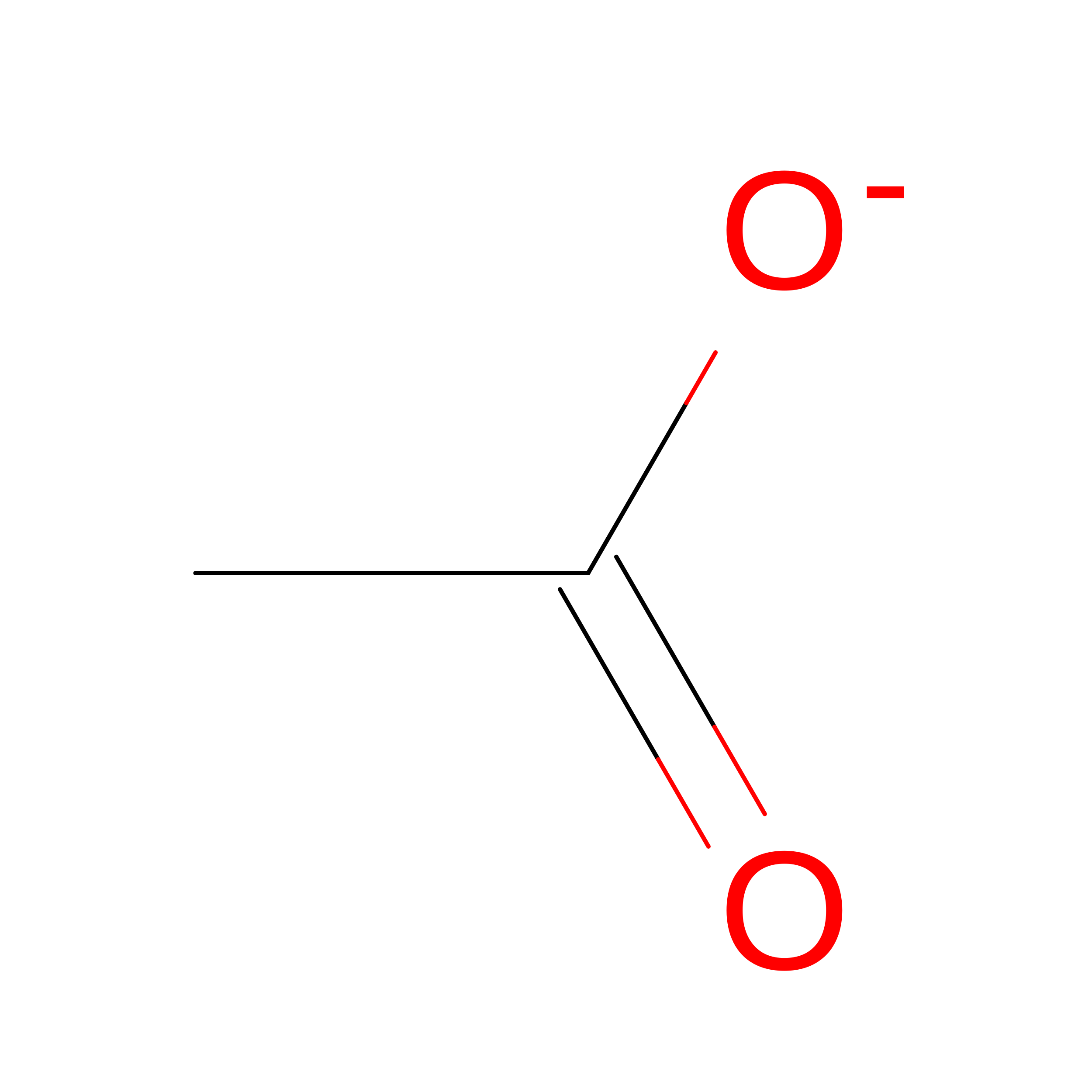
ACETATE ION
C2 H3 O2
QTBSBXVTEAMEQO-UHFFFAOYSA-M
NA

Query on NA


Download:Ideal Coordinates CCD File
I [auth A]SODIUM ION
Na
FKNQFGJONOIPTF-UHFFFAOYSA-N

Experimental Data & Validation

Experimental Data

  • Method: X-RAY DIFFRACTION
  • Resolution: 2.43 Å
  • R-Value Free:  0.267 (Depositor), 0.266 (DCC) 
  • R-Value Work:  0.223 (Depositor), 0.221 (DCC) 
  • R-Value Observed: 0.226 (Depositor) 
Space Group: P 1 21 1
Unit Cell:
Length ( Å )Angle ( ˚ )
a = 38.044α = 90
b = 76.936β = 91.234
c = 59.619γ = 90
Software Package:
Software NamePurpose
PHENIXrefinement
XDSdata reduction
XDSdata scaling
PHASERphasing

Structure Validation

View Full Validation Report


Entry History 

& Funding Information

Deposition Data


Funding OrganizationLocationGrant Number
Austrian Science FundAustria--

Revision History  (Full details and data files)

  • Version 1.0: 2025-08-13
    Type: Initial release
  • Version 1.1: 2025-12-10
    Changes: Database references
  • Version 1.2: 2025-12-17
    Changes: Database references
  • Version 1.3: 2026-01-07
    Changes: Database references