9FSM | pdb_00009fsm

Cryo-EM structure of the decameric TraT surface exclusion lipoprotein from Klebsiella pneumoniae (pKpQIL plasmid)


Experimental Data Snapshot

  • Method: ELECTRON MICROSCOPY
  • Resolution: 2.47 Å
  • Aggregation State: PARTICLE 
  • Reconstruction Method: SINGLE PARTICLE 

Starting Model: in silico
View more details

wwPDB Validation 3D Report Full Report

Validation slider image for 9FSM

This is version 1.1 of the entry. See complete history

Literature

Cryo-EM structure and evolutionary history of the conjugation surface exclusion protein TraT.

Seddon, C.David, S.Wong, J.L.C.Ishimoto, N.He, S.Bradshaw, J.Low, W.W.Frankel, G.Beis, K.

(2025) Nat Commun 16: 659-659

  • DOI: https://doi.org/10.1038/s41467-025-55834-w
  • Primary Citation Related Structures: 
    9FS5, 9FSM

  • PubMed Abstract: 

    Conjugation plays a major role in dissemination of antimicrobial resistance genes. Following transfer of IncF-like plasmids, recipients become refractory to a second wave of conjugation with the same plasmid via entry (TraS) and surface (TraT) exclusion mechanisms. Here, we show that TraT from the pKpQIL and F plasmids (TraT pKpQIL and TraT F ) exhibits plasmid surface exclusion specificity. The cryo-EM structures of TraT pKpQIL and TraT F reveal that they oligomerise into decameric champagne bottle cork-like structures, which are anchored to the outer membrane via a diacylglycerol and palmitic acid modified α-helical barrel domain. Unexpectedly, we identify chromosomal TraT homologues from multiple Gram-negative phyla which form numerous divergent lineages in a phylogenetic tree of TraT sequences. Plasmid-associated TraT sequences are found in multiple distinct lineages, including two separate clades incorporating TraT from Enterobacteriaceae IncF/F-like and Legionellaceae F-like plasmids. These findings suggest that different plasmid backbones have acquired and co-opted TraT on independent occasions.


  • Organizational Affiliation
    • Department of Life Sciences, Imperial College London, London, SW7 2AZ, UK.

Macromolecule Content 

  • Total Structure Weight: 246.15 kDa 
  • Atom Count: 17,060 
  • Modeled Residue Count: 2,260 
  • Deposited Residue Count: 2,260 
  • Unique protein chains: 1

Macromolecules

Find similar proteins by:|  3D Structure
Entity ID: 1
MoleculeChains  Sequence LengthOrganismDetailsImage
TraT complement resistance protein
A, B, C, D, E
A, B, C, D, E, F, G, H, I, J
226Klebsiella pneumoniaeMutation(s): 0 
Membrane Entity: Yes 
UniProt
Find proteins for W1DJ50 (Klebsiella pneumoniae IS43)
Explore W1DJ50 
Go to UniProtKB:  W1DJ50
Entity Groups
Sequence Clusters30% Identity50% Identity70% Identity90% Identity95% Identity100% Identity
UniProt GroupW1DJ50
Sequence Annotations
Expand
Reference Sequence

Small Molecules

Ligands 1 Unique
IDChains Name / Formula / InChI Key2D Diagram3D Interactions
DGA
(Subject of Investigation/LOI)

Query on DGA


Download:Ideal Coordinates CCD File
K [auth A]
L [auth B]
M [auth C]
N [auth D]
O [auth E]
K [auth A],
L [auth B],
M [auth C],
N [auth D],
O [auth E],
P [auth F],
Q [auth G],
R [auth H],
S [auth I],
T [auth J]
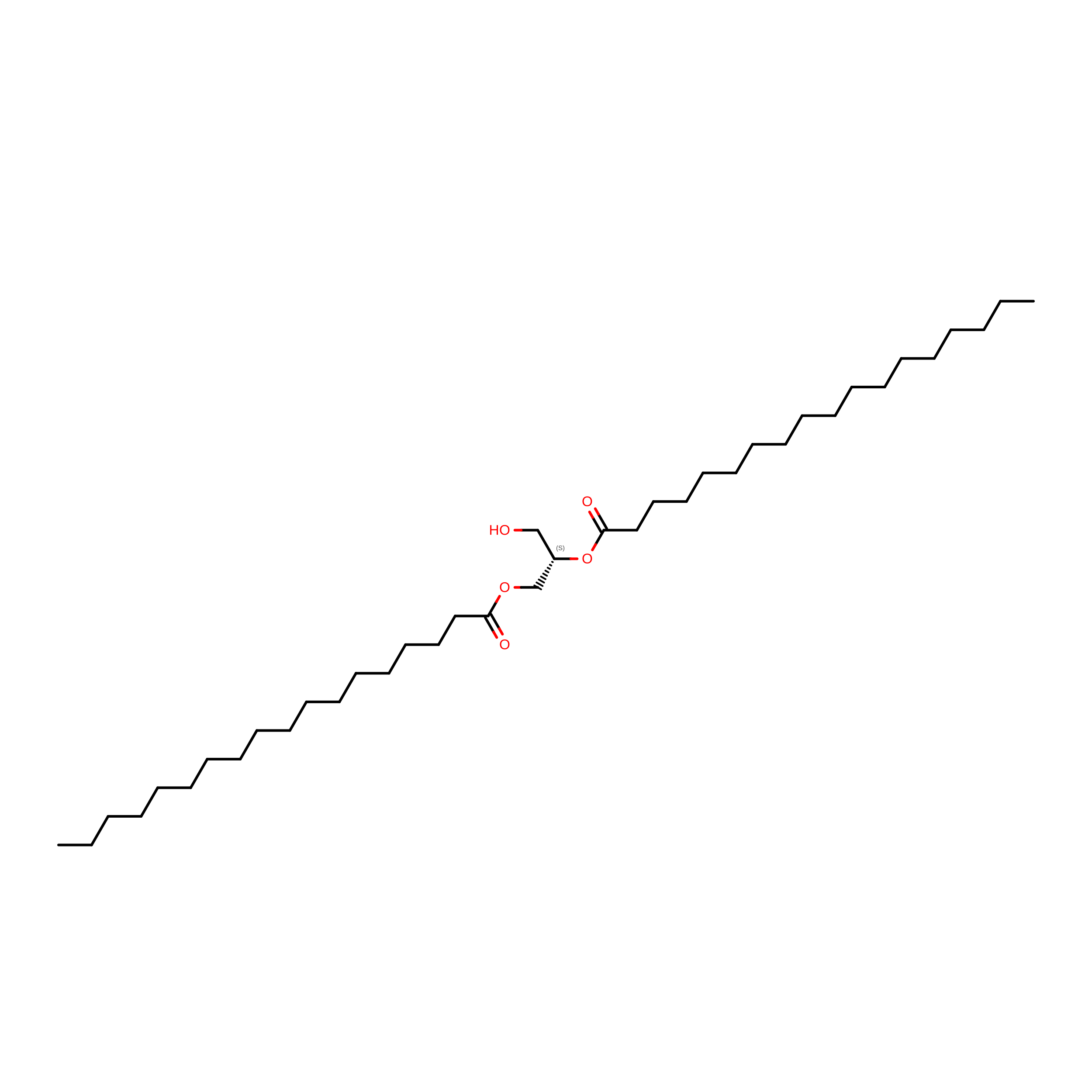
DIACYL GLYCEROL
C39 H76 O5
UHUSDOQQWJGJQS-QNGWXLTQSA-N

Experimental Data & Validation

Experimental Data

  • Method: ELECTRON MICROSCOPY
  • Resolution: 2.47 Å
  • Aggregation State: PARTICLE 
  • Reconstruction Method: SINGLE PARTICLE 
EM Software:
TaskSoftware PackageVersion
MODEL REFINEMENTPHENIX1.18

Structure Validation

View Full Validation Report


Entry History 

& Funding Information

Deposition Data


Funding OrganizationLocationGrant Number
Biotechnology and Biological Sciences Research Council (BBSRC)United KingdomBB/M011178/1

Revision History  (Full details and data files)

  • Version 1.0: 2024-12-11
    Type: Initial release
  • Version 1.1: 2025-06-11
    Changes: Data collection, Database references