9EYJ | pdb_00009eyj

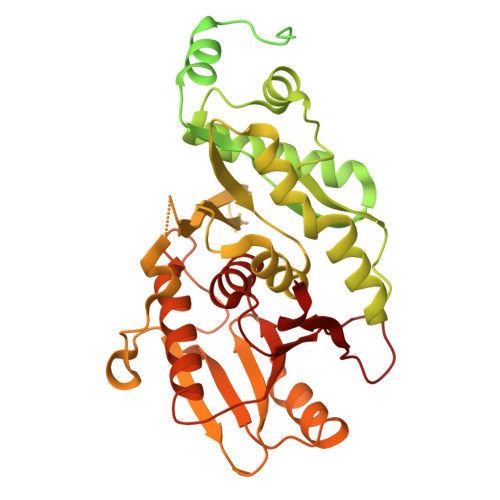
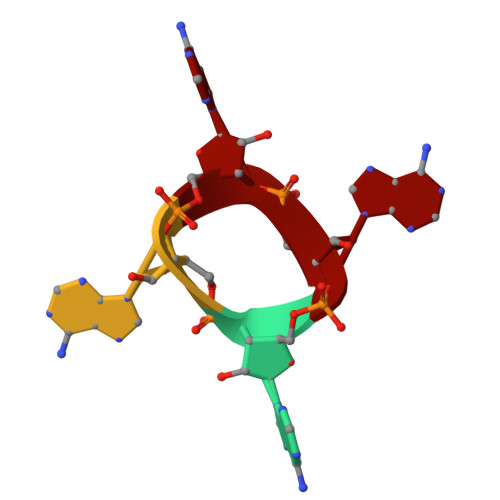
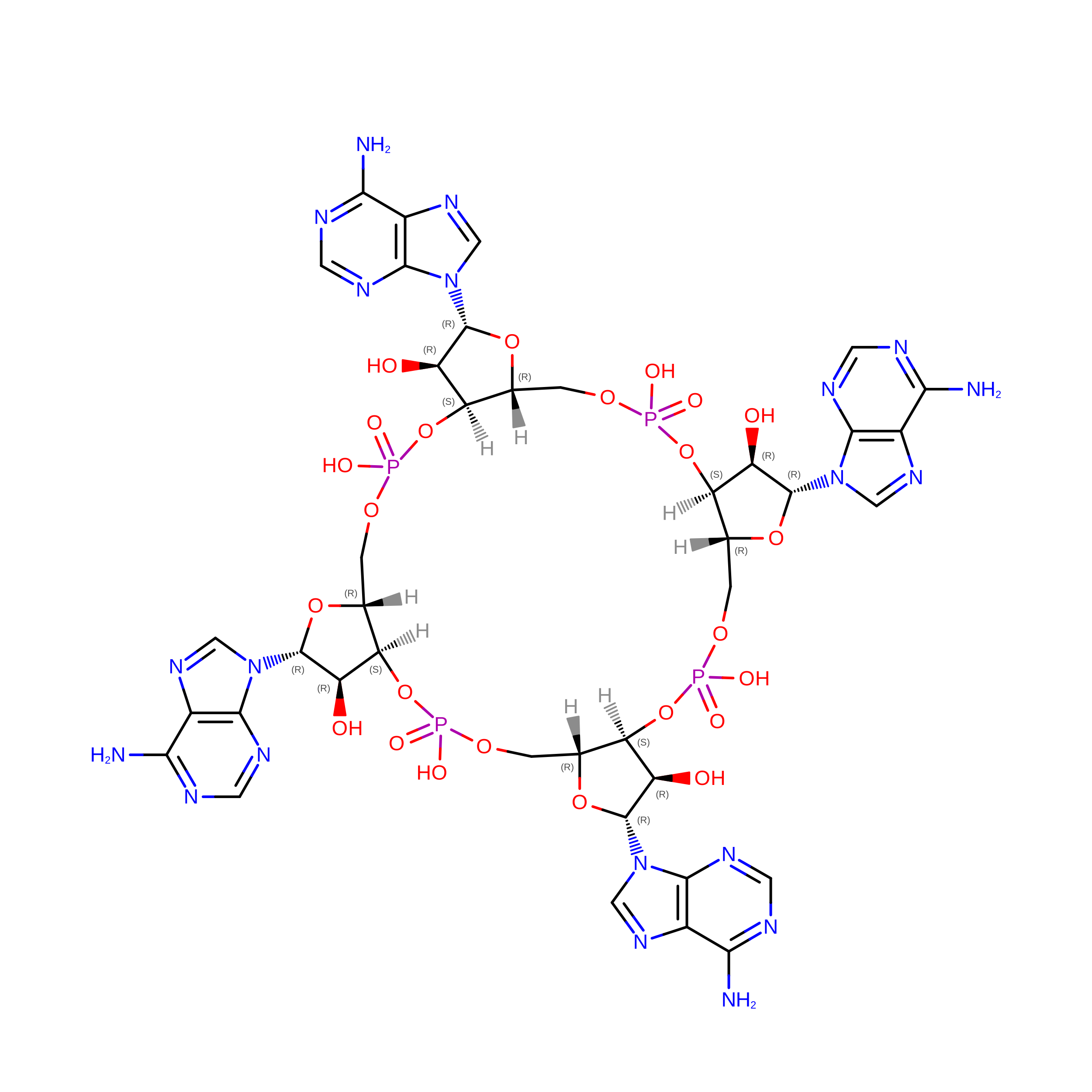
Cryo-EM structure of SAVED-Lon protease CCaCalpL filament bound to cA4


Experimental Data Snapshot

  • Method: ELECTRON MICROSCOPY
  • Resolution: 2.97 Å
  • Aggregation State: FILAMENT 
  • Reconstruction Method: SINGLE PARTICLE 

wwPDB Validation 3D Report Full Report

Validation slider image for 9EYJ

This is version 1.2 of the entry. See complete history

Literature

Filament formation activates protease and ring nuclease activities of CRISPR Lon-SAVED.

Smalakyte, D.Ruksenaite, A.Sasnauskas, G.Tamulaitiene, G.Tamulaitis, G.

(2024) Mol Cell 84: 4239-4255.e8

  • DOI: https://doi.org/10.1016/j.molcel.2024.09.002
  • Primary Citation Related Structures: 
    9EYI, 9EYJ, 9EYK

  • PubMed Abstract: 

    To combat phage infection, type III CRISPR-Cas systems utilize cyclic oligoadenylates (cA n ) signaling to activate various auxiliary effectors, including the CRISPR-associated Lon-SAVED protease CalpL, which forms a tripartite effector system together with an anti-σ factor, CalpT, and an ECF-like σ factor, CalpS. Here, we report the characterization of the Candidatus Cloacimonas acidaminovorans CalpL-CalpT-CalpS. We demonstrate that cA 4 binding triggers CalpL filament formation and activates it to cleave CalpT within the CalpT-CalpS dimer. This cleavage exposes the CalpT C-degron, which targets it for further degradation by cellular proteases. Consequently, CalpS is released to bind to RNA polymerase, causing growth arrest in E. coli. Furthermore, the CalpL-CalpT-CalpS system is regulated by the SAVED domain of CalpL, which is a ring nuclease that cleaves cA 4 in a sequential three-step mechanism. These findings provide key mechanistic details for the activation, proteolytic events, and regulation of the signaling cascade in the type III CRISPR-Cas immunity.


  • Organizational Affiliation
    • Institute of Biotechnology, Life Sciences Center, Vilnius University, Saulėtekio av. 7, 10257 Vilnius, Lithuania.

Macromolecule Content 

  • Total Structure Weight: 127.86 kDa 
  • Atom Count: 4,334 
  • Modeled Residue Count: 580 
  • Deposited Residue Count: 1,102 
  • Unique protein chains: 1
  • Unique nucleic acid chains: 1

Macromolecules


Find similar proteins by:|  3D Structure
Entity ID: 1
MoleculeChains  Sequence LengthOrganismDetailsImage
SMODS-associated and fused to various effectors domain-containing protein
A, B
549Candidatus Cloacimonas acidaminovoransMutation(s): 0 
Gene Names: CLOAM0848
UniProt
Find proteins for B0VHB4 (Cloacimonas acidaminovorans (strain Evry))
Explore B0VHB4 
Go to UniProtKB:  B0VHB4
Entity Groups
Sequence Clusters30% Identity50% Identity70% Identity90% Identity95% Identity100% Identity
UniProt GroupB0VHB4
Sequence Annotations
Expand
Reference Sequence
Find similar nucleic acids by:  Sequence
Entity ID: 2
MoleculeChains LengthOrganismImage
cA4C [auth D]4synthetic construct
Sequence Annotations
Expand
Reference Sequence

Biologically Interesting Molecules (External Reference) 

1 Unique

Experimental Data & Validation

Experimental Data

  • Method: ELECTRON MICROSCOPY
  • Resolution: 2.97 Å
  • Aggregation State: FILAMENT 
  • Reconstruction Method: SINGLE PARTICLE 
EM Software:
TaskSoftware PackageVersion
MODEL REFINEMENTPHENIX
RECONSTRUCTIONcryoSPARCv4.4.1

Structure Validation

View Full Validation Report


Entry History 

& Funding Information

Deposition Data


Funding OrganizationLocationGrant Number
Research Council of LithuaniaLithuaniaS-MIP-22-9

Revision History  (Full details and data files)

  • Version 1.0: 2024-10-02
    Type: Initial release
  • Version 1.1: 2024-12-18
    Changes: Data collection, Database references, Structure summary
  • Version 1.2: 2025-07-09
    Changes: Data collection