9EXS | pdb_00009exs

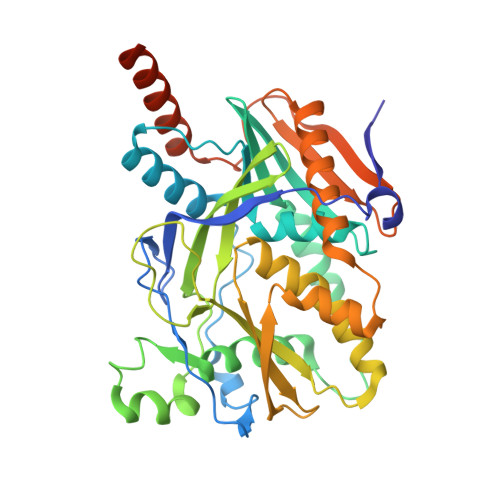
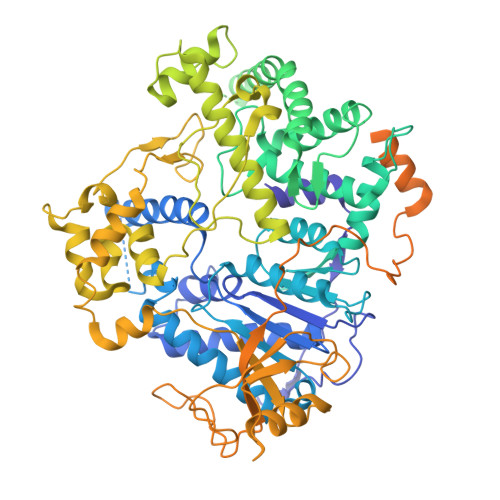
Cryo-EM structure of Ch. thermophilum Rai1-Rat1 dimer.


Experimental Data Snapshot

  • Method: ELECTRON MICROSCOPY
  • Resolution: 3.28 Å
  • Aggregation State: PARTICLE 
  • Reconstruction Method: SINGLE PARTICLE 

wwPDB Validation 3D Report Full Report

Validation slider image for 9EXS

This is version 1.2 of the entry. See complete history

Literature

Assembly of the Xrn2/Rat1-Rai1-Rtt103 termination complexes in mesophilic and thermophilic organisms.

Dikunova, A.Noskova, N.Overbeck, J.H.Polak, M.Stelzig, D.Zapletal, D.Kubicek, K.Novacek, J.Sprangers, R.Stefl, R.

(2025) Structure 33: 300

  • DOI: https://doi.org/10.1016/j.str.2024.11.010
  • Primary Citation Related Structures: 
    8Q6V, 9EXS, 9FMS

  • PubMed Abstract: 

    The 5'-3' exoribonuclease Xrn2, known as Rat1 in yeasts, terminates mRNA transcription by RNA polymerase II (RNAPII). In the torpedo model of termination, the activity of Xrn2/Rat1 is enhanced by Rai1, which is recruited to the termination site by Rtt103, an adaptor protein binding to the RNAPII C-terminal domain (CTD). The overall architecture of the Xrn2/Rat1-Rai1-Rtt103 complex remains unknown. We combined structural biology methods to characterize the torpedo complex from Saccharomyces cerevisiae and Chaetomium thermophilum. Comparison of the structures from these organisms revealed a conserved protein core fold of the subunits, but significant variability in their interaction interfaces. We found that in the mesophile, Rtt103 utilizes an unstructured region to augment a Rai1 β-sheet, while in the thermophile Rtt103 binds to a C-terminal helix of Rai1 via its CTD-interacting domain with an α-helical fold. These different torpedo complex assemblies reflect adaptations to the environment and impact complex recruitment to RNAPII.


  • Organizational Affiliation
    • CEITEC-Central European Institute of Technology, Masaryk University, Brno, Czechia; National Centre for Biomolecular Research, Faculty of Science, Masaryk University, Brno, Czechia.

Macromolecule Content 

  • Total Structure Weight: 166.18 kDa 
  • Atom Count: 8,016 
  • Modeled Residue Count: 1,004 
  • Deposited Residue Count: 1,462 
  • Unique protein chains: 2

Macromolecules

Find similar proteins by:|  3D Structure
Entity ID: 1
MoleculeChains  Sequence LengthOrganismDetailsImage
Decapping nuclease396Thermochaetoides thermophilaMutation(s): 0 
Gene Names: CTHT_0061920
EC: 3.6.1
UniProt
Find proteins for G0SE00 (Chaetomium thermophilum (strain DSM 1495 / CBS 144.50 / IMI 039719))
Explore G0SE00 
Go to UniProtKB:  G0SE00
Entity Groups
Sequence Clusters30% Identity50% Identity70% Identity90% Identity95% Identity100% Identity
UniProt GroupG0SE00
Sequence Annotations
Expand
Reference Sequence
Find similar proteins by:|  3D Structure
Entity ID: 2
MoleculeChains  Sequence LengthOrganismDetailsImage
5'-3' exoribonuclease1,066Thermochaetoides thermophilaMutation(s): 0 
Gene Names: CTHT_0008830
EC: 3.1.13
UniProt
Find proteins for G0S058 (Chaetomium thermophilum (strain DSM 1495 / CBS 144.50 / IMI 039719))
Explore G0S058 
Go to UniProtKB:  G0S058
Entity Groups
Sequence Clusters30% Identity50% Identity70% Identity90% Identity95% Identity100% Identity
UniProt GroupG0S058
Sequence Annotations
Expand
Reference Sequence

Small Molecules

Ligands 1 Unique
IDChains Name / Formula / InChI Key2D Diagram3D Interactions
MG
(Subject of Investigation/LOI)

Query on MG


Download:Ideal Coordinates CCD File
C [auth A]MAGNESIUM ION
Mg
JLVVSXFLKOJNIY-UHFFFAOYSA-N

Experimental Data & Validation

Experimental Data

  • Method: ELECTRON MICROSCOPY
  • Resolution: 3.28 Å
  • Aggregation State: PARTICLE 
  • Reconstruction Method: SINGLE PARTICLE 
EM Software:
TaskSoftware PackageVersion
RECONSTRUCTIONcryoSPARC4.4.1

Structure Validation

View Full Validation Report


Entry History 

& Funding Information

Deposition Data


Funding OrganizationLocationGrant Number
Czech Science FoundationCzech Republic--

Revision History  (Full details and data files)

  • Version 1.0: 2024-12-18
    Type: Initial release
  • Version 1.1: 2024-12-25
    Changes: Data collection, Database references
  • Version 1.2: 2025-02-19
    Changes: Data collection, Database references