9EMS | pdb_00009ems

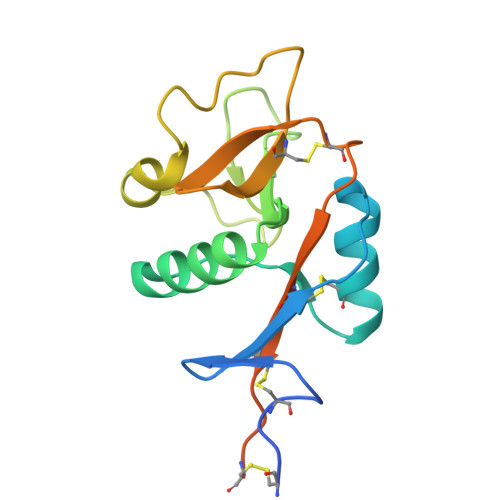
Crystal Structure of DC-SIGN in complex with JXH1902


Experimental Data Snapshot

  • Method: X-RAY DIFFRACTION
  • Resolution: 2.90 Å
  • R-Value Free: 
    0.254 (Depositor), 0.250 (DCC) 
  • R-Value Work: 
    0.222 (Depositor), 0.225 (DCC) 
  • R-Value Observed: 
    0.224 (Depositor) 

Starting Model: experimental
View more details

wwPDB Validation 3D Report Full Report

Validation slider image for 9EMS

Ligand Structure Quality Assessment 


This is version 1.0 of the entry. See complete history

Literature

Thermodynamics-Guided Design Reveals a Cooperative Hydrogen Bond in DC-SIGN-targeted Glycomimetics.

Nemli, D.D.Jiang, X.Jakob, R.P.Gloder, L.M.Schwardt, O.Rabbani, S.Maier, T.Ernst, B.Cramer, J.

(2024) J Med Chem 67: 13813-13828

  • DOI: https://doi.org/10.1021/acs.jmedchem.4c00623
  • Primary Citation Related Structures: 
    9EMQ, 9EMR, 9EMS

  • PubMed Abstract: 

    Due to the shallow and hydrophilic binding sites of carbohydrate-binding proteins, the design of glycomimetics is often complicated by high desolvation costs as well as competition with solvent. Therefore, a careful optimization of interaction vectors and ligand properties is required in the design and optimization of glycomimetics. Here, we employ thermodynamics-guided design to optimize mannose-based glycomimetics targeting the human C-type lectin receptor dendritic cell-specific intercellular adhesion molecule 3 grabbing nonintegrin (DC-SIGN), a pathogenic host factor in viral infections. By exploring ligand rigidification and hydrogen bond engineering, a monovalent glycomimetic with an unprecedented affinity for DC-SIGN in the low μM range was discovered. A matched molecular pair analysis based on microcalorimetric data revealed a stereospecific hydrogen bond interaction with Glu358/Ser360 as the origin of this cooperative and enthalpically dominated interaction. This detailed insight into the binding mechanism paves the way for an improvement of monovalent glycomimetics targeting DC-SIGN.


  • Organizational Affiliation
    • Institute for Pharmaceutical and Medicinal Chemistry, Heinrich-Heine-University Düsseldorf, Universitätsstraße 1, Düsseldorf 40225, Germany.

Macromolecule Content 

  • Total Structure Weight: 18.62 kDa 
  • Atom Count: 1,114 
  • Modeled Residue Count: 132 
  • Deposited Residue Count: 159 
  • Unique protein chains: 1

Macromolecules

Find similar proteins by:|  3D Structure
Entity ID: 1
MoleculeChains  Sequence LengthOrganismDetailsImage
DC-SIGN, CRD domain159Homo sapiensMutation(s): 0 
Gene Names: CD209CLEC4L
UniProt & NIH Common Fund Data Resources
Find proteins for Q9NNX6 (Homo sapiens)
Explore Q9NNX6 
Go to UniProtKB:  Q9NNX6
PHAROS:  Q9NNX6
GTEx:  ENSG00000090659 
Entity Groups
Sequence Clusters30% Identity50% Identity70% Identity90% Identity95% Identity100% Identity
UniProt GroupQ9NNX6
Sequence Annotations
Expand
Reference Sequence

Small Molecules

Experimental Data & Validation

Experimental Data

  • Method: X-RAY DIFFRACTION
  • Resolution: 2.90 Å
  • R-Value Free:  0.254 (Depositor), 0.250 (DCC) 
  • R-Value Work:  0.222 (Depositor), 0.225 (DCC) 
  • R-Value Observed: 0.224 (Depositor) 
Space Group: P 43 21 2
Unit Cell:
Length ( Å )Angle ( ˚ )
a = 74.901α = 90
b = 74.901β = 90
c = 61.146γ = 90
Software Package:
Software NamePurpose
PHENIXrefinement
XDSdata reduction
Aimlessdata scaling
PHASERphasing

Structure Validation

View Full Validation Report


Ligand Structure Quality Assessment 


Entry History 

& Funding Information

Deposition Data


Funding OrganizationLocationGrant Number
German Research Foundation (DFG)Germany532758733

Revision History  (Full details and data files)

  • Version 1.0: 2024-11-13
    Type: Initial release