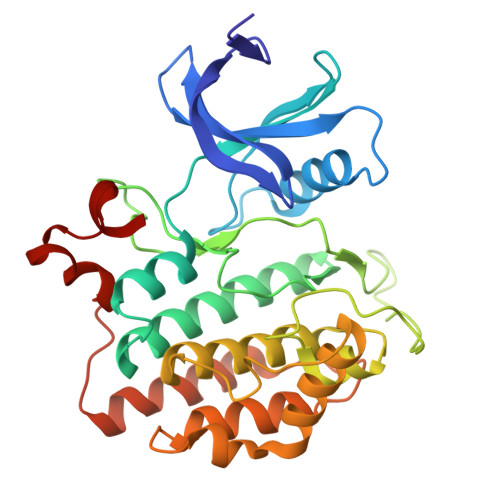
9EDX | pdb_00009edx

Crystal structure of Yck2 from Candida albicans in complex with inhibitor 2a: 2-(4-fluorophenyl)-3-(pyridin-4-yl)pyrazolo[1,5-a]pyridine-6-carbonitrile


Experimental Data Snapshot

  • Method: X-RAY DIFFRACTION
  • Resolution: 2.03 Å
  • R-Value Free: 
    0.239 (Depositor), 0.238 (DCC) 
  • R-Value Work: 
    0.216 (Depositor), 0.216 (DCC) 
  • R-Value Observed: 
    0.217 (Depositor) 

Starting Model: experimental
View more details

wwPDB Validation 3D Report Full Report

Validation slider image for 9EDX

Ligand Structure Quality Assessment 


This is version 1.1 of the entry. See complete history

Literature

Structure-guided optimization of small molecules targeting Yck2 as a strategy to combat Candida albicans.

Puumala, E.Nandakumar, M.Yiu, B.Stogios, P.J.Strickland, B.G.Zarnowski, R.Wang, X.Williams, N.S.Savchenko, A.Andes, D.R.Robbins, N.Whitesell, L.Willson, T.M.Cowen, L.E.

(2025) Nat Commun 16: 2156-2156

  • DOI: https://doi.org/10.1038/s41467-025-57346-z
  • Primary Citation Related Structures: 
    9EDV, 9EDW, 9EDX, 9EDY

  • PubMed Abstract: 

    Candida albicans is the most common cause of life-threatening fungal infection in the developed world but remains a therapeutic challenge. Protein kinases have been rewarding drug targets across diverse indications but remain untapped for antifungal development. Previously, screening kinase inhibitors against C. albicans revealed a 2,3-aryl-pyrazolopyridine, GW461484A (GW), which targets casein kinase 1 (CK1) family member Yck2. Here, we report optimization of GW via two complementary approaches, synthesis of bioisosteres possessing an imidazo[1,2-a]pyridine core, and R-group substitution of GW's pyrazolo[1,5-a]pyridine core. Characterization of compounds reveals two 6-cyano derivatives with improved pharmacological properties that retain whole-cell bioactivity and selectivity for fungal Yck2 compared to human CK1α. Efficacy studies in mice indicate both analogs possess single-agent activity against C. albicans resistant to first-line echinocandin antifungals and potentiate non-curative echinocandin treatment. Results validate Yck2 as an antifungal target and encourage further development of inhibitors acting by this previously unexploited mode of action.


  • Organizational Affiliation
    • Department of Molecular Genetics, University of Toronto, Toronto, ON, Canada.

Macromolecule Content 

  • Total Structure Weight: 35.78 kDa 
  • Atom Count: 2,572 
  • Modeled Residue Count: 306 
  • Deposited Residue Count: 309 
  • Unique protein chains: 1

Macromolecules

Find similar proteins by:|  3D Structure
Entity ID: 1
MoleculeChains  Sequence LengthOrganismDetailsImage
non-specific serine/threonine protein kinase309Candida albicansMutation(s): 0 
Gene Names: FOB64_000203
EC: 2.7.11.1
UniProt
Find proteins for A0A1D8PKB4 (Candida albicans (strain SC5314 / ATCC MYA-2876))
Explore A0A1D8PKB4 
Go to UniProtKB:  A0A1D8PKB4
Entity Groups
Sequence Clusters30% Identity50% Identity70% Identity90% Identity95% Identity100% Identity
UniProt GroupA0A1D8PKB4
Sequence Annotations
Expand
Reference Sequence

Experimental Data & Validation

Experimental Data

  • Method: X-RAY DIFFRACTION
  • Resolution: 2.03 Å
  • R-Value Free:  0.239 (Depositor), 0.238 (DCC) 
  • R-Value Work:  0.216 (Depositor), 0.216 (DCC) 
  • R-Value Observed: 0.217 (Depositor) 
Space Group: H 3
Unit Cell:
Length ( Å )Angle ( ˚ )
a = 91.71α = 90
b = 91.71β = 90
c = 118.95γ = 120
Software Package:
Software NamePurpose
PHENIXrefinement
xia2data reduction
xia2data scaling
PHENIXphasing

Structure Validation

View Full Validation Report


Ligand Structure Quality Assessment 


Entry History 

& Funding Information

Deposition Data


Funding OrganizationLocationGrant Number
National Institutes of Health/National Institute Of Allergy and Infectious Diseases (NIH/NIAID)United States75N93022C00035

Revision History  (Full details and data files)

  • Version 1.0: 2025-01-08
    Type: Initial release
  • Version 1.1: 2025-09-24
    Changes: Database references