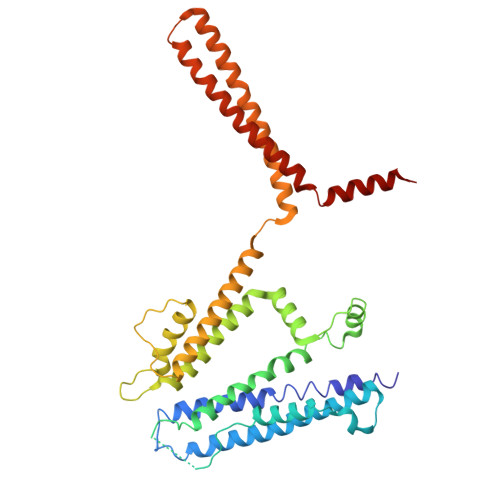
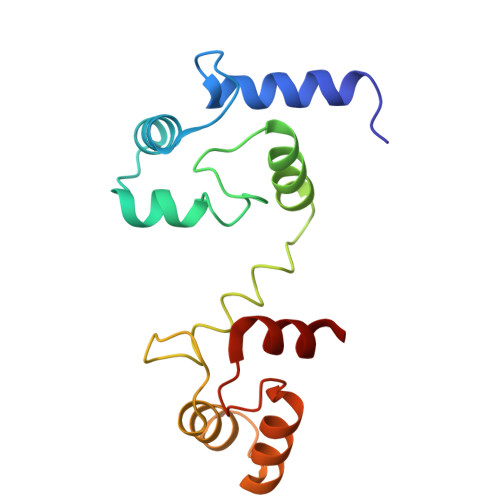
9ED1 | pdb_00009ed1

Cryo-EM structure of the human KCa3.1/calmodulin channel in complex with Ca2+ and 1,4-dihydropyridine (DHP-103)


Experimental Data Snapshot

  • Method: ELECTRON MICROSCOPY
  • Resolution: 3.50 Å
  • Aggregation State: PARTICLE 
  • Reconstruction Method: SINGLE PARTICLE 

wwPDB Validation 3D Report Full Report

Validation slider image for 9ED1

This is version 1.1 of the entry. See complete history

Literature

Design and structural basis of selective 1,4-dihydropyridine inhibitors of the calcium-activated potassium channel K Ca 3.1.

Ong, S.T.Nam, Y.W.Nasburg, J.A.Ramanishka, A.Ng, X.R.Zhuang, Z.Goay, S.S.M.Nguyen, H.M.Singh, L.Singh, V.Rivera, A.Eyster, M.E.Xu, Y.Alper, S.L.Wulff, H.Zhang, M.Chandy, K.G.

(2025) Proc Natl Acad Sci U S A 122: e2425494122-e2425494122

  • DOI: https://doi.org/10.1073/pnas.2425494122
  • Primary Citation Related Structures: 
    9ED1

  • PubMed Abstract: 

    The 1,4-dihydropyridines, drugs with well-established bioavailability and toxicity profiles, have proven efficacy in treating human hypertension, peripheral vascular disorders, and coronary artery disease. Every 1,4-dihydropyridine in clinical use blocks L-type voltage-gated calcium channels. We now report our development, using selective optimization of a side activity (SOSA), of a class of 1,4-dihydropyridines that selectively and potently inhibit the intermediate-conductance calcium-activated K + channel K Ca 3.1, a validated therapeutic target for diseases affecting many organ systems. One of these 1,4-dihydropyridines, DHP-103, blocked K Ca 3.1 with an IC 50 of 6 nM and exhibited exquisite selectivity over calcium channels and a panel of >100 additional molecular targets. Using high-resolution structure determination by cryogenic electron microscopy together with mutagenesis and electrophysiology, we delineated the drug binding pocket for DHP-103 within the water-filled central cavity of the K Ca 3.1 channel pore, where bound drug directly impedes ion permeation. DHP-103 inhibited gain-of-function mutant K Ca 3.1 channels that cause hereditary xerocytosis, suggesting its potential use as a therapeutic for this hemolytic anemia. In a rat model of acute ischemic stroke, the second leading cause of death worldwide, DHP-103 administered 12 h postischemic insult in proof-of-concept studies reduced infarct volume, improved balance beam performance (measure of proprioception) and decreased numbers of activated microglia in infarcted areas. K Ca 3.1-selective 1,4-dihydropyridines hold promise for the many diseases for which K Ca 3.1 has been experimentally confirmed as a therapeutic target.


  • Organizational Affiliation
    • Lee Kong Chian School of Medicine-Innovative CRO Explorer Collaborative Platform, Lee Kong Chian School of Medicine, Nanyang Technological University, Singapore 636921, Singapore.

Macromolecule Content 

  • Total Structure Weight: 236.69 kDa 
  • Atom Count: 15,449 
  • Modeled Residue Count: 2,020 
  • Deposited Residue Count: 2,092 
  • Unique protein chains: 2

Macromolecules

Find similar proteins by:|  3D Structure
Entity ID: 1
MoleculeChains  Sequence LengthOrganismDetailsImage
Intermediate conductance calcium-activated potassium channel protein 4
A, B, C, D
378Homo sapiensMutation(s): 0 
Gene Names: KCNN4IK1IKCA1KCA4SK4
Membrane Entity: Yes 
UniProt & NIH Common Fund Data Resources
Find proteins for O15554 (Homo sapiens)
Explore O15554 
Go to UniProtKB:  O15554
PHAROS:  O15554
GTEx:  ENSG00000104783 
Entity Groups
Sequence Clusters30% Identity50% Identity70% Identity90% Identity95% Identity100% Identity
UniProt GroupO15554
Sequence Annotations
Expand
Reference Sequence
Find similar proteins by:|  3D Structure
Entity ID: 2
MoleculeChains  Sequence LengthOrganismDetailsImage
Calmodulin-1
E, F, G, H
145Rattus norvegicusMutation(s): 0 
Gene Names: Calm1CalmCamCam1CaMI
UniProt
Find proteins for P0DP29 (Rattus norvegicus)
Explore P0DP29 
Go to UniProtKB:  P0DP29
Entity Groups
Sequence Clusters30% Identity50% Identity70% Identity90% Identity95% Identity100% Identity
UniProt GroupP0DP29
Sequence Annotations
Expand
Reference Sequence

Small Molecules

Ligands 2 Unique
IDChains Name / Formula / InChI Key2D Diagram3D Interactions
CA
(Subject of Investigation/LOI)

Query on CA


Download:Ideal Coordinates CCD File
N [auth E]
O [auth E]
P [auth E]
Q [auth F]
R [auth F]
N [auth E],
O [auth E],
P [auth E],
Q [auth F],
R [auth F],
S [auth F],
T [auth G],
U [auth G],
V [auth G],
W [auth H],
X [auth H],
Y [auth H]
CALCIUM ION
Ca
BHPQYMZQTOCNFJ-UHFFFAOYSA-N
K
(Subject of Investigation/LOI)

Query on K


Download:Ideal Coordinates CCD File
I [auth A],
J [auth A],
K [auth A],
L [auth B],
M [auth B]
POTASSIUM ION
K
NPYPAHLBTDXSSS-UHFFFAOYSA-N

Experimental Data & Validation

Experimental Data

  • Method: ELECTRON MICROSCOPY
  • Resolution: 3.50 Å
  • Aggregation State: PARTICLE 
  • Reconstruction Method: SINGLE PARTICLE 
EM Software:
TaskSoftware PackageVersion
MODEL REFINEMENTPHENIX1.21.1

Structure Validation

View Full Validation Report


Entry History 

& Funding Information

Deposition Data


Funding OrganizationLocationGrant Number
National Institutes of Health/National Institute of Neurological Disorders and Stroke (NIH/NINDS)United States4R33 NS101182-03
National Institutes of Health/National Institute of Neurological Disorders and Stroke (NIH/NINDS)United States1R15 NS130420-01A1
American Heart AssociationUnited States23AIREA1039423
American Heart AssociationUnited States24CDA1260237

Revision History  (Full details and data files)

  • Version 1.0: 2025-04-16
    Type: Initial release
  • Version 1.1: 2025-05-07
    Changes: Data collection, Database references