9EBW | pdb_00009ebw

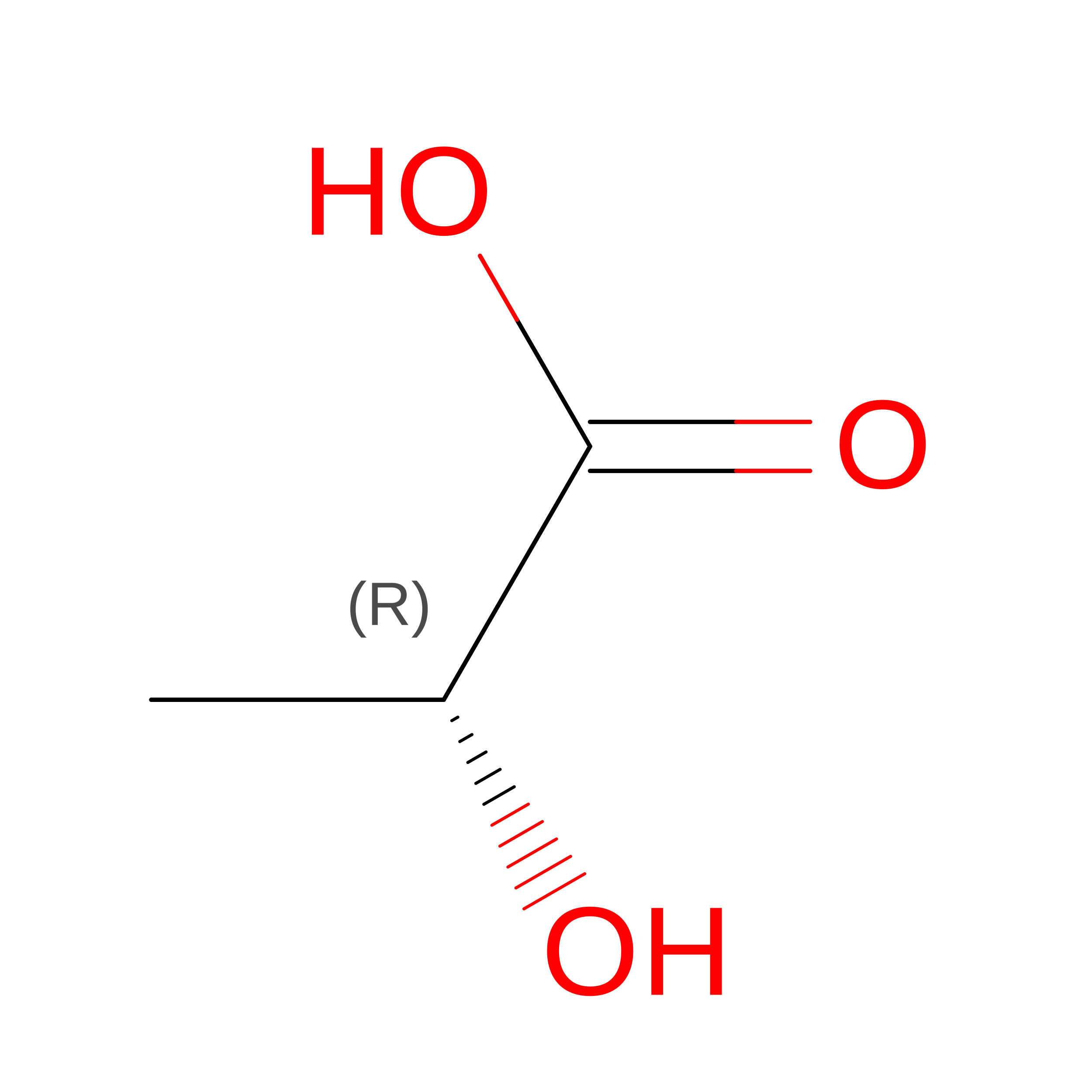
Chimeric fluorescence biosensor formed from a lactate-binding protein and GFP, bound to lactate


Experimental Data Snapshot

  • Method: X-RAY DIFFRACTION
  • Resolution: 2.78 Å
  • R-Value Free: 
    0.285 (Depositor), 0.287 (DCC) 
  • R-Value Work: 
    0.242 (Depositor), 0.243 (DCC) 
  • R-Value Observed: 
    0.244 (Depositor) 

Starting Models: experimental
View more details

wwPDB Validation 3D Report Full Report

Validation slider image for 9EBW

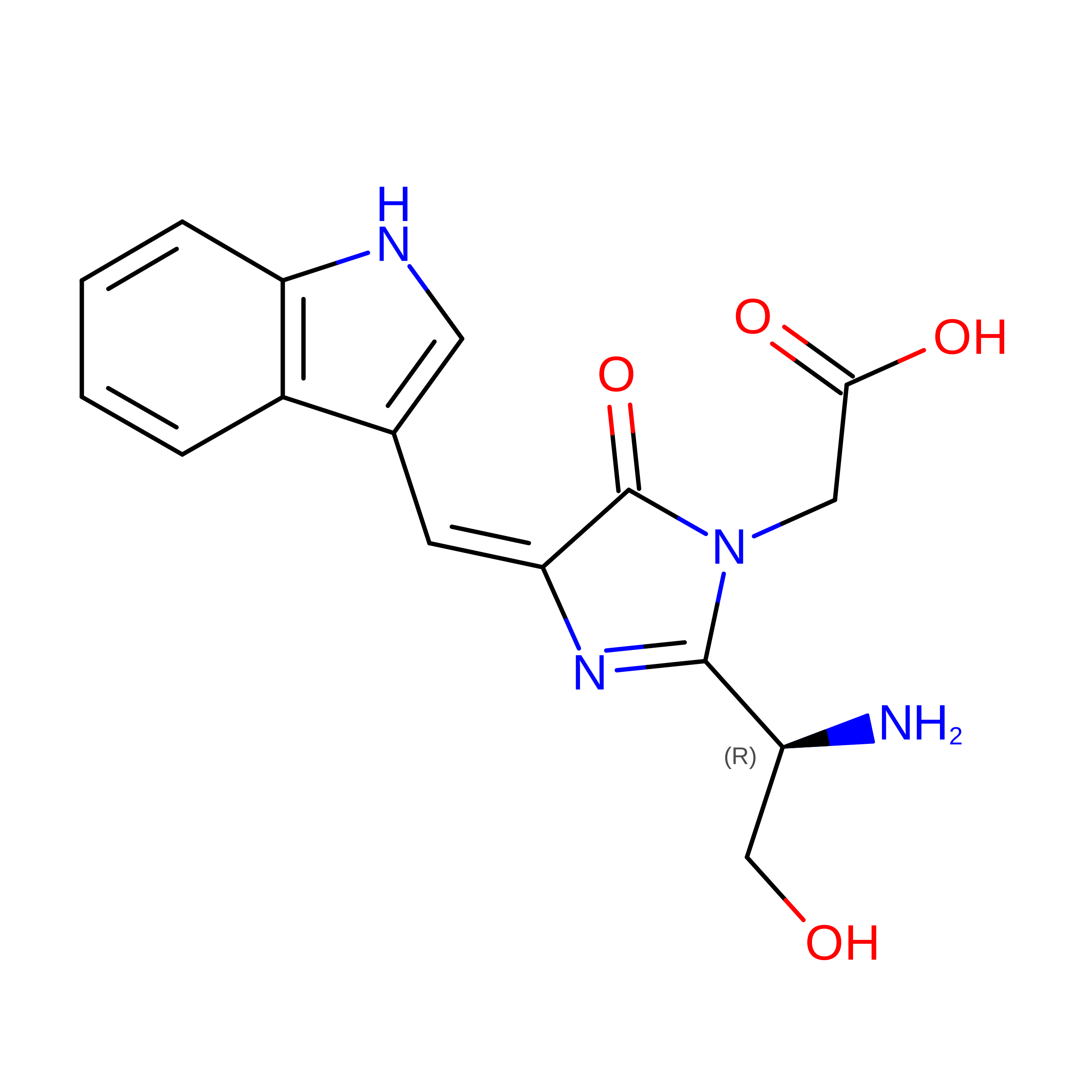
Ligand Structure Quality Assessment 


This is version 2.0 of the entry. See complete history

Literature

State-dependent motion of a genetically encoded fluorescent biosensor.

Rosen, P.C.Horwitz, S.M.Brooks, D.J.Kim, E.Ambarian, J.A.Waidmann, L.Davis, K.M.Yellen, G.

(2025) Proc Natl Acad Sci U S A 122: e2426324122-e2426324122

  • DOI: https://doi.org/10.1073/pnas.2426324122
  • Primary Citation Related Structures: 
    9EBW, 9EBX

  • PubMed Abstract: 

    Genetically encoded biosensors can measure biochemical properties such as small-molecule concentrations with single-cell resolution, even in vivo. Despite their utility, these sensors are "black boxes": Very little is known about the structures of their low- and high-fluorescence states or what features are required to transition between them. We used LiLac, a lactate biosensor with a quantitative fluorescence-lifetime readout, as a model system to address these questions. X-ray crystal structures and engineered high-affinity metal bridges demonstrate that LiLac exhibits a large interdomain twist motion that pulls the fluorescent protein away from a "sealed," high-lifetime state in the absence of lactate to a "cracked," low-lifetime state in its presence. Understanding the structures and dynamics of LiLac will help to think about and engineer other fluorescent biosensors.


  • Organizational Affiliation
    • Department of Neurobiology, Harvard Medical School, Boston, MA 02115.

Macromolecule Content 

  • Total Structure Weight: 234.13 kDa 
  • Atom Count: 14,710 
  • Modeled Residue Count: 1,923 
  • Deposited Residue Count: 2,060 
  • Unique protein chains: 1

Macromolecules

Find similar proteins by:|  3D Structure
Entity ID: 1
MoleculeChains  Sequence LengthOrganismDetailsImage
Green fluorescent protein,Methyl-accepting chemotaxis transducer (TlpC)
A, B, C, D
515Aequorea victoriaHelicobacter pylori 26695Mutation(s): 1 
Gene Names: GFPHP_0082
UniProt
Find proteins for O24911 (Helicobacter pylori (strain ATCC 700392 / 26695))
Explore O24911 
Go to UniProtKB:  O24911
Entity Groups
Sequence Clusters30% Identity50% Identity70% Identity90% Identity95% Identity100% Identity
UniProt GroupO24911
Sequence Annotations
Expand
Reference Sequence

Experimental Data & Validation

Experimental Data

  • Method: X-RAY DIFFRACTION
  • Resolution: 2.78 Å
  • R-Value Free:  0.285 (Depositor), 0.287 (DCC) 
  • R-Value Work:  0.242 (Depositor), 0.243 (DCC) 
  • R-Value Observed: 0.244 (Depositor) 
Space Group: P 1 21 1
Unit Cell:
Length ( Å )Angle ( ˚ )
a = 90.878α = 90
b = 109.803β = 110.14
c = 123.711γ = 90
Software Package:
Software NamePurpose
PHENIXrefinement
XDSdata reduction
Aimlessdata scaling
PHASERphasing

Structure Validation

View Full Validation Report


Ligand Structure Quality Assessment 


Entry History 

& Funding Information

Deposition Data


Funding OrganizationLocationGrant Number
National Institutes of Health/National Center for Research Resources (NIH/NCRR)United StatesR01GM124038
National Institutes of Health/National Center for Research Resources (NIH/NCRR)United StatesF31CA254162
National Science Foundation (NSF, United States)United States1937971

Revision History  (Full details and data files)

  • Version 1.0: 2025-03-19
    Type: Initial release
  • Version 2.0: 2026-03-18
    Changes: Polymer sequence