Download Mendeley
A Covalent Allosteric Molecular Glue Suppresses NRF2-Dependent Cancer Growth.
Roy, N., Wyseure, T., Lo, I.C., Lu, J., Eissler, C.L., Bernard, S.M., Bok, I., Snead, A.N., Parker, A., Lo, U.G., Green, J.C., Inloes, J., Jacinto, S.R., Kuenzi, B., Pariollaud, M., Negri, K., Le, K., Horning, B.D., Ibrahim, N., Grabow, S., Panda, H., Bhatt, D.P., Wilkerson, E.M., Saeidi, S., Zolkind, P., Rush, Z., Williams, H.N., Walton, E., Pastuszka, M.K., Sigler, J.J., Tran, E., Hee, K., McLaughlin, J., Ambrus-Aikelin, G., Pollock, J., Abraham, R.T., Kinsella, T.M., Simon, G.M., Major, M.B., Weinstein, D.S., Patricelli, M.P.(2026) Cancer Discov 16: 953-975
- PubMed: 41417010 Search on PubMed
- DOI: https://doi.org/10.1158/2159-8290.CD-25-1187
- Primary Citation Related Structures:
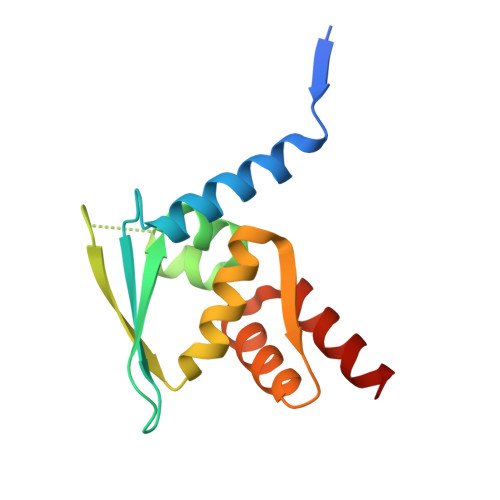
9DU7 - PubMed Abstract:
The NRF2 transcription factor is constitutively active in cancer where it functions to maintain oxidative homeostasis and reprogram cellular metabolism. NRF2-active tumors exhibit NRF2-dependency and resistance to chemo/radiotherapy. Here we characterize VVD-065, a first-in-class NRF2 inhibitor that acts via an unprecedented allosteric molecular glue mechanism. In the absence of stress or mutation, NRF2 is rapidly degraded by the KEAP1-CUL3 ubiquitin-ligase complex. VVD-065 specifically and covalently engages Cys151 on KEAP1, which in turn promotes KEAP1-CUL3 complex formation, leading to enhancement of NRF2 degradation. Previously reported Cys151-directed compounds decrease KEAP1-CUL3 interactions and stabilize NRF2, thus establishing KEAP1_Cys151 as a tunable regulator of the KEAP1-CUL3 complex and NRF2 stability. VVD-065 inhibited NRF2-dependent tumor growth and sensitized cancers to chemo/radiotherapy, supporting an open Phase I clinical trial (NCT05954312).
- Vividion Therapeutics (United States) San Diego United States.
Organizational Affiliation: