9DIE | pdb_00009die

Structure of phospholipase D BetaIB1i from Sicarius terrosus venom, H47N mutant bound to product and substrate sphingolipids at 1.85 A resolution


Experimental Data Snapshot

  • Method: X-RAY DIFFRACTION
  • Resolution: 1.85 Å
  • R-Value Free: 
    0.167 (Depositor), 0.178 (DCC) 
  • R-Value Work: 
    0.119 (Depositor), 0.149 (DCC) 
  • R-Value Observed: 
    0.121 (Depositor) 

Starting Model: experimental
View more details

wwPDB Validation 3D Report Full Report

Validation slider image for 9DIE

Ligand Structure Quality Assessment 


This is version 1.1 of the entry. See complete history

Literature

Spider venom phospholipase D toxin structure: Interfacial binding site, mechanism, activation, and head group preference.

Sundman, A.K.Binford, G.J.Montfort, W.R.Cordes, M.H.J.

(2026) Proc Natl Acad Sci U S A 123: e2513997123-e2513997123

  • DOI: https://doi.org/10.1073/pnas.2513997123
  • Primary Citation Related Structures: 
    9DIE, 9OZO, 9OZS

  • PubMed Abstract: 

    Envenomation by sicariid spiders such as the brown recluse can cause loxoscelism, a syndrome involving localized dermonecrosis and/or systemic effects like hemolysis. The causative venom toxins are unusual interfacial phospholipase D enzymes that cyclize sphingolipid and lysophospholipid substrates when bound to membrane surfaces. Crystal structures of several of these toxins have been reported, but none of them directly illuminates how lipids bind in the active site and at the interfacial binding site (IBS); indeed, as a general rule the lipid interfaces of peripheral membrane proteins resist crystallographic determination. Here, however, we report X-ray crystal structures at 1.85 to 2.6 Å resolution of a venom toxin from the Chilean six-eyed sand spider Sicarius levii (terrosus) bound to a micelle-like agglomeration of product and substrate sphingolipids. Each enzyme subunit binds three sphingolipid molecules, one in the active site and two at adjacent noncatalytic sites, generating an interface that approximates the IBS predicted by molecular dynamics. The conformations of substrate and cyclic product in the active site definitively confirm our previously proposed catalytic mechanism. Comparisons with lipid-free structures show conformational changes in two loops that suggest a mechanism for allosteric/surface activation. Docking studies suggest that the variable preference of these toxins for phosphocholine and phosphoethanolamine head groups involves subtle changes in size and shape of the active-site pocket. The structures reveal key facets of the molecular basis of loxoscelism and show that in favorable cases crystallography can illuminate the IBS of peripheral membrane proteins.


  • Organizational Affiliation
    • Department of Chemistry and Biochemistry, University of Arizona, Tucson, AZ 85701.

Macromolecule Content 

  • Total Structure Weight: 72.32 kDa 
  • Atom Count: 5,866 
  • Modeled Residue Count: 556 
  • Deposited Residue Count: 602 
  • Unique protein chains: 1

Macromolecules

Find similar proteins by:|  3D Structure
Entity ID: 1
MoleculeChains  Sequence LengthOrganismDetailsImage
Dermonecrotic toxin StSicTox-betaIB1i
A, B
301Sicarius terrosusMutation(s): 1 
EC: 4.6.1
UniProt
Find proteins for A0A0D4WV12 (Sicarius terrosus)
Explore A0A0D4WV12 
Go to UniProtKB:  A0A0D4WV12
Entity Groups
Sequence Clusters30% Identity50% Identity70% Identity90% Identity95% Identity100% Identity
UniProt GroupA0A0D4WV12
Sequence Annotations
Expand
Reference Sequence

Small Molecules

Ligands 5 Unique
IDChains Name / Formula / InChI Key2D Diagram3D Interactions
A1A43
(Subject of Investigation/LOI)

Query on A1A43


Download:Ideal Coordinates CCD File
C [auth A],
D [auth A],
K [auth B],
L [auth B]
2-aminoethyl (2S,3R,4E)-2-dodecanamido-3-hydroxyheptadec-4-en-1-yl hydrogen (S)-phosphate
C31 H63 N2 O6 P
ZIEWVPJUBVRCAL-DQBIDPIGSA-N
A1A44
(Subject of Investigation/LOI)

Query on A1A44


Download:Ideal Coordinates CCD File
E [auth A],
M [auth B]
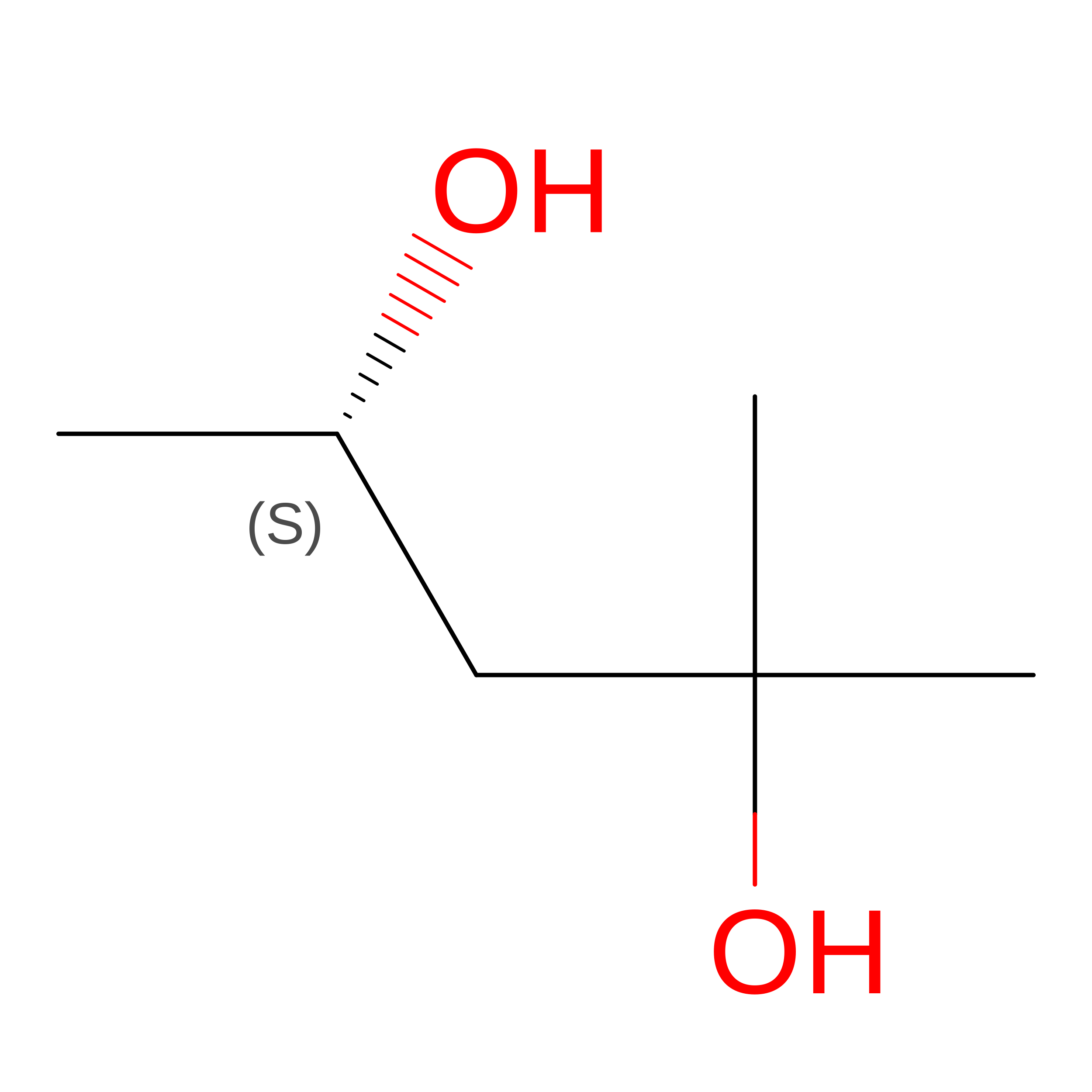
N-{(2S,4R,5S)-2-hydroxy-2-oxo-4-[(1E,7Z)-tetradeca-1,7-dien-1-yl]-1,3,2lambda~5~-dioxaphosphinan-5-yl}dodecanamide
C29 H56 N O5 P
WCWADZSYRHRKHD-LVDQGNEYSA-N
MPD

Query on MPD


Download:Ideal Coordinates CCD File
I [auth A],
J [auth A]
(4S)-2-METHYL-2,4-PENTANEDIOL
C6 H14 O2
SVTBMSDMJJWYQN-YFKPBYRVSA-N
MG

Query on MG


Download:Ideal Coordinates CCD File
H [auth A],
P [auth B]
MAGNESIUM ION
Mg
JLVVSXFLKOJNIY-UHFFFAOYSA-N
NA

Query on NA


Download:Ideal Coordinates CCD File
F [auth A],
G [auth A],
N [auth B],
O [auth B]
SODIUM ION
Na
FKNQFGJONOIPTF-UHFFFAOYSA-N

Experimental Data & Validation

Experimental Data

  • Method: X-RAY DIFFRACTION
  • Resolution: 1.85 Å
  • R-Value Free:  0.167 (Depositor), 0.178 (DCC) 
  • R-Value Work:  0.119 (Depositor), 0.149 (DCC) 
  • R-Value Observed: 0.121 (Depositor) 
Space Group: I 1 2 1
Unit Cell:
Length ( Å )Angle ( ˚ )
a = 79.999α = 90
b = 105.327β = 93.83
c = 108.406γ = 90
Software Package:
Software NamePurpose
REFMACrefinement
Aimlessdata scaling
PROTEUM2data reduction
MOLREPphasing

Structure Validation

View Full Validation Report


Ligand Structure Quality Assessment 


Entry History 

& Funding Information

Deposition Data


Funding OrganizationLocationGrant Number
National Science Foundation (NSF, United States)United StatesCHE-1808716

Revision History  (Full details and data files)

  • Version 1.0: 2025-09-10
    Type: Initial release
  • Version 1.1: 2026-06-24
    Changes: Database references