9D8V | pdb_00009d8v

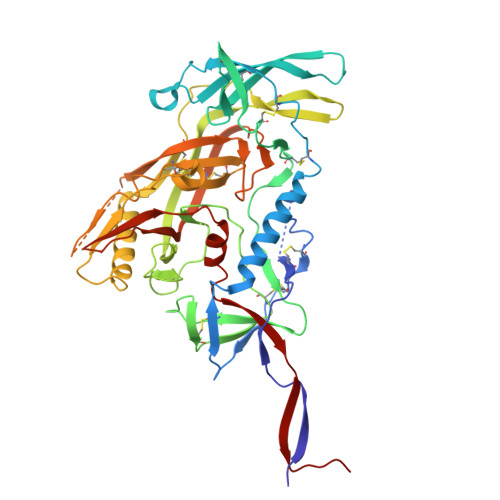
Cryo-EM structure of the BG505 SOSIPv2


Experimental Data Snapshot

  • Method: ELECTRON MICROSCOPY
  • Resolution: 2.90 Å
  • Aggregation State: PARTICLE 
  • Reconstruction Method: SINGLE PARTICLE 

Starting Model: experimental
View more details

wwPDB Validation 3D Report Full Report

Validation slider image for 9D8V

This is version 1.2 of the entry. See complete history. 

Literature

Profiling of HIV-1 elite neutralizer cohort reveals a CD4bs bnAb for HIV-1 prevention and therapy.

Gieselmann, L., DeLaitsch, A.T., Rohde, M., Gruell, H., Kreer, C., Ercanoglu, M.S., Gristick, H.B., Schommers, P., Ahmadov, E., Radford, C., Mazzolini, A., Zhang, L., West Jr., A.P., Worczinski, J., Momot, A., Reichwein, M.L., Knufer, J., Stumpf, R., Mkhize, N.N., Kaldine, H., Bhebhe, S., Deshpande, S., Giovannoni, F., Stefanutti, E., Benigni, F., Havenar-Daughton, C., Corti, D., Kroidl, A., Adhikari, A., Nanfack, A.J., Ambada, G.E., Duerr, R., Maganga, L., William, W., Ntinginya, N.E., Wolf, T., Geldmacher, C., Hoelscher, M., Lehmann, C., Moore, P.L., Mora, T., Walczak, A.M., Gilbert, P.B., Doria-Rose, N.A., Huang, Y., Bloom, J.D., Seaman, M.S., Bjorkman, P.J., Klein, F.

(2025) Nat Immunol 26: 2016-2029

  • DOI: https://doi.org/10.1038/s41590-025-02286-5
  • Primary Citation Related Structures: 
    8UKI, 8ULR, 8ULS, 8ULT, 8ULU, 9D8V

  • PubMed Abstract: 

    Administration of HIV-1 neutralizing antibodies can suppress viremia and prevent infection in vivo. However, clinical use is challenged by envelope diversity and rapid viral escape. Here, we performed single B cell profiling of 32 top HIV-1 elite neutralizers to identify broadly neutralizing antibodies with highest antiviral activity. From 831 expressed monoclonal antibodies, we identified 04_A06, a V H 1-2-encoded broadly neutralizing antibody to the CD4 binding site with remarkable breadth and potency against multiclade pseudovirus panels (geometric mean half-maximal inhibitory concentration = 0.059 µg ml -1 , breadth = 98.5%, 332 strains). Moreover, 04_A06 was not susceptible to classic CD4 binding site escape variants and maintained full viral suppression in HIV-1-infected humanized mice. Structural analyses revealed an unusually long 11-amino-acid heavy chain insertion that facilitates interprotomer contacts with highly conserved residues on the adjacent gp120 protomer. Finally, 04_A06 demonstrated high activity against contemporaneously circulating viruses from the Antibody-Mediated Prevention trials (geometric mean half-maximal inhibitory concentration = 0.082 µg ml -1 , breadth = 98.4%, 191 virus strains), and in silico modeling for 04_A06LS predicted prevention efficacy of >93%. Thus, 04_A06 will provide unique opportunities for effective treatment and prevention of HIV-1 infection.


  • Organizational Affiliation: 
    • Laboratory of Experimental Immunology, Institute of Virology, Faculty of Medicine and University Hospital Cologne, University of Cologne, Cologne, Germany.

Macromolecule Content 

  • Total Structure Weight: 221.43 kDa 
  • Atom Count: 14,219 
  • Modeled Residue Count: 1,692 
  • Deposited Residue Count: 1,848 
  • Unique protein chains: 2

Macromolecules

Find similar proteins by:|  3D Structure
Entity ID: 1
MoleculeChains  Sequence LengthOrganismDetailsImage
BG505 SOSIP gp120
A, C, E
470Human immunodeficiency virus 1Mutation(s): 0 
Gene Names: env
UniProt
Find proteins for Q2N0S6 (Human immunodeficiency virus type 1)
Explore Q2N0S6 
Go to UniProtKB:  Q2N0S6
Entity Groups
Sequence Clusters30% Identity50% Identity70% Identity90% Identity95% Identity100% Identity
UniProt GroupQ2N0S6
Glycosylation
Glycosylation Sites: 15
Sequence Annotations
Expand
Reference Sequence
Find similar proteins by:|  3D Structure
Entity ID: 2
MoleculeChains  Sequence LengthOrganismDetailsImage
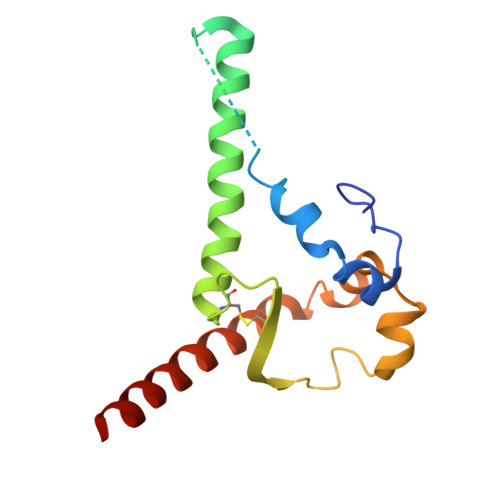
BG505 SOSIP gp41
B, D, F
146Human immunodeficiency virus 1Mutation(s): 0 
Gene Names: env
UniProt
Find proteins for A0ABF7PQ88 (Human immunodeficiency virus type 1)
Explore A0ABF7PQ88 
Go to UniProtKB:  A0ABF7PQ88
Entity Groups
Sequence Clusters30% Identity50% Identity70% Identity90% Identity95% Identity100% Identity
UniProt GroupA0ABF7PQ88
Sequence Annotations
Expand
Reference Sequence

Oligosaccharides

Help  
Entity ID: 3
MoleculeChains Length2D Diagram GlycosylationD Interactions
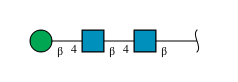
beta-D-mannopyranose-(1-4)-2-acetamido-2-deoxy-beta-D-glucopyranose-(1-4)-2-acetamido-2-deoxy-beta-D-glucopyranose
G, L, V
3N-Glycosylation
Glycosylation Resources
GlyTouCan: G15407YE
GlyCosmos: G15407YE
GlyGen: G15407YE
Entity ID: 4
MoleculeChains Length2D Diagram GlycosylationD Interactions
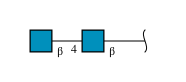
2-acetamido-2-deoxy-beta-D-glucopyranose-(1-4)-2-acetamido-2-deoxy-beta-D-glucopyranose
H, I, J, K, M
H, I, J, K, M, N, O, P, Q, R, S, T, U
2N-Glycosylation
Glycosylation Resources
GlyTouCan: G42666HT
GlyCosmos: G42666HT
GlyGen: G42666HT

Small Molecules

Ligands 1 Unique
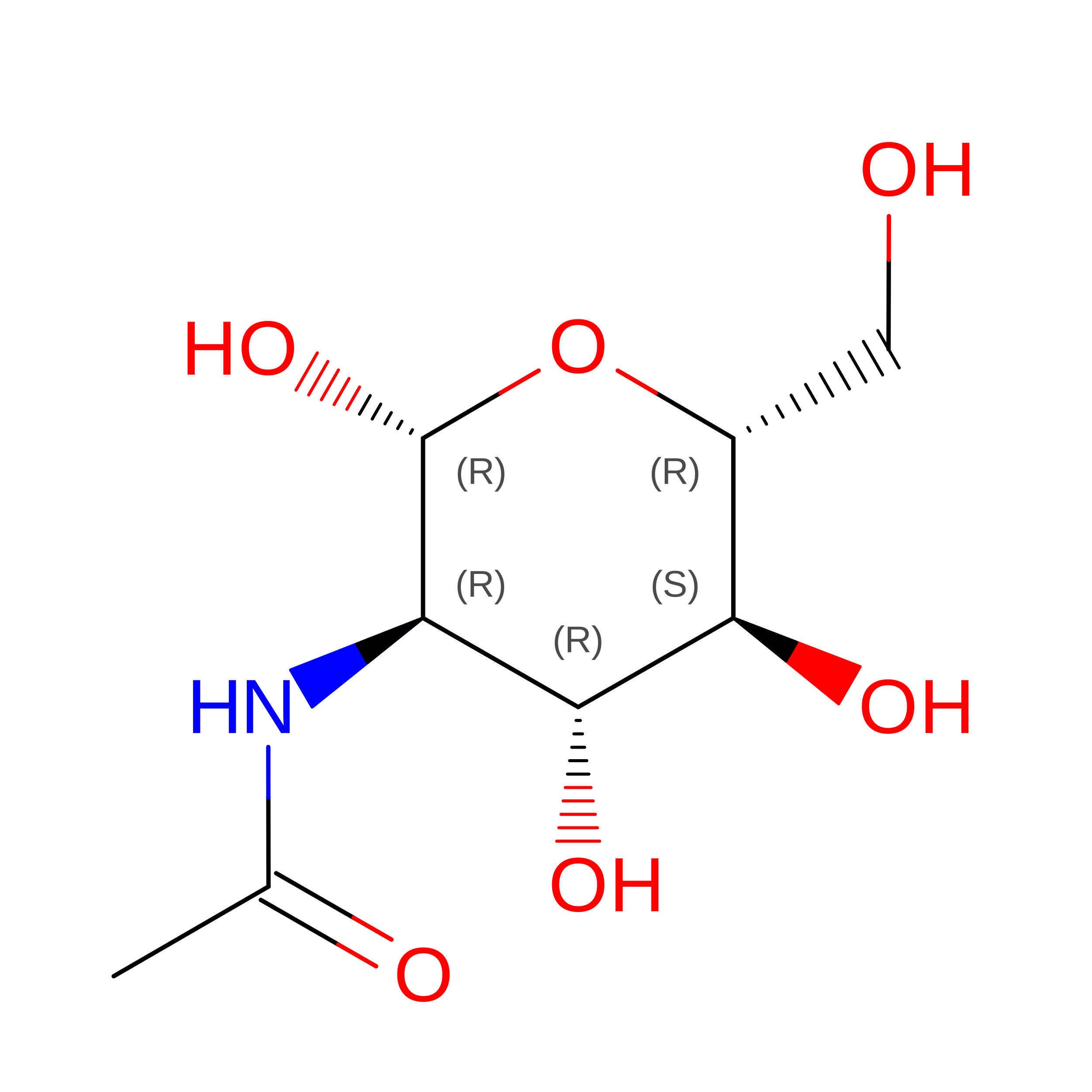
IDChains Name / Formula / InChI Key2D Diagram3D Interactions
NAG

Query on NAG


Download:Ideal Coordinates CCD File
AA [auth A]
BA [auth A]
CA [auth A]
DA [auth A]
EA [auth A]
AA [auth A],
BA [auth A],
CA [auth A],
DA [auth A],
EA [auth A],
FA [auth A],
GA [auth C],
HA [auth C],
IA [auth C],
JA [auth C],
KA [auth C],
LA [auth C],
MA [auth C],
NA [auth C],
OA [auth C],
PA [auth C],
QA [auth E],
RA [auth E],
SA [auth E],
TA [auth E],
UA [auth E],
VA [auth E],
W [auth A],
WA [auth E],
X [auth A],
XA [auth E],
Y [auth A],
YA [auth E],
Z [auth A]
2-acetamido-2-deoxy-beta-D-glucopyranose
C8 H15 N O6
OVRNDRQMDRJTHS-FMDGEEDCSA-N

Experimental Data & Validation

Experimental Data

  • Method: ELECTRON MICROSCOPY
  • Resolution: 2.90 Å
  • Aggregation State: PARTICLE 
  • Reconstruction Method: SINGLE PARTICLE 
EM Software:
TaskSoftware PackageVersion
RECONSTRUCTIONcryoSPARC
MODEL REFINEMENTPHENIX

Structure Validation

View Full Validation Report


Entry History 

& Funding Information

Deposition Data


Funding OrganizationLocationGrant Number
Bill & Melinda Gates FoundationUnited StatesINV-002143

Revision History  (Full details and data files)

  • Version 1.0: 2025-08-20
    Type: Initial release
  • Version 1.1: 2025-10-29
    Changes: Data collection, Database references
  • Version 1.2: 2025-11-12
    Changes: Data collection, Database references