9D21 | pdb_00009d21

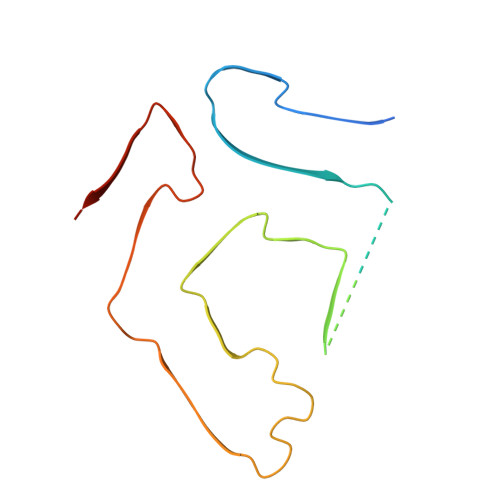
Cryo-EM structure of amyloid fibril extracted from heart of a variant ATTR T60A amyloidosis patient 1

  • Classification: PROTEIN FIBRIL
  • Organism(s): Homo sapiens
  • Mutation(s): Yes 

  • Deposited: 2024-08-08 Released: 2025-08-13 
  • Deposition Author(s): Nguyen, A.B., Fernandez-Ramirez, M.C., Saelices, L.
  • Funding Organization(s): National Institutes of Health/Eunice Kennedy Shriver National Institute of Child Health & Human Development (NIH/NICHD), American Heart Association

Experimental Data Snapshot

  • Method: ELECTRON MICROSCOPY
  • Resolution: 3.40 Å
  • Aggregation State: HELICAL ARRAY 
  • Reconstruction Method: HELICAL 

Starting Model: experimental
View more details

wwPDB Validation 3D Report Full Report

Validation slider image for 9D21

This is version 1.3 of the entry. See complete history

Literature

Structural and molecular homogeneity of ATTRv-T60A amyloid fibrils across patients and organs.

Fernandez-Ramirez, M.D.C.Nguyen, B.A.Afrin, S.Singh, V.Evers, B.Shelton, J.M.Escobar, C.L.Bassett, P.Wang, L.Pekala, M.Ahmed, Y.Cabrera Hernandez, L.O.Pedretti, R.Singh, P.Canepa, J.Wosztyl, A.Li, Y.Boyer, D.R.Cao, Q.Saelices, L.

(2025) Structure 33: 2013-2019.e4

  • DOI: https://doi.org/10.1016/j.str.2025.09.008
  • Primary Citation Related Structures: 
    9D21, 9D23, 9D24, 9D27, 9D2G

  • PubMed Abstract: 

    Transthyretin amyloidosis is a systemic protein misfolding disorder with diverse clinical phenotypes, including cardiomyopathy, polyneuropathy, or a combination of both. While structural polymorphism of amyloid fibrils has been linked to disease heterogeneity in neurodegenerative disorders, its role in transthyretin amyloidosis remains unclear. Here, we used cryo-electron microscopy to analyze ex vivo fibrils extracted from the hearts of three patients carrying the T60A mutation, a variant associated with mixed cardiac and neuropathic symptoms. In one patient, we additionally examined fibrils from the thyroid, kidney, and liver. All fibrils across patients and tissues adopted a single morphology previously associated with cardiomyopathy. Complementary molecular analyses revealed high compositional homogeneity. Notably, we extracted fibrils from the liver, an organ considered fibril-free, with seeding capacity in vitro. These findings suggest structural homogeneity as a hallmark of cardiac and mixed phenotypes, and provide a mechanistic rationale for the transmission of amyloidosis following domino liver transplantation.


  • Organizational Affiliation
    • Center for Alzheimer's and Neurodegenerative Diseases, Department of Biophysics, Peter O'Donnell Jr. Brain Institute, University of Texas Southwestern Medical Center (UTSW), Dallas, TX, USA.

Macromolecule Content 

  • Total Structure Weight: 68.74 kDa 
  • Atom Count: 3,560 
  • Modeled Residue Count: 455 
  • Deposited Residue Count: 635 
  • Unique protein chains: 1

Macromolecules

Find similar proteins by:|  3D Structure
Entity ID: 1
MoleculeChains  Sequence LengthOrganismDetailsImage
TransthyretinA [auth C],
B [auth A],
C [auth B],
D,
E
127Homo sapiensMutation(s): 1 
UniProt & NIH Common Fund Data Resources
Find proteins for P02766 (Homo sapiens)
Explore P02766 
Go to UniProtKB:  P02766
PHAROS:  P02766
GTEx:  ENSG00000118271 
Entity Groups
Sequence Clusters30% Identity50% Identity70% Identity90% Identity95% Identity100% Identity
UniProt GroupP02766
Sequence Annotations
Expand
Reference Sequence

Experimental Data & Validation

Experimental Data

  • Method: ELECTRON MICROSCOPY
  • Resolution: 3.40 Å
  • Aggregation State: HELICAL ARRAY 
  • Reconstruction Method: HELICAL 
EM Software:
TaskSoftware PackageVersion
RECONSTRUCTIONRELION3.1
MODEL REFINEMENTPHENIX

Structure Validation

View Full Validation Report


Entry History 

& Funding Information

Deposition Data


Funding OrganizationLocationGrant Number
National Institutes of Health/Eunice Kennedy Shriver National Institute of Child Health & Human Development (NIH/NICHD)United States1DP2HL163810-01
American Heart AssociationUnited States847236

Revision History  (Full details and data files)

  • Version 1.0: 2025-08-13
    Type: Initial release
  • Version 1.1: 2025-10-22
    Changes: Data collection, Database references
  • Version 1.2: 2025-10-29
    Changes: Data collection, Database references
  • Version 1.3: 2025-12-17
    Changes: Data collection, Database references