9BJA | pdb_00009bja

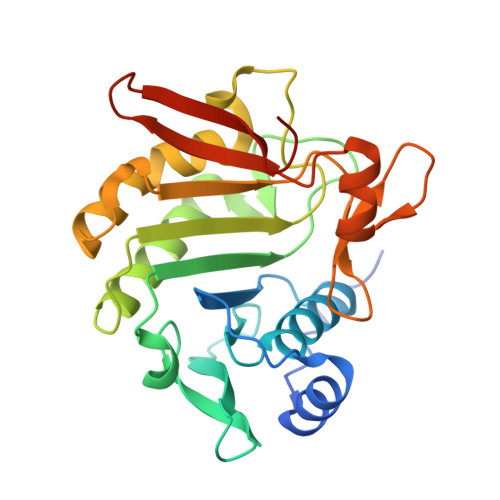
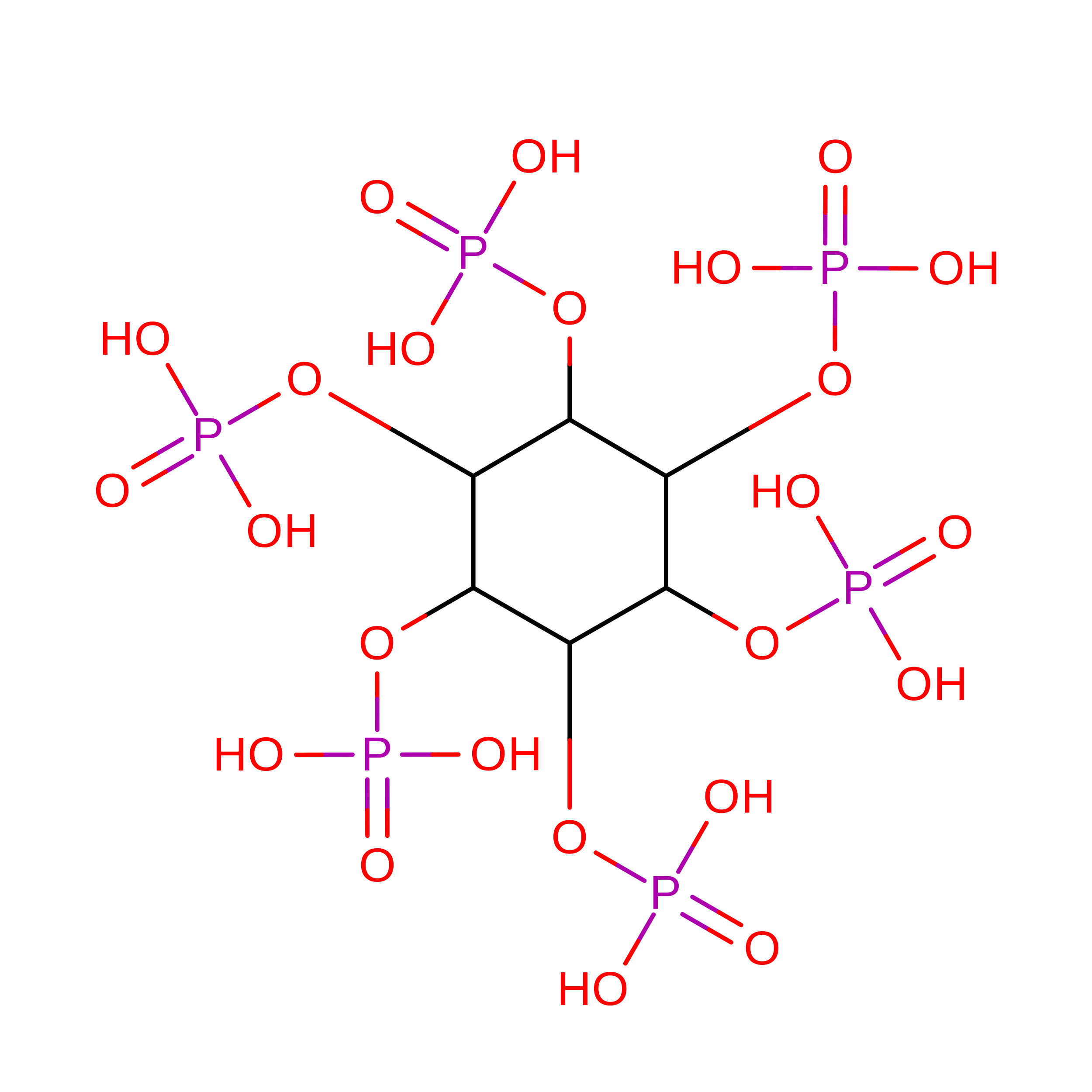
C. difficile Tcdb cysteine protease domain in complex with IP6


Experimental Data Snapshot

  • Method: X-RAY DIFFRACTION
  • Resolution: 2.10 Å
  • R-Value Free: 
    0.257 (Depositor), 0.257 (DCC) 
  • R-Value Work: 
    0.228 (Depositor), 0.228 (DCC) 
  • R-Value Observed: 
    0.230 (Depositor) 

Starting Model: experimental
View more details

wwPDB Validation 3D Report Full Report

Validation slider image for 9BJA

Ligand Structure Quality Assessment 


This is version 1.1 of the entry. See complete history

Literature

Structure-Activity Relationship of Inositol Thiophosphate Analogs as Allosteric Activators of Clostridioides difficile Toxin B.

Cummer, R.Grosjean, F.Bolteau, R.Vasegh, S.E.Veyron, S.Keogh, L.Trempe, J.F.Castagner, B.

(2024) J Med Chem 67: 16576-16597

  • DOI: https://doi.org/10.1021/acs.jmedchem.4c01408
  • Primary Citation Related Structures: 
    9BJA

  • PubMed Abstract: 

    Clostridioides difficile is a bacterium that causes life-threatening intestinal infections. Infection symptoms are mediated by a toxin secreted by the bacterium. Toxin pathogenesis is modulated by the intracellular molecule, inositol-hexakisphosphate (IP6). IP6 binds to a cysteine protease domain (CPD) on the toxin, inducing autoproteolysis, which liberates a virulence factor in the cell cytosol. We developed second-generation IP6 analogs designed to induce autoproteolysis in the gut lumen, prior to toxin uptake, circumventing pathogenesis. We synthesized a panel of thiophosphate-/sulfate-containing IP6 analogs and characterized their toxin binding affinity, autoproteolysis induction, and cation interactions. Our top candidate was soluble in extracellular cation concentrations, unlike IP6. The IP6 analogs were more negatively charged than IP6, which improved affinity and stabilization of the CPD, enhancing toxin autoproteolysis. Our data illustrate the optimization of IP6 with thiophosphate biomimetic which are more capable of inducing toxin autoproteolysis than the native ligand, warranting further studies in vivo.


  • Organizational Affiliation
    • Department of Pharmacology and Therapeutics, McGill University, Québec H3G 1Y6, Canada.

Macromolecule Content 

  • Total Structure Weight: 61.05 kDa 
  • Atom Count: 4,220 
  • Modeled Residue Count: 497 
  • Deposited Residue Count: 522 
  • Unique protein chains: 1

Macromolecules

Find similar proteins by:|  3D Structure
Entity ID: 1
MoleculeChains  Sequence LengthOrganismDetailsImage
Toxin B
A, B
261Clostridioides difficile 342Mutation(s): 0 
Gene Names: tcdBtoxB
EC: 3.4.22
UniProt
Find proteins for P18177 (Clostridioides difficile)
Explore P18177 
Go to UniProtKB:  P18177
Entity Groups
Sequence Clusters30% Identity50% Identity70% Identity90% Identity95% Identity100% Identity
UniProt GroupP18177
Sequence Annotations
Expand
Reference Sequence

Small Molecules

Binding Affinity Annotations 
IDSourceBinding Affinity
IHP BindingDB:  9BJA Kd: 1360 (nM) from 1 assay(s)
EC50: min: 8390, max: 5.36e+5 (nM) from 2 assay(s)

Experimental Data & Validation

Experimental Data

  • Method: X-RAY DIFFRACTION
  • Resolution: 2.10 Å
  • R-Value Free:  0.257 (Depositor), 0.257 (DCC) 
  • R-Value Work:  0.228 (Depositor), 0.228 (DCC) 
  • R-Value Observed: 0.230 (Depositor) 
Space Group: P 1 21 1
Unit Cell:
Length ( Å )Angle ( ˚ )
a = 44.051α = 90
b = 89.171β = 103.78
c = 67.597γ = 90
Software Package:
Software NamePurpose
PHENIXrefinement
BUSTERrefinement
autoPROCdata reduction
Aimlessdata scaling
PHASERphasing

Structure Validation

View Full Validation Report


Ligand Structure Quality Assessment 


Entry History 

& Funding Information

Deposition Data


Funding OrganizationLocationGrant Number
Canadian Institutes of Health Research (CIHR)CanadaPJT-173262
Natural Sciences and Engineering Research Council (NSERC, Canada)CanadaRGPIN-2020-04908

Revision History  (Full details and data files)

  • Version 1.0: 2024-07-03
    Type: Initial release
  • Version 1.1: 2025-03-05
    Changes: Database references, Structure summary