8ZMG | pdb_00008zmg

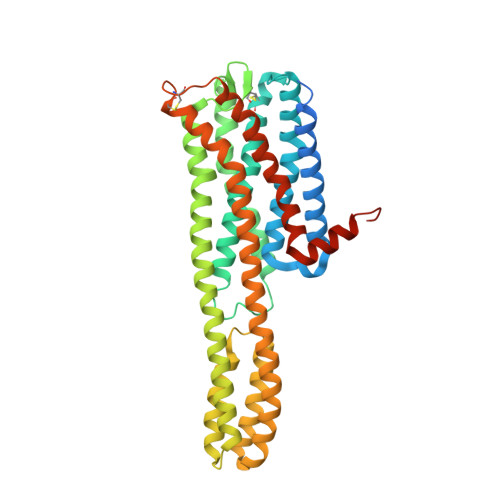
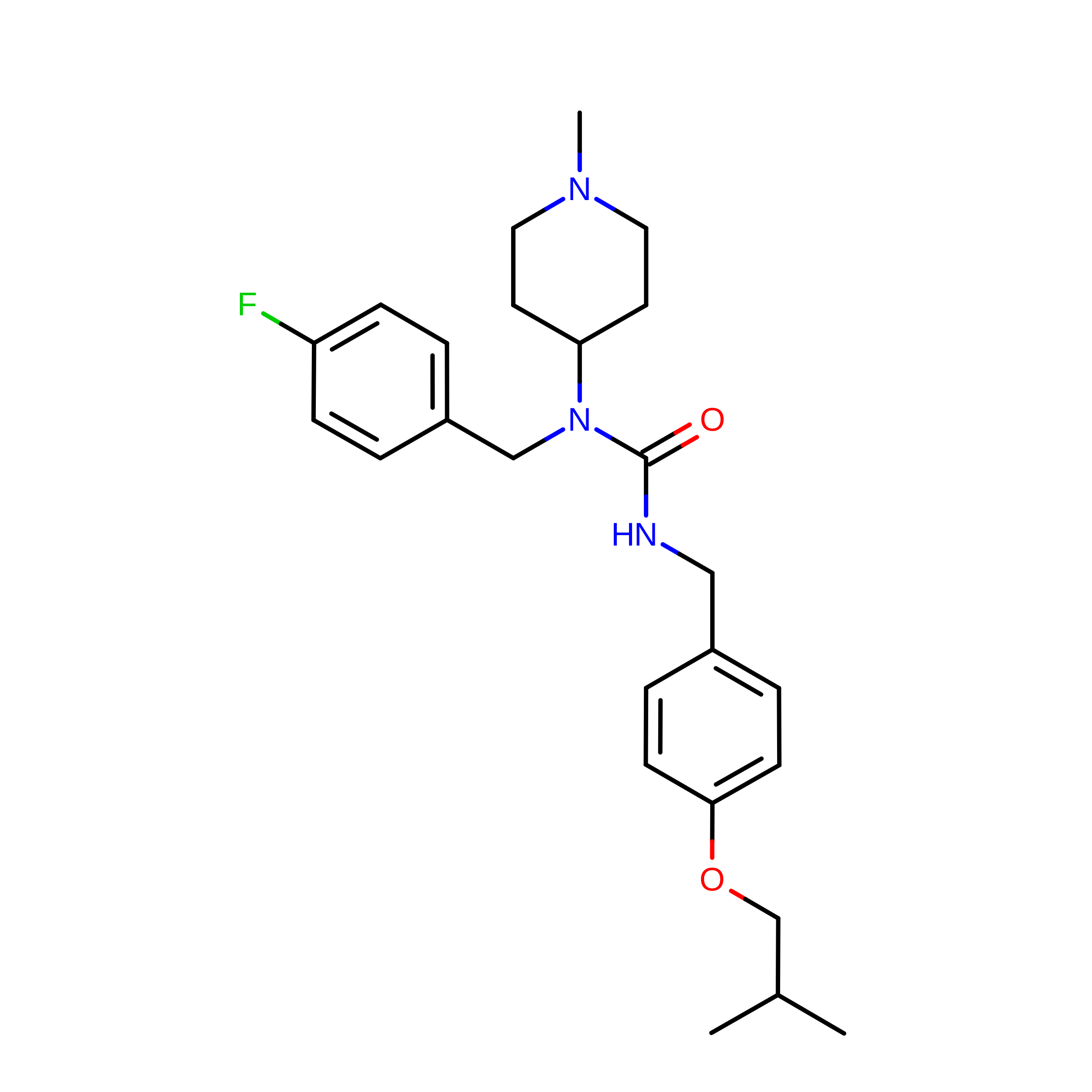
Crystal structure of an inverse agonist antipsychotic drug pimavanserin-bound 5-HT2A


Experimental Data Snapshot

  • Method: X-RAY DIFFRACTION
  • Resolution: 3.40 Å
  • R-Value Free: 
    0.328 (Depositor), 0.326 (DCC) 
  • R-Value Work: 
    0.291 (Depositor), 0.291 (DCC) 
  • R-Value Observed: 
    0.294 (Depositor) 

Starting Model: experimental
View more details

wwPDB Validation 3D Report Full Report

Validation slider image for 8ZMG

Ligand Structure Quality Assessment 


This is version 1.2 of the entry. See complete history

Literature

Dual 5-HT 2A and 5-HT 2C Receptor Inverse Agonist That Affords In Vivo Antipsychotic Efficacy with Minimal hERG Inhibition for the Treatment of Dementia-Related Psychosis.

Oguma, T.Jino, K.Nakahara, K.Asada, H.Fuchino, K.Nagatani, K.Kouki, K.Okamoto, R.Takai, N.Koda, K.Fujita, S.Sekiguchi, Y.Yasuo, K.Mayumi, K.Abe, A.Imono, M.Horiguchi, N.Iwata, S.Kusakabe, K.I.

(2024) J Med Chem 67: 14478-14492

  • DOI: https://doi.org/10.1021/acs.jmedchem.4c01244
  • Primary Citation Related Structures: 
    8ZMF, 8ZMG

  • PubMed Abstract: 

    Psychosis is a distressing symptom commonly occurring in people with dementia. To treat Parkinson's disease psychosis, pimavanserin ( 1 ), a 5-HT 2A receptor inverse agonist having minimal 5-HT 2C receptor affinity and no dopamine D 2 receptor affinity, was approved in the United States, but not for dementia-related psychosis due to limited efficacy issues. Herein, we report on the identification of a potent and dual 5-HT 2A and 5-HT 2C receptor inverse agonist 8 having minimal hERG inhibition, after having demonstrated the involvement of both 5-HT 2A and 5-HT 2C receptors to deliver antipsychotic efficacy in an MK-801-induced locomotor model and having conducted 5-HT 2A and 5-HT 2C occupancy studies including a surrogate method. The introduction of a spirocyclopropyl group boosting 5-HT 2C affinity in 1 followed by further optimization to control lipophilicity resulted in balanced dual potency and metabolic stability, and mitigating hERG inhibition led to 8 that showed significant antipsychotic efficacy due to the involvement of both receptors.


  • Organizational Affiliation
    • Laboratory for Medicinal Chemistry Research, Shionogi Pharmaceutical Research Center, 1-1 Futaba-cho 3-chome, Toyonaka, Osaka 561-0825, Japan.

Macromolecule Content 

  • Total Structure Weight: 94.07 kDa 
  • Atom Count: 5,769 
  • Modeled Residue Count: 726 
  • Deposited Residue Count: 828 
  • Unique protein chains: 1

Macromolecules

Find similar proteins by:|  3D Structure
Entity ID: 1
MoleculeChains  Sequence LengthOrganismDetailsImage
5-hydroxytryptamine receptor 2A,Soluble cytochrome b562
A, B
414Homo sapiensEscherichia coliMutation(s): 6 
Gene Names: HTR2AHTR2cybC
UniProt & NIH Common Fund Data Resources
Find proteins for P0ABE7 (Escherichia coli)
Explore P0ABE7 
Go to UniProtKB:  P0ABE7
Find proteins for P28223 (Homo sapiens)
Explore P28223 
Go to UniProtKB:  P28223
PHAROS:  P28223
GTEx:  ENSG00000102468 
Entity Groups
Sequence Clusters30% Identity50% Identity70% Identity90% Identity95% Identity100% Identity
UniProt GroupsP28223P0ABE7
Sequence Annotations
Expand
Reference Sequence

Experimental Data & Validation

Experimental Data

  • Method: X-RAY DIFFRACTION
  • Resolution: 3.40 Å
  • R-Value Free:  0.328 (Depositor), 0.326 (DCC) 
  • R-Value Work:  0.291 (Depositor), 0.291 (DCC) 
  • R-Value Observed: 0.294 (Depositor) 
Space Group: C 1 2 1
Unit Cell:
Length ( Å )Angle ( ˚ )
a = 276.26α = 90
b = 42.04β = 93.147
c = 90.41γ = 90
Software Package:
Software NamePurpose
PHENIXrefinement
XSCALEdata scaling
XDSdata reduction
PHENIXphasing

Structure Validation

View Full Validation Report


Ligand Structure Quality Assessment 


Entry History 

& Funding Information

Deposition Data


Funding OrganizationLocationGrant Number
Japan Society for the Promotion of Science (JSPS)Japan22KK0099

Revision History  (Full details and data files)

  • Version 1.0: 2024-08-28
    Type: Initial release
  • Version 1.1: 2024-09-04
    Changes: Database references, Structure summary
  • Version 1.2: 2024-10-09
    Changes: Structure summary