8X9H | pdb_00008x9h

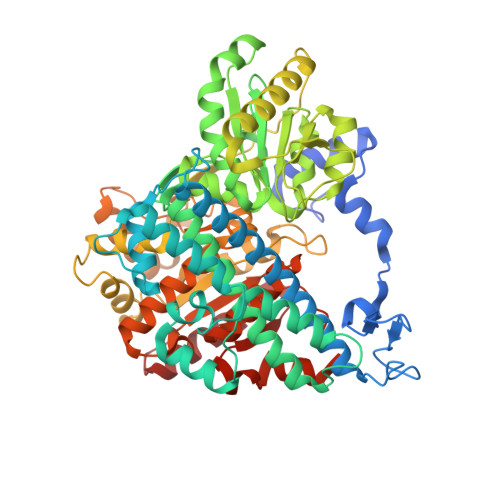
Crystal structure of CO dehydrogenase mutant (F41C)


Experimental Data Snapshot

  • Method: X-RAY DIFFRACTION
  • Resolution: 2.20 Å
  • R-Value Free: 
    0.193 (Depositor), 0.193 (DCC) 
  • R-Value Work: 
    0.141 (Depositor), 0.142 (DCC) 
  • R-Value Observed: 
    0.144 (Depositor) 

Starting Model: experimental
View more details

wwPDB Validation 3D Report Full Report

Validation slider image for 8X9H

This is version 1.2 of the entry. See complete history. 

Literature

Identifying a key spot for electron mediator-interaction to tailor CO dehydrogenase's affinity.

Kim, S.M., Kang, S.H., Lee, J., Heo, Y., Poloniataki, E.G., Kang, J., Yoon, H.J., Kong, S.Y., Yun, Y., Kim, H., Ryu, J., Lee, H.H., Kim, Y.H.

(2024) Nat Commun 15: 2732-2732

  • DOI: https://doi.org/10.1038/s41467-024-46909-1
  • Primary Citation Related Structures: 
    8X9D, 8X9E, 8X9F, 8X9G, 8X9H

  • PubMed Abstract: 

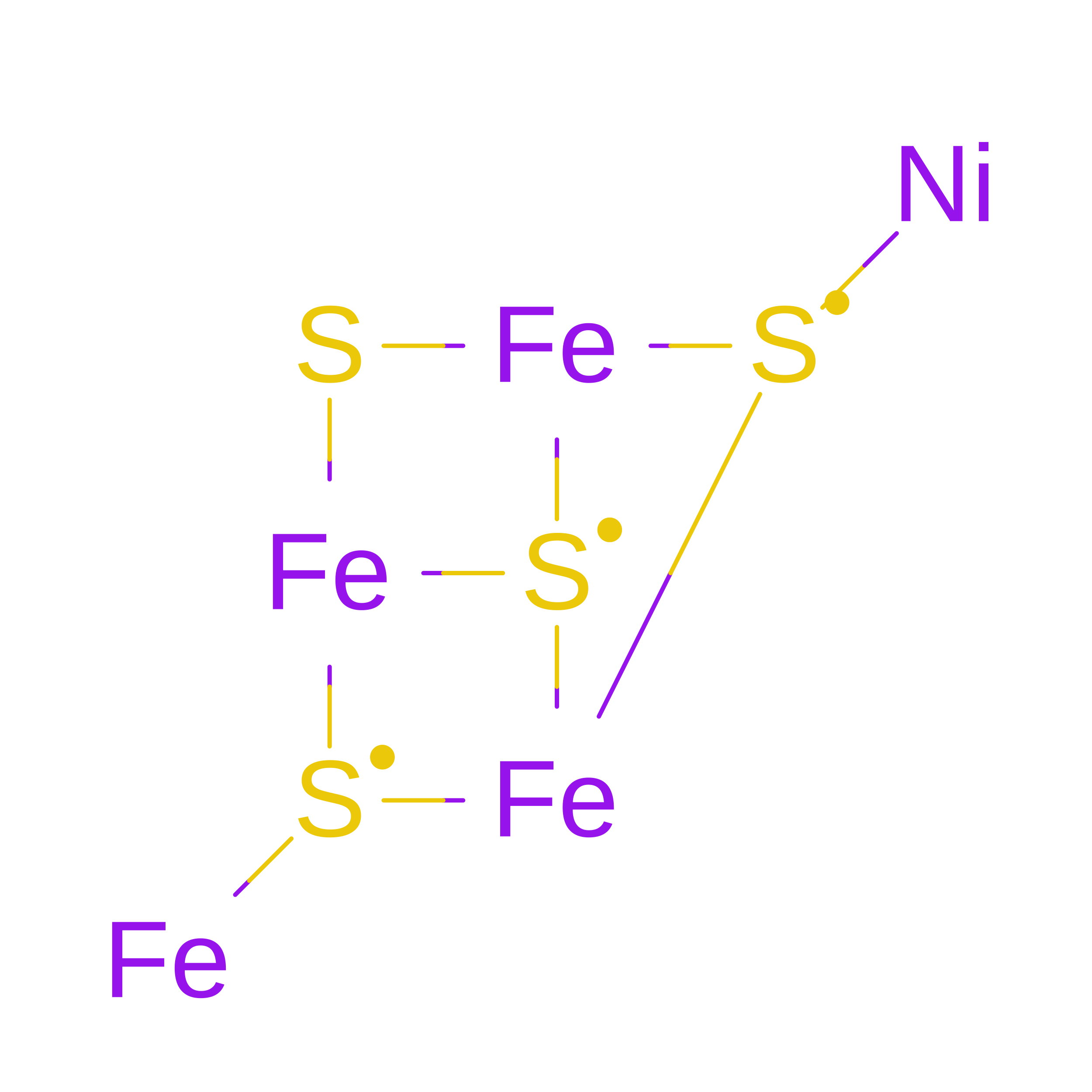
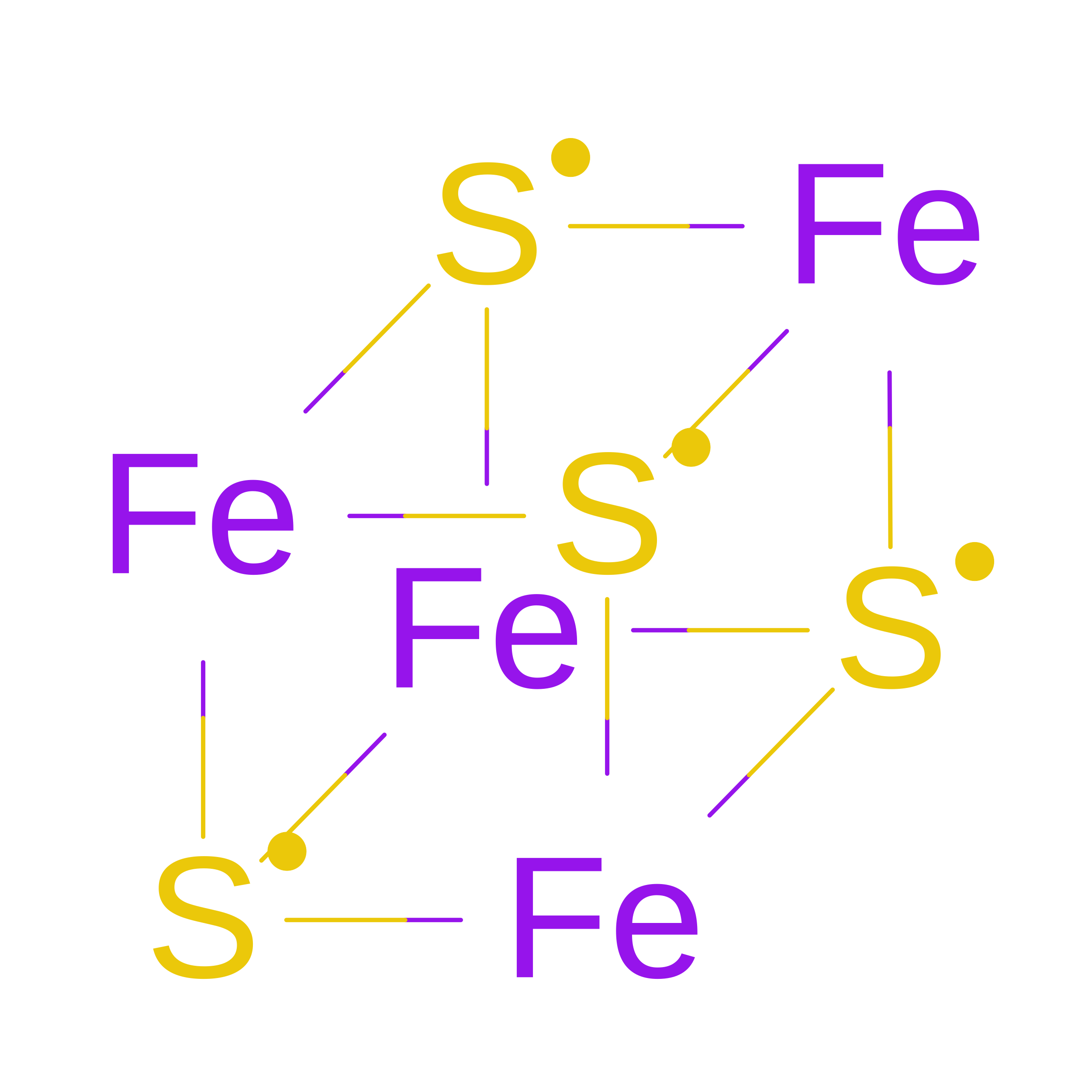
    Fe‒S cluster-harboring enzymes, such as carbon monoxide dehydrogenases (CODH), employ sophisticated artificial electron mediators like viologens to serve as potent biocatalysts capable of cleaning-up industrial off-gases at stunning reaction rates. Unraveling the interplay between these enzymes and their associated mediators is essential for improving the efficiency of CODHs. Here we show the electron mediator-interaction site on ChCODHs (Ch, Carboxydothermus hydrogenoformans) using a systematic approach that leverages the viologen-reactive characteristics of superficial aromatic residues. By enhancing mediator-interaction (R57G/N59L) near the D-cluster, the strategically tailored variants exhibit a ten-fold increase in ethyl viologen affinity relative to the wild-type without sacrificing the turn-over rate (k cat ). Viologen-complexed structures reveal the pivotal positions of surface phenylalanine residues, serving as external conduits for the D-cluster to/from viologen. One variant (R57G/N59L/A559W) can treat a broad spectrum of waste gases (from steel-process and plastic-gasification) containing O 2 . Decoding mediator interactions will facilitate the development of industrially high-efficient biocatalysts encompassing gas-utilizing enzymes.


  • Organizational Affiliation: 
    • School of Energy and Chemical Engineering, Ulsan National Institute of Science and Technology (UNIST), 50 UNIST-gil, Ulsan, 44919, Republic of Korea. smkimlife@unist.ac.kr.

Macromolecule Content 

  • Total Structure Weight: 70.11 kDa 
  • Atom Count: 5,024 
  • Modeled Residue Count: 633 
  • Deposited Residue Count: 656 
  • Unique protein chains: 1

Macromolecules

Find similar proteins by:|  3D Structure
Entity ID: 1
MoleculeChains  Sequence LengthOrganismDetailsImage
Carbon monoxide dehydrogenase 2656Carboxydothermus hydrogenoformans Z-2901Mutation(s): 1 
Gene Names: cooS2
EC: 1.2.7.4
UniProt
Find proteins for Q9F8A8 (Carboxydothermus hydrogenoformans (strain ATCC BAA-161 / DSM 6008 / Z-2901))
Explore Q9F8A8 
Go to UniProtKB:  Q9F8A8
Entity Groups
Sequence Clusters30% Identity50% Identity70% Identity90% Identity95% Identity100% Identity
UniProt GroupQ9F8A8
Sequence Annotations
Expand
Reference Sequence

Experimental Data & Validation

Experimental Data

  • Method: X-RAY DIFFRACTION
  • Resolution: 2.20 Å
  • R-Value Free:  0.193 (Depositor), 0.193 (DCC) 
  • R-Value Work:  0.141 (Depositor), 0.142 (DCC) 
  • R-Value Observed: 0.144 (Depositor) 
Space Group: C 1 2 1
Unit Cell:
Length ( Å )Angle ( ˚ )
a = 112.281α = 90
b = 75.39β = 111.18
c = 70.792γ = 90
Software Package:
Software NamePurpose
PHENIXrefinement
XDSdata scaling
XDSdata reduction
REFMACphasing

Structure Validation

View Full Validation Report


Entry History 

& Funding Information

Deposition Data


Funding OrganizationLocationGrant Number
Other governmentKorea, Republic Of--

Revision History  (Full details and data files)

  • Version 1.0: 2024-04-17
    Type: Initial release
  • Version 1.1: 2024-05-08
    Changes: Database references
  • Version 1.2: 2026-08-12
    Type: Remediation
    Reason: Metalloprotein remediation
    Changes: Data collection, Derived calculations, Structure summary