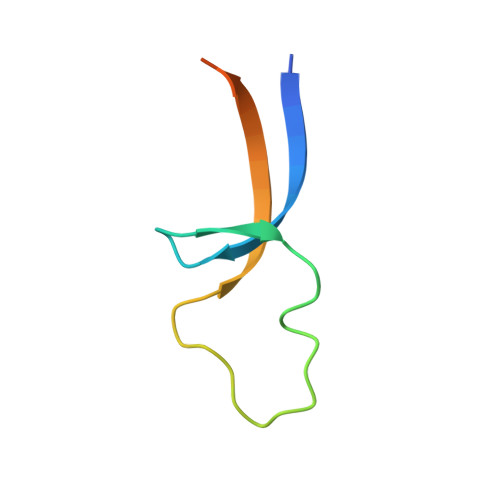
8TTO | pdb_00008tto

Structure of Hachiman anti-defense 1 (Had1)


Experimental Data Snapshot

  • Method: X-RAY DIFFRACTION
  • Resolution: 2.00 Å
  • R-Value Free: 
    0.255 (Depositor), 0.253 (DCC) 
  • R-Value Work: 
    0.215 (Depositor), 0.214 (DCC) 
  • R-Value Observed: 
    0.219 (Depositor) 

Starting Model: in silico
View more details

wwPDB Validation 3D Report Full Report

Validation slider image for 8TTO

This is version 1.3 of the entry. See complete history

Literature

Phages overcome bacterial immunity via diverse anti-defence proteins.

Yirmiya, E.Leavitt, A.Lu, A.Ragucci, A.E.Avraham, C.Osterman, I.Garb, J.Antine, S.P.Mooney, S.E.Hobbs, S.J.Kranzusch, P.J.Amitai, G.Sorek, R.

(2024) Nature 625: 352-359

  • DOI: https://doi.org/10.1038/s41586-023-06869-w
  • Primary Citation Related Structures: 
    8SMD, 8SME, 8SMF, 8SMG, 8TTO

  • PubMed Abstract: 

    It was recently shown that bacteria use, apart from CRISPR-Cas and restriction systems, a considerable diversity of phage resistance systems 1-4 , but it is largely unknown how phages cope with this multilayered bacterial immunity. Here we analysed groups of closely related Bacillus phages that showed differential sensitivity to bacterial defence systems, and discovered four distinct families of anti-defence proteins that inhibit the Gabija, Thoeris and Hachiman systems. We show that these proteins Gad1, Gad2, Tad2 and Had1 efficiently cancel the defensive activity when co-expressed with the respective defence system or introduced into phage genomes. Homologues of these anti-defence proteins are found in hundreds of phages that infect taxonomically diverse bacterial species. We show that the anti-Gabija protein Gad1 blocks the ability of the Gabija defence complex to cleave phage-derived DNA. Our data further reveal that the anti-Thoeris protein Tad2 is a 'sponge' that sequesters the immune signalling molecules produced by Thoeris TIR-domain proteins in response to phage infection. Our results demonstrate that phages encode an arsenal of anti-defence proteins that can disable a variety of bacterial defence mechanisms.


  • Organizational Affiliation
    • Department of Molecular Genetics, Weizmann Institute of Science, Rehovot, Israel.

Macromolecule Content 

  • Total Structure Weight: 24.88 kDa 
  • Atom Count: 1,533 
  • Modeled Residue Count: 165 
  • Deposited Residue Count: 212 
  • Unique protein chains: 1

Macromolecules

Find similar proteins by:|  3D Structure
Entity ID: 1
MoleculeChains  Sequence LengthOrganismDetailsImage
Hachiman
A, B, C, D
53unidentifiedMutation(s): 0 
UniProt
Find proteins for A0AAJ6N6K5 (unidentified)
Explore A0AAJ6N6K5 
Go to UniProtKB:  A0AAJ6N6K5
Entity Groups
Sequence Clusters30% Identity50% Identity70% Identity90% Identity95% Identity100% Identity
UniProt GroupA0AAJ6N6K5
Sequence Annotations
Expand
Reference Sequence

Experimental Data & Validation

Experimental Data

  • Method: X-RAY DIFFRACTION
  • Resolution: 2.00 Å
  • R-Value Free:  0.255 (Depositor), 0.253 (DCC) 
  • R-Value Work:  0.215 (Depositor), 0.214 (DCC) 
  • R-Value Observed: 0.219 (Depositor) 
Space Group: P 1
Unit Cell:
Length ( Å )Angle ( ˚ )
a = 30.938α = 75.22
b = 40.181β = 89.42
c = 45.291γ = 74.91
Software Package:
Software NamePurpose
PHENIXrefinement
XDSdata reduction
Aimlessdata scaling
PHASERphasing

Structure Validation

View Full Validation Report


Entry History 

& Funding Information

Deposition Data


Funding OrganizationLocationGrant Number
National Institutes of Health/National Institute of General Medical Sciences (NIH/NIGMS)United States1DP2GM146250-01

Revision History  (Full details and data files)

  • Version 1.0: 2023-11-22
    Type: Initial release
  • Version 1.1: 2023-12-06
    Changes: Database references
  • Version 1.2: 2024-01-17
    Changes: Database references
  • Version 1.3: 2024-06-05
    Changes: Structure summary