8P8T | pdb_00008p8t

Ex vivo Ym2 crystal structure


Experimental Data Snapshot

  • Method: X-RAY DIFFRACTION
  • Resolution: 1.71 Å
  • R-Value Free: 
    0.205 (Depositor), 0.210 (DCC) 
  • R-Value Work: 
    0.177 (Depositor), 0.182 (DCC) 
  • R-Value Observed: 
    0.178 (Depositor) 

Starting Model: experimental
View more details

wwPDB Validation 3D Report Full Report

Validation slider image for 8P8T

This is version 1.2 of the entry. See complete history

Literature

Ym1 protein crystals promote type 2 immunity.

Heyndrickx, I.Deswarte, K.Verstraete, K.Verschueren, K.H.G.Smole, U.Aegerter, H.Dansercoer, A.Hammad, H.Savvides, S.N.Lambrecht, B.N.

(2024) Elife 12

  • DOI: https://doi.org/10.7554/eLife.90676
  • Primary Citation Related Structures: 
    8P8Q, 8P8R, 8P8S, 8P8T

  • PubMed Abstract: 

    Spontaneous protein crystallization is a rare event, yet protein crystals are frequently found in eosinophil-rich inflammation. In humans, Charcot-Leyden crystals (CLCs) are made from galectin-10 (Gal10) protein, an abundant protein in eosinophils. Although mice do not encode Gal10 in their genome, they do form pseudo-CLCs, made from the chitinase-like proteins Ym1 and/or Ym2, encoded by Chil3 and Chil4 and made by myeloid and epithelial cells respectively. Here, we investigated the biological effects of pseudo-CLCs since their function is currently unknown. We produced recombinant Ym1 crystals which were shown to have identical crystal packing and structure by X-ray crystallography as in vivo native crystals derived from murine lung. When administered to the airways of mice, crystalline but not soluble Ym1 stimulated innate and adaptive immunity and acted as a type 2 immune adjuvant for eosinophilic inflammation via triggering of dendritic cells (DCs). Murine Ym1 protein crystals found at sites of eosinophilic inflammation reinforce type 2 immunity and could serve as a surrogate model for studying the biology of human CLCs.


  • Organizational Affiliation
    • Laboratory of Immunoregulation and Mucosal Immunology, VIB-UGent Center for Inflammation Research, Ghent, Belgium.

Macromolecule Content 

  • Total Structure Weight: 45.11 kDa 
  • Atom Count: 3,251 
  • Modeled Residue Count: 374 
  • Deposited Residue Count: 402 
  • Unique protein chains: 1

Macromolecules

Find similar proteins by:|  3D Structure
Entity ID: 1
MoleculeChains  Sequence LengthOrganismDetailsImage
Chitinase-like protein 4402Mus musculusMutation(s): 0 
UniProt
Find proteins for Q91Z98 (Mus musculus)
Explore Q91Z98 
Go to UniProtKB:  Q91Z98
Entity Groups
Sequence Clusters30% Identity50% Identity70% Identity90% Identity95% Identity100% Identity
UniProt GroupQ91Z98
Sequence Annotations
Expand
Reference Sequence

Small Molecules

Ligands 1 Unique
IDChains Name / Formula / InChI Key2D Diagram3D Interactions
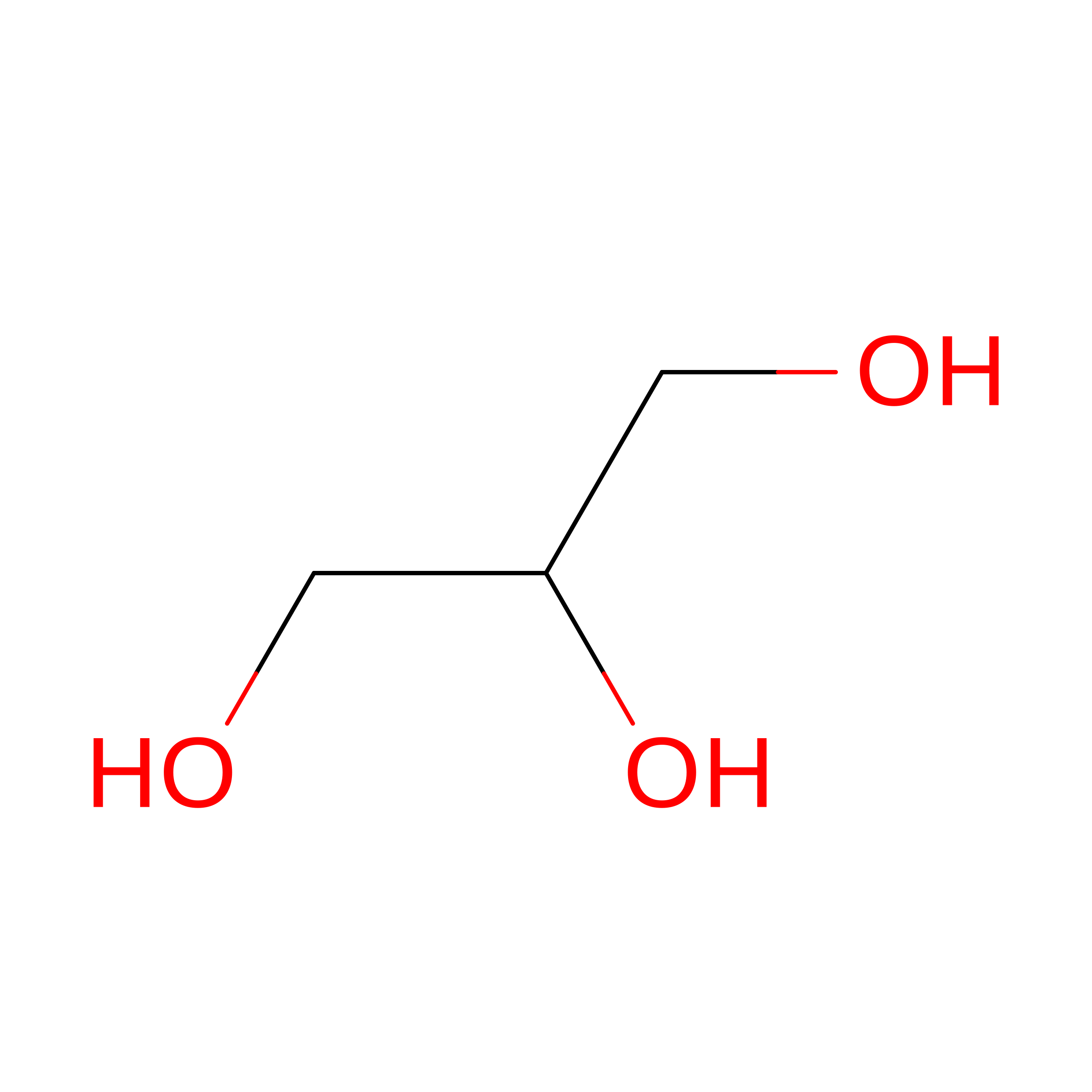
GOL

Query on GOL


Download:Ideal Coordinates CCD File
B [auth A]GLYCEROL
C3 H8 O3
PEDCQBHIVMGVHV-UHFFFAOYSA-N

Experimental Data & Validation

Experimental Data

  • Method: X-RAY DIFFRACTION
  • Resolution: 1.71 Å
  • R-Value Free:  0.205 (Depositor), 0.210 (DCC) 
  • R-Value Work:  0.177 (Depositor), 0.182 (DCC) 
  • R-Value Observed: 0.178 (Depositor) 
Space Group: P 1 21 1
Unit Cell:
Length ( Å )Angle ( ˚ )
a = 51.261α = 90
b = 60.205β = 94.24
c = 60.173γ = 90
Software Package:
Software NamePurpose
BUSTERrefinement
XDSdata reduction
Aimlessdata scaling
PHASERphasing

Structure Validation

View Full Validation Report


Entry History 

& Funding Information

Deposition Data


Funding OrganizationLocationGrant Number
European Research Council (ERC)European Union789384
Research Foundation - Flanders (FWO)BelgiumG0H1222N

Revision History  (Full details and data files)

  • Version 1.0: 2024-01-17
    Type: Initial release
  • Version 1.1: 2024-01-24
    Changes: Database references
  • Version 1.2: 2024-10-23
    Changes: Structure summary