8ZWO | pdb_00008zwo

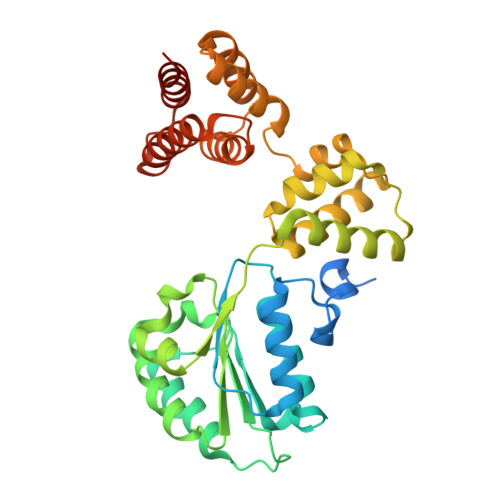
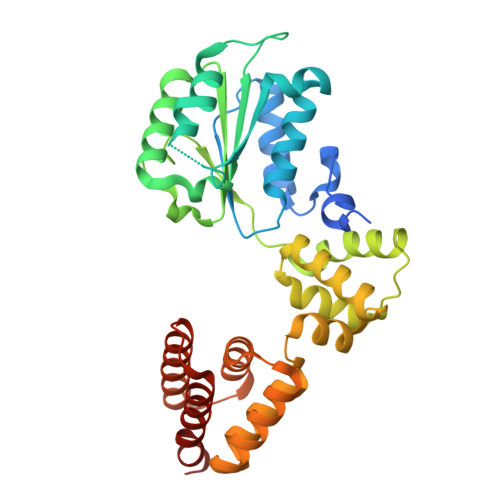
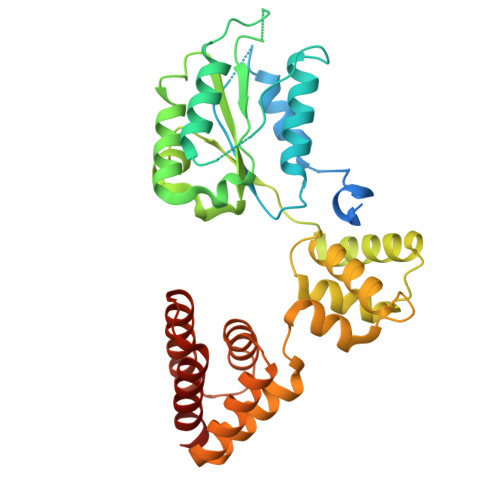
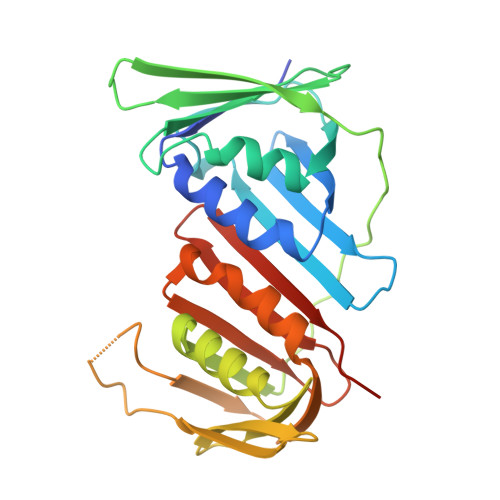
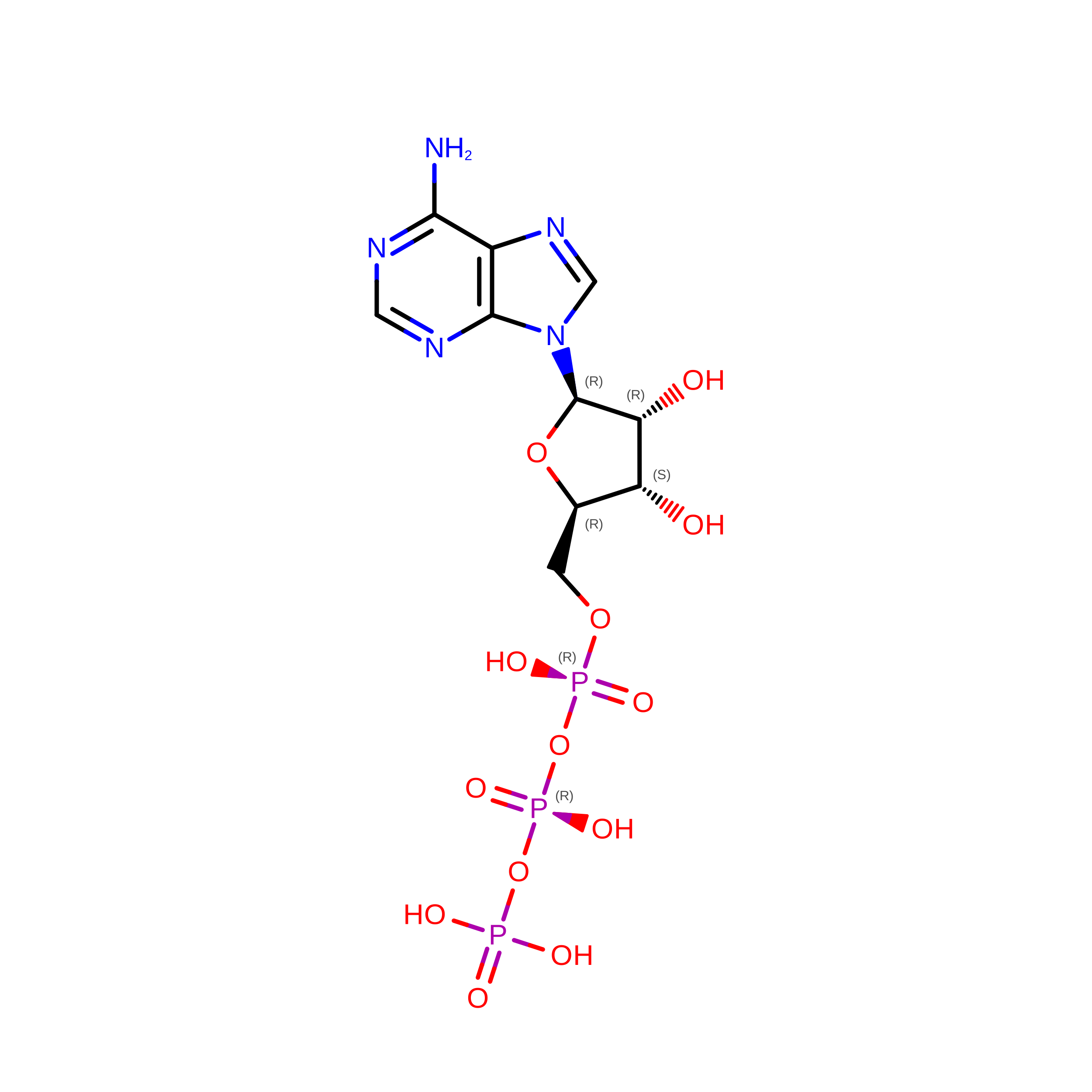
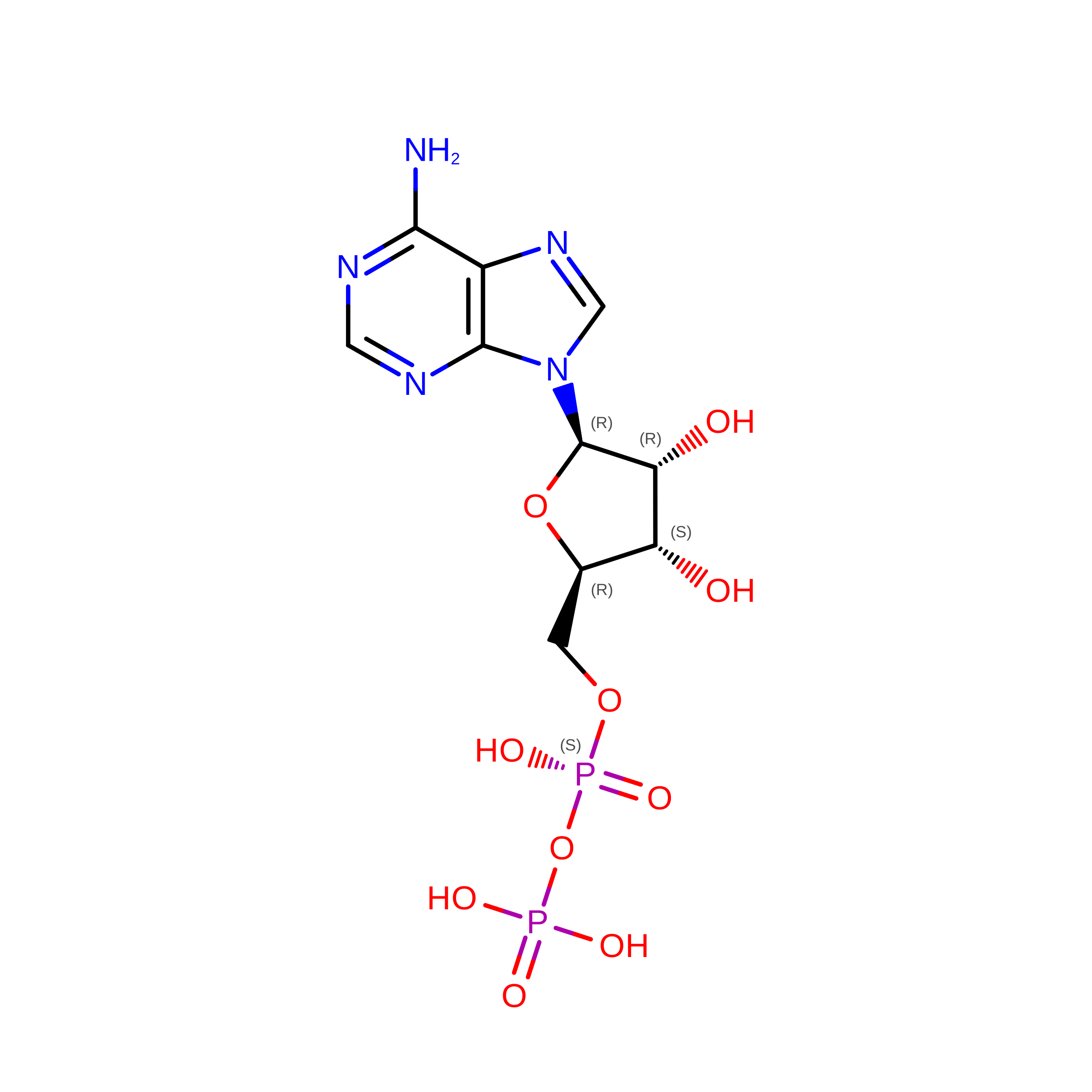
Structure of CTF18-PCNA with ATP


Experimental Data Snapshot

  • Method: ELECTRON MICROSCOPY
  • Resolution: 2.99 Å
  • Aggregation State: PARTICLE 
  • Reconstruction Method: SINGLE PARTICLE 

Starting Model: experimental
View more details

wwPDB Validation 3D Report Full Report

Validation slider image for 8ZWO

This is version 1.2 of the entry. See complete history

Literature

Structure of the human CTF18-RFC clamp loader bound to PCNA.

Briola, G.R.Tehseen, M.Al-Amodi, A.Young, G.Danazumi, A.U.Nguyen, P.Q.Savva, C.G.Hedglin, M.Hamdan, S.M.De Biasio, A.

(2026) Elife 13

  • DOI: https://doi.org/10.7554/eLife.103493
  • Primary Citation Related Structures: 
    8ZWO, 9IIN

  • PubMed Abstract: 

    Sliding clamps like PCNA are crucial processivity factors for replicative polymerases, requiring specific clamp loaders for loading onto DNA. The human alternative clamp loader CTF18-RFC interacts with the leading strand polymerase Pol ε and loads PCNA onto primer/template DNA using its RFC pentameric module. Here, we provide a structural characterization of the human CTF18-RFC complex and its interaction with PCNA. Our cryo-EM data support that the Ctf8 and Dcc1 subunits of CTF18-RFC, which form the regulatory module interacting with Pol ε, are flexibly tethered to the RFC module. A 2.9 Å cryo-EM structure shows the RFC module bound to PCNA in an autoinhibited conformation similar to the canonical RFC loader, marking the initial step of the clamp-loading reaction. The unique RFC1 (Ctf18) large subunit of CTF18-RFC, which based on the cryo-EM map shows high relative flexibility, is anchored to PCNA through an atypical low-affinity PIP box in the AAA+ domain and engages the RFC5 subunit using a novel β-hairpin at the disordered N-terminus. We show that deletion of this β-hairpin impairs the CTF18-RFC-PCNA complex stability, slows down clamp loading, and decreases the rate of primer synthesis by Pol ε. Our research identifies distinctive structural characteristics of the human CTF18-RFC complex, providing insights into its role in PCNA loading and the stimulation of leading strand synthesis by Pol ε.


  • Organizational Affiliation
    • Bioscience Program, Division of Biomedical Sciences, King Abdullah University of Science and Technology, Thuwal, Saudi Arabia.

Macromolecule Content 

  • Total Structure Weight: 361.13 kDa 
  • Atom Count: 19,771 
  • Modeled Residue Count: 2,504 
  • Deposited Residue Count: 3,232 
  • Unique protein chains: 6

Macromolecules

Find similar proteins by:|  3D Structure
Entity ID: 1
MoleculeChains  Sequence LengthOrganismDetailsImage
Chromosome transmission fidelity protein 18 homolog1,012Homo sapiensMutation(s): 0 
Gene Names: CHTF18C16orf41CTF18
UniProt & NIH Common Fund Data Resources
Find proteins for Q8WVB6 (Homo sapiens)
Explore Q8WVB6 
Go to UniProtKB:  Q8WVB6
PHAROS:  Q8WVB6
GTEx:  ENSG00000127586 
Entity Groups
Sequence Clusters30% Identity50% Identity70% Identity90% Identity95% Identity100% Identity
UniProt GroupQ8WVB6
Sequence Annotations
Expand
Reference Sequence
Find similar proteins by:|  3D Structure
Entity ID: 2
MoleculeChains  Sequence LengthOrganismDetailsImage
Replication factor C subunit 2354Homo sapiensMutation(s): 0 
Gene Names: RFC2
UniProt & NIH Common Fund Data Resources
Find proteins for P35250 (Homo sapiens)
Explore P35250 
Go to UniProtKB:  P35250
PHAROS:  P35250
GTEx:  ENSG00000049541 
Entity Groups
Sequence Clusters30% Identity50% Identity70% Identity90% Identity95% Identity100% Identity
UniProt GroupP35250
Sequence Annotations
Expand
Reference Sequence
Find similar proteins by:|  3D Structure
Entity ID: 3
MoleculeChains  Sequence LengthOrganismDetailsImage
Replication factor C subunit 5340Homo sapiensMutation(s): 0 
Gene Names: RFC5
UniProt & NIH Common Fund Data Resources
Find proteins for P40937 (Homo sapiens)
Explore P40937 
Go to UniProtKB:  P40937
PHAROS:  P40937
GTEx:  ENSG00000111445 
Entity Groups
Sequence Clusters30% Identity50% Identity70% Identity90% Identity95% Identity100% Identity
UniProt GroupP40937
Sequence Annotations
Expand
Reference Sequence
Find similar proteins by:|  3D Structure
Entity ID: 4
MoleculeChains  Sequence LengthOrganismDetailsImage
Replication factor C subunit 4363Homo sapiensMutation(s): 0 
Gene Names: RFC4
UniProt & NIH Common Fund Data Resources
Find proteins for P35249 (Homo sapiens)
Explore P35249 
Go to UniProtKB:  P35249
PHAROS:  P35249
GTEx:  ENSG00000163918 
Entity Groups
Sequence Clusters30% Identity50% Identity70% Identity90% Identity95% Identity100% Identity
UniProt GroupP35249
Sequence Annotations
Expand
Reference Sequence
Find similar proteins by:|  3D Structure
Entity ID: 5
MoleculeChains  Sequence LengthOrganismDetailsImage
Replication factor C subunit 3362Homo sapiensMutation(s): 0 
Gene Names: RFC3
UniProt & NIH Common Fund Data Resources
Find proteins for P40938 (Homo sapiens)
Explore P40938 
Go to UniProtKB:  P40938
PHAROS:  P40938
GTEx:  ENSG00000133119 
Entity Groups
Sequence Clusters30% Identity50% Identity70% Identity90% Identity95% Identity100% Identity
UniProt GroupP40938
Sequence Annotations
Expand
Reference Sequence
Find similar proteins by:|  3D Structure
Entity ID: 6
MoleculeChains  Sequence LengthOrganismDetailsImage
Proliferating cell nuclear antigen
F, G, H
267Homo sapiensMutation(s): 0 
Gene Names: PCNA
UniProt & NIH Common Fund Data Resources
Find proteins for P12004 (Homo sapiens)
Explore P12004 
Go to UniProtKB:  P12004
PHAROS:  P12004
GTEx:  ENSG00000132646 
Entity Groups
Sequence Clusters30% Identity50% Identity70% Identity90% Identity95% Identity100% Identity
UniProt GroupP12004
Sequence Annotations
Expand
Reference Sequence

Experimental Data & Validation

Experimental Data

  • Method: ELECTRON MICROSCOPY
  • Resolution: 2.99 Å
  • Aggregation State: PARTICLE 
  • Reconstruction Method: SINGLE PARTICLE 
EM Software:
TaskSoftware PackageVersion
RECONSTRUCTIONRELION4.0
MODEL REFINEMENTPHENIX

Structure Validation

View Full Validation Report


Entry History 

& Funding Information

Deposition Data


Funding OrganizationLocationGrant Number
Other governmentSaudi Arabia--

Revision History  (Full details and data files)

  • Version 1.0: 2025-06-18
    Type: Initial release
  • Version 1.1: 2025-08-27
    Changes: Data collection, Database references
  • Version 1.2: 2026-03-11
    Changes: Data collection, Database references