8ZLT | pdb_00008zlt

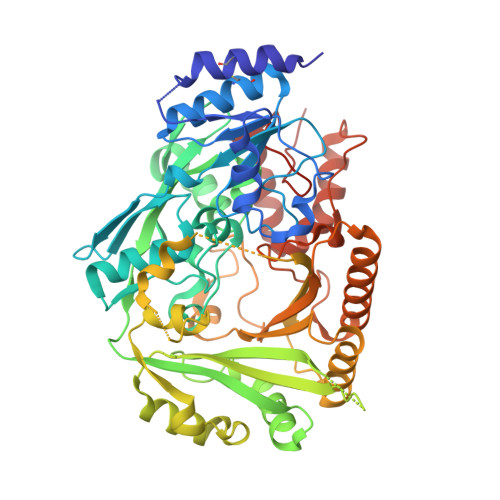
Co-crystal structure of MaDS1 with diene


Experimental Data Snapshot

  • Method: X-RAY DIFFRACTION
  • Resolution: 2.03 Å
  • R-Value Free: 
    0.219 (Depositor), 0.220 (DCC) 
  • R-Value Work: 
    0.167 (Depositor), 0.167 (DCC) 
  • R-Value Observed: 
    0.168 (Depositor) 

Starting Model: experimental
View more details

wwPDB Validation 3D Report Full Report

Validation slider image for 8ZLT

Ligand Structure Quality Assessment 


This is version 1.2 of the entry. See complete history

Literature

Aspartic acid residues in BBE-like enzymes from Morus alba promote a function shift from oxidative cyclization to dehydrogenation.

Guo, N.Gu, J.Zhou, Q.Liu, F.Dong, H.Ding, Q.Wang, Q.Wu, D.Yang, J.Fan, J.Gao, L.Houk, K.N.Lei, X.

(2025) Proc Natl Acad Sci U S A 122: e2504346122-e2504346122

  • DOI: https://doi.org/10.1073/pnas.2504346122
  • Primary Citation Related Structures: 
    8ZLS, 8ZLT

  • PubMed Abstract: 

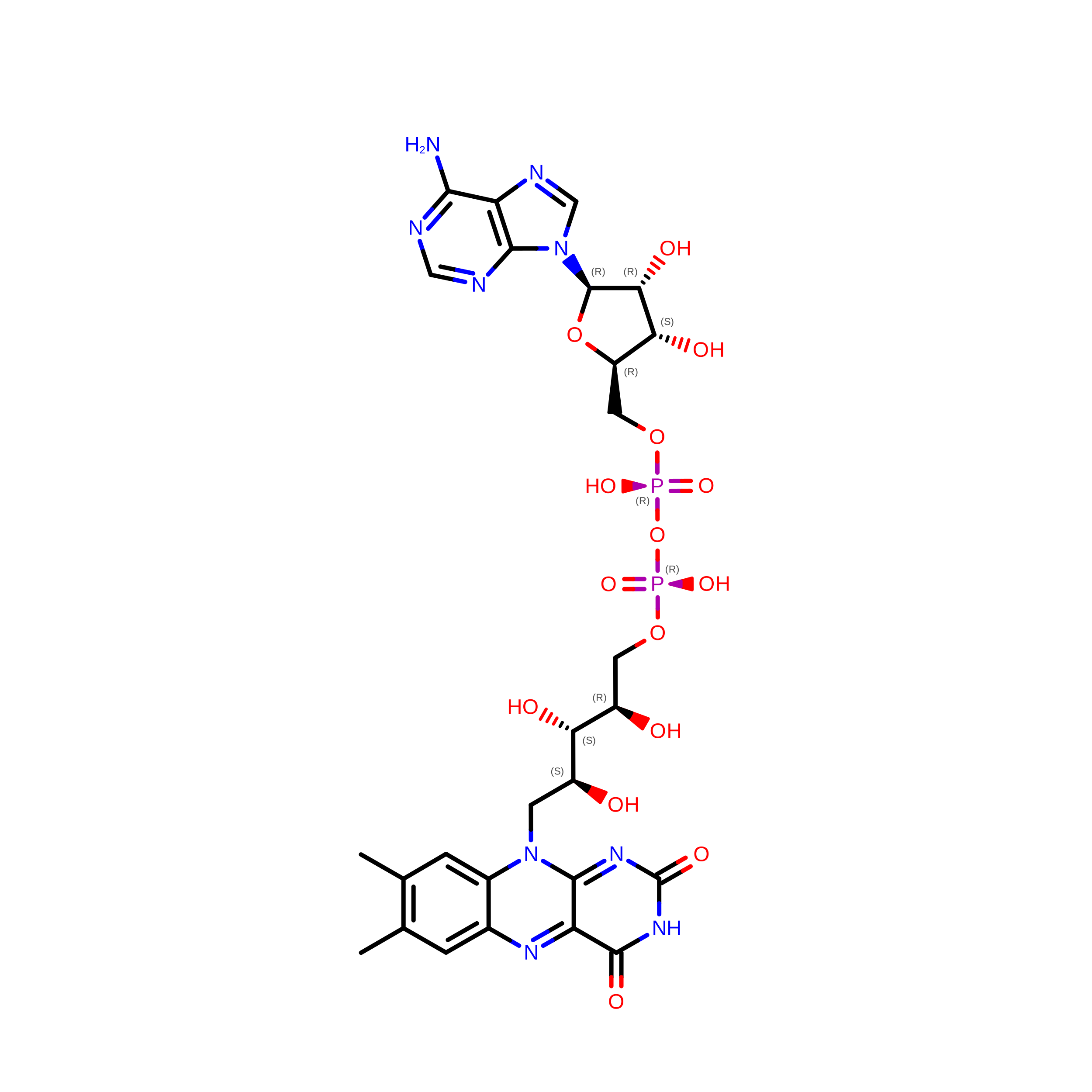
    Berberine bridge enzyme (BBE)-like enzymes catalyze various oxidative cyclization and dehydrogenation reactions in natural product biosynthesis, but the molecular mechanism underlying the selectivity remains unknown. Here, we elucidated the catalytic mechanism of BBE-like oxidases from Morus alba involved in the oxidative cyclization and dehydrogenation of moracin C. X-ray crystal structures of a functionally promiscuous flavin adenine dinucleotide (FAD)-bound oxidase, MaDS1, with and without an oxidative dehydrogenation product were determined at 2.03 Å and 2.21 Å resolution, respectively. Structure-guided mutagenesis and sequence analysis have identified a conserved aspartic acid that directs the reaction toward the oxidative dehydrogenation pathway. A combination of density functional theory (DFT) calculations and molecular dynamics (MD) simulations has revealed that aspartic acid acts as the catalytic base to deprotonate the carbon-cation intermediate to generate the dehydrogenated product, which otherwise undergoes a spontaneous 6π electrocyclization in the oxidative cyclization pathway to furnish the 2H-benzopyran product.


  • Organizational Affiliation
    • Peking-Tsinghua Center for Life Sciences, Peking University, Beijing 100871, China.

Macromolecule Content 

  • Total Structure Weight: 120.02 kDa 
  • Atom Count: 8,701 
  • Modeled Residue Count: 1,002 
  • Deposited Residue Count: 1,040 
  • Unique protein chains: 1

Macromolecules

Find similar proteins by:|  3D Structure
Entity ID: 1
MoleculeChains  Sequence LengthOrganismDetailsImage
MaDS1
A, B
520Morus albaMutation(s): 0 

Experimental Data & Validation

Experimental Data

  • Method: X-RAY DIFFRACTION
  • Resolution: 2.03 Å
  • R-Value Free:  0.219 (Depositor), 0.220 (DCC) 
  • R-Value Work:  0.167 (Depositor), 0.167 (DCC) 
  • R-Value Observed: 0.168 (Depositor) 
Space Group: P 1 21 1
Unit Cell:
Length ( Å )Angle ( ˚ )
a = 52.392α = 90
b = 122.632β = 95.859
c = 84.05γ = 90
Software Package:
Software NamePurpose
PHENIXrefinement
Cootmodel building
HKL-2000data reduction
HKL-2000data scaling
PHASERphasing

Structure Validation

View Full Validation Report


Ligand Structure Quality Assessment 


Entry History 

& Funding Information

Deposition Data


Funding OrganizationLocationGrant Number
National Natural Science Foundation of China (NSFC)China22193073

Revision History  (Full details and data files)

  • Version 1.0: 2025-08-13
    Type: Initial release
  • Version 1.1: 2025-09-03
    Changes: Database references
  • Version 1.2: 2025-10-15
    Changes: Database references, Structure summary