8Z4I | pdb_00008z4i

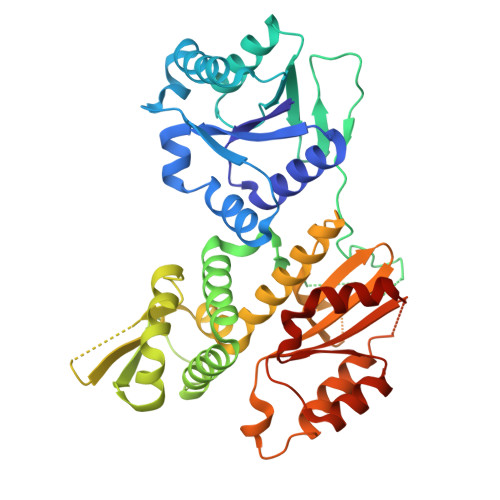
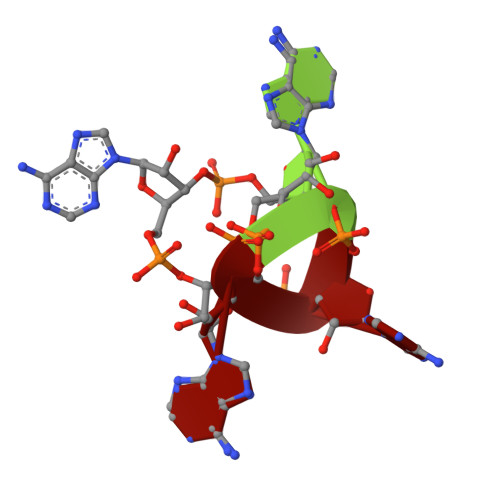
crystal structure of Cdn1 in complex with cA3


Experimental Data Snapshot

  • Method: X-RAY DIFFRACTION
  • Resolution: 2.80 Å
  • R-Value Free: 
    0.277 (Depositor), 0.277 (DCC) 
  • R-Value Work: 
    0.248 (Depositor), 0.248 (DCC) 
  • R-Value Observed: 
    0.251 (Depositor) 

Starting Model: experimental
View more details

wwPDB Validation 3D Report Full Report

Validation slider image for 8Z4I

This is version 1.0 of the entry. See complete history

Literature

Structural plasticity enables broad cAn binding and dual activation of CRISPR-associated ribonuclease Cdn1.

Zhang, W.Kong, J.Zeng, Y.Su, Y.Zhang, S.Li, Y.Hu, C.Chen, Q.Xiao, Y.Lu, M.

(2026) Nucleic Acids Res 54

  • DOI: https://doi.org/10.1093/nar/gkaf1524
  • Primary Citation Related Structures: 
    8Z4I, 9U49

  • PubMed Abstract: 

    Prokaryotes have naturally evolved diverse RNA-guided defense systems against viral infections, with the type III CRISPR-Cas systems representing the most intricate. These systems feature accessory proteins activated by cyclic oligoadenylates (cOAs) produced upon target RNA recognition, synergizing with the CRISPR-Cas machinery to defend against exogenous invaders. Typically, each accessory protein is activated by only one specific cOA type. Here, we characterize Cdn1, a type III-B CRISPR accessory protein from Psychrobacter lutiphocae, which binds to cA3, cA4, and cA6, but activated by cA4 and cA6 with different efficacies to catalyze ssRNA cleavage. Combined structural and biochemical analyses reveal that cOA binding triggers dramatic conformational reorganization, including the formation of a dimerization interface of nuclease domains, the emergence of substrate binding cleft, and the reconstruction of a metal-dependent catalytic center essential for RNA cleavage. This dual activation mechanism illustrates evolutionary innovation within CRISPR-associated Rossman-fold nucleases. We propose that such structural plasticity evolved to maximize defensive resilience during microbial competition and horizontal gene transfer, while preserving broad-spectrum antiviral ability. These findings not only elucidate the activation mechanisms of Cdn1 within the type III systems but also underscore the functional complexity and adaptability of CRISPR-Cas ancillary proteins.


  • Organizational Affiliation
    • State Key Laboratory of Natural Medicines, School of Pharmacy, China Pharmaceutical University, Nanjing 211198, China.

Macromolecule Content 

  • Total Structure Weight: 94.2 kDa 
  • Atom Count: 6,404 
  • Modeled Residue Count: 775 
  • Deposited Residue Count: 813 
  • Unique protein chains: 1
  • Unique nucleic acid chains: 1

Macromolecules


Find similar proteins by:|  3D Structure
Entity ID: 1
MoleculeChains  Sequence LengthOrganismDetailsImage
CARF-domain cantaining dual-activated nuclease
A, B
405Psychrobacter lutiphocae DSM 21542Mutation(s): 0 
Find similar nucleic acids by:  Sequence
Entity ID: 2
MoleculeChains LengthOrganismImage
cyclic tri-adenylate3synthetic construct
Sequence Annotations
Expand
Reference Sequence

Small Molecules

Ligands 3 Unique
IDChains Name / Formula / InChI Key2D Diagram3D Interactions
PEG

Query on PEG


Download:Ideal Coordinates CCD File
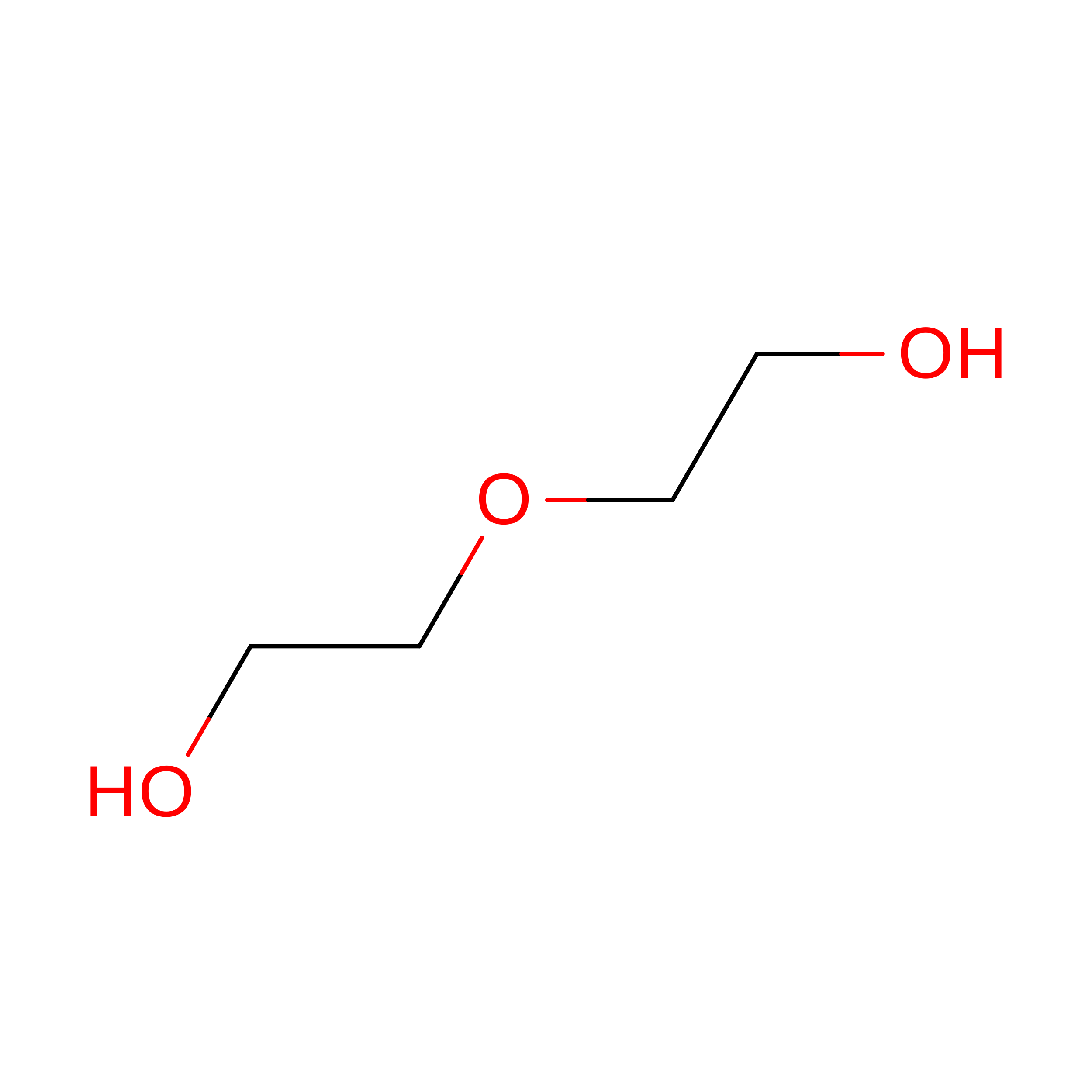
I [auth A]DI(HYDROXYETHYL)ETHER
C4 H10 O3
MTHSVFCYNBDYFN-UHFFFAOYSA-N
GOL

Query on GOL


Download:Ideal Coordinates CCD File
H [auth A],
K [auth B]
GLYCEROL
C3 H8 O3
PEDCQBHIVMGVHV-UHFFFAOYSA-N
CA

Query on CA


Download:Ideal Coordinates CCD File
D [auth A],
E [auth A],
F [auth A],
G [auth A],
J [auth B]
CALCIUM ION
Ca
BHPQYMZQTOCNFJ-UHFFFAOYSA-N

Experimental Data & Validation

Experimental Data

  • Method: X-RAY DIFFRACTION
  • Resolution: 2.80 Å
  • R-Value Free:  0.277 (Depositor), 0.277 (DCC) 
  • R-Value Work:  0.248 (Depositor), 0.248 (DCC) 
  • R-Value Observed: 0.251 (Depositor) 
Space Group: C 1 2 1
Unit Cell:
Length ( Å )Angle ( ˚ )
a = 152.49α = 90
b = 61.3β = 97.55
c = 103.57γ = 90
Software Package:
Software NamePurpose
PHENIXrefinement
XDSdata scaling
XDSdata reduction
PHENIXphasing

Structure Validation

View Full Validation Report


Entry History 

& Funding Information

Deposition Data

  • Released Date: 2026-02-04 
  • Deposition Author(s): Zhang, W.

Funding OrganizationLocationGrant Number
National Natural Science Foundation of China (NSFC)China--

Revision History  (Full details and data files)

  • Version 1.0: 2026-02-04
    Type: Initial release