8YY2 | pdb_00008yy2

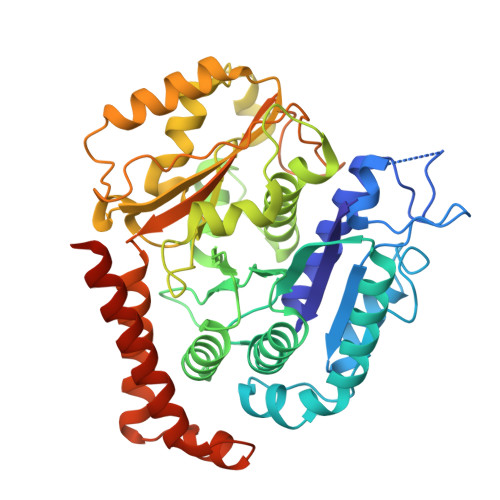
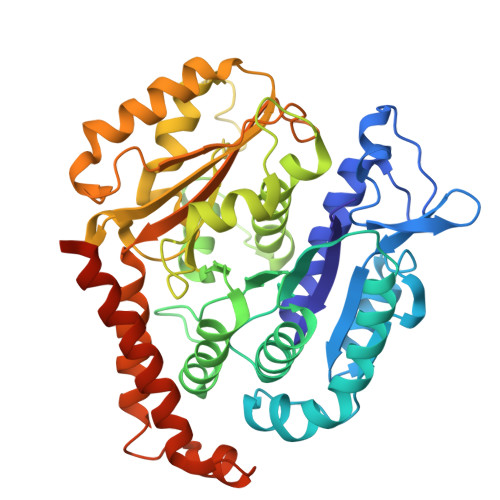
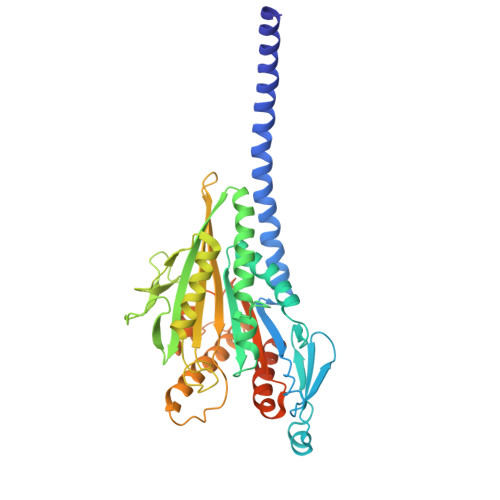
Kinesin-14 in nucleotide-free state bound to 13 PF Microtubule


Experimental Data Snapshot

  • Method: ELECTRON MICROSCOPY
  • Resolution: 3.60 Å
  • Aggregation State: FILAMENT 
  • Reconstruction Method: HELICAL 

wwPDB Validation 3D Report Full Report

Validation slider image for 8YY2

This is version 2.1 of the entry. See complete history

Literature

Structural analysis of a motor with increased mechanical output reveals new transitions in kinesin microtubule motility.

Shibata, S.Wang, M.Y.Imasaki, T.Shigematsu, H.Ugarte La Torre, D.Wei, Y.Jobichen, C.Hagio, H.Sivaraman, J.Sugita, Y.Endow, S.A.Nitta, R.

(2026) Sci Rep 16: 487-487

  • DOI: https://doi.org/10.1038/s41598-025-28573-7
  • Primary Citation Related Structures: 
    8YUE, 8YY2, 8YY3, 8YY4, 8YY5

  • PubMed Abstract: 

    Kinesin motors use ATP to produce force in cells, yet the conformational changes that generate force remain uncertain. Here, we report structural and mechanistic insights into a minus-end-directed kinesin-14 that exhibits increased mechanical output – the variant motor binds microtubules more tightly and moves with faster velocity than wild type. High-resolution structures, together with molecular dynamics simulations, reveal previously unobserved transitions in the nucleotide hydrolysis cycle. ADP release, triggered by microtubule binding, is coupled to twisting of the central β-sheet and stabilization of the stalk prior to the power stroke. ATP binding induces stalk fluctuations and a swing of the neck mimic, an element analogous to the kinesin-1 neck linker, resembling neck linker docking in plus-end-directed kinesins. The power stroke, characterized by a large stalk rotation, is followed by motor detachment from microtubules. The subsequent recovery stroke occurs while the motor is bound to ADP and free Pi, accompanied by β-strand-to-loop transitions, or β-sheet melting, implying that β-sheet refolding facilitates Pi release. The observed twisting and melting identify the central β-sheet as the long-sought elastic element or spring required for motor force production. The transitions we observe in kinesin-14 may also apply to other kinesins – this remains to be tested. The online version contains supplementary material available at 10.1038/s41598-025-28573-7.


  • Organizational Affiliation
    • Division of Structural Medicine and Anatomy, Department of Physiology and Cell Biology, Kobe University Graduate School of Medicine, 650-0017, Kobe, Japan.

Macromolecule Content 

  • Total Structure Weight: 194.24 kDa 
  • Atom Count: 12,668 
  • Modeled Residue Count: 1,596 
  • Deposited Residue Count: 1,713 
  • Unique protein chains: 3

Macromolecules

Find similar proteins by:|  3D Structure
Entity ID: 1
MoleculeChains  Sequence LengthOrganismDetailsImage
Tubulin alpha-1B chain451Sus scrofaMutation(s): 0 
EC: 3.6.5
UniProt
Find proteins for Q2XVP4 (Sus scrofa)
Explore Q2XVP4 
Go to UniProtKB:  Q2XVP4
Entity Groups
Sequence Clusters30% Identity50% Identity70% Identity90% Identity95% Identity100% Identity
UniProt GroupQ2XVP4
Sequence Annotations
Expand
Reference Sequence
Find similar proteins by:|  3D Structure
Entity ID: 2
MoleculeChains  Sequence LengthOrganismDetailsImage
Tubulin beta chain444Sus scrofaMutation(s): 0 
UniProt
Find proteins for Q767L7 (Sus scrofa)
Explore Q767L7 
Go to UniProtKB:  Q767L7
Entity Groups
Sequence Clusters30% Identity50% Identity70% Identity90% Identity95% Identity100% Identity
UniProt GroupQ767L7
Sequence Annotations
Expand
Reference Sequence
Find similar proteins by:|  3D Structure
Entity ID: 3
MoleculeChains  Sequence LengthOrganismDetailsImage
Protein claret segregational
C, D
409Drosophila melanogasterMutation(s): 3 
Gene Names: ncdCA(ND)CG7831
EC: 3.6.4
UniProt
Find proteins for P20480 (Drosophila melanogaster)
Explore P20480 
Go to UniProtKB:  P20480
Entity Groups
Sequence Clusters30% Identity50% Identity70% Identity90% Identity95% Identity100% Identity
UniProt GroupP20480
Sequence Annotations
Expand
Reference Sequence

Experimental Data & Validation

Experimental Data

  • Method: ELECTRON MICROSCOPY
  • Resolution: 3.60 Å
  • Aggregation State: FILAMENT 
  • Reconstruction Method: HELICAL 
EM Software:
TaskSoftware PackageVersion
MODEL REFINEMENTPHENIX

Structure Validation

View Full Validation Report


Entry History 

& Funding Information

Deposition Data


Funding OrganizationLocationGrant Number
Japan Science and TechnologyJapanJPMJFR214K
Japan Science and TechnologyJapanJPMJMS2024
Japan Agency for Medical Research and Development (AMED)JapanJP21gm1610003
Japan Society for the Promotion of Science (JSPS)Japan22K06809

Revision History  (Full details and data files)

  • Version 1.0: 2025-10-08
    Type: Initial release
  • Version 2.0: 2025-10-22
    Changes: Advisory, Atomic model, Author supporting evidence, Data collection, Derived calculations
  • Version 2.1: 2026-04-22
    Changes: Data collection, Database references