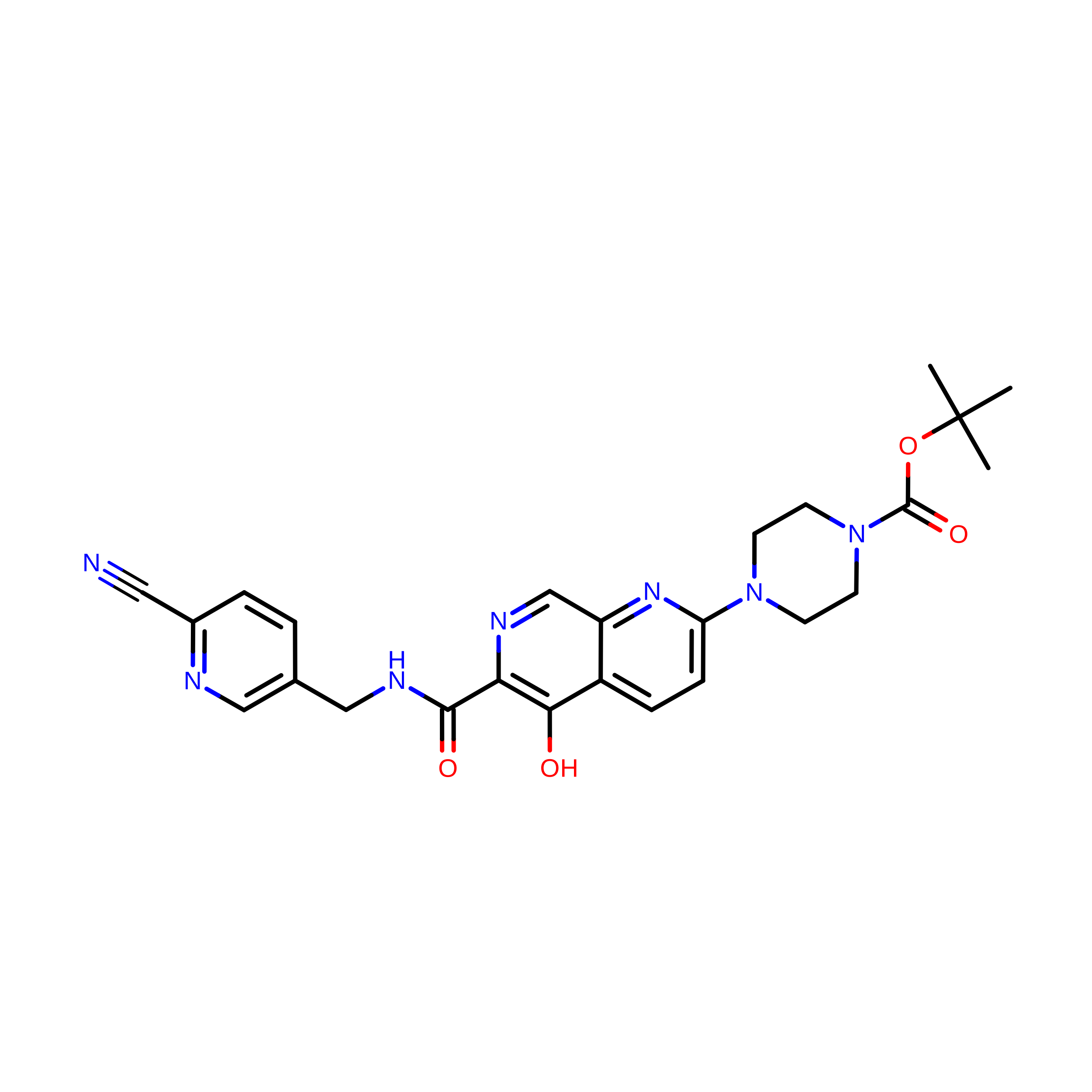
8Y0V | pdb_00008y0v

HIF prolyl hydroxylase 2 in complex with inhibitor


Experimental Data Snapshot

  • Method: X-RAY DIFFRACTION
  • Resolution: 2.50 Å
  • R-Value Free: 
    0.291 (Depositor), 0.297 (DCC) 
  • R-Value Work: 
    0.226 (Depositor), 0.228 (DCC) 

Starting Model: experimental
View more details

wwPDB Validation 3D Report Full Report

Validation slider image for 8Y0V

Ligand Structure Quality Assessment 


This is version 1.2 of the entry. See complete history

Literature

Intestinal mucosal barrier repair and immune regulation with an AI-developed gut-restricted PHD inhibitor.

Fu, Y.Ding, X.Zhang, M.Feng, C.Yan, Z.Wang, F.Xu, J.Lin, X.Ding, X.Wang, L.Fan, Y.Li, T.Yin, Y.Liang, X.Xu, C.Chen, S.Pulous, F.E.Gennert, D.Pun, F.W.Kamya, P.Ren, F.Aliper, A.Zhavoronkov, A.

(2025) Nat Biotechnol 43: 1772-1777

  • DOI: https://doi.org/10.1038/s41587-024-02503-w
  • Primary Citation Related Structures: 
    8Y0V

  • PubMed Abstract: 

    Hypoxia-inducible factor prolyl hydroxylase (PHD) inhibitors have been approved for treating renal anemia yet have failed clinical testing for inflammatory bowel disease because of a lack of efficacy. Here we used a multimodel multimodal generative artificial intelligence platform to design an orally gut-restricted selective PHD1 and PHD2 inhibitor that exhibits favorable safety and pharmacokinetic profiles in preclinical studies. ISM012-042 restores intestinal barrier function and alleviates gut inflammation in multiple experimental colitis models.


  • Organizational Affiliation
    • Insilico Medicine US, Inc., Boston, MA, USA.

Macromolecule Content 

  • Total Structure Weight: 28.07 kDa 
  • Atom Count: 1,634 
  • Modeled Residue Count: 197 
  • Deposited Residue Count: 246 
  • Unique protein chains: 1

Macromolecules

Find similar proteins by:|  3D Structure
Entity ID: 1
MoleculeChains  Sequence LengthOrganismDetailsImage
Egl nine homolog 1246Homo sapiensMutation(s): 0 
Gene Names: EGLN1C1orf12PNAS-118PNAS-137
EC: 1.14.11.29
UniProt & NIH Common Fund Data Resources
Find proteins for Q9GZT9 (Homo sapiens)
Explore Q9GZT9 
Go to UniProtKB:  Q9GZT9
PHAROS:  Q9GZT9
GTEx:  ENSG00000135766 
Entity Groups
Sequence Clusters30% Identity50% Identity70% Identity90% Identity95% Identity100% Identity
UniProt GroupQ9GZT9
Sequence Annotations
Expand
Reference Sequence

Small Molecules

Ligands 2 Unique
IDChains Name / Formula / InChI Key2D Diagram3D Interactions
A1D5X
(Subject of Investigation/LOI)

Query on A1D5X


Download:Ideal Coordinates CCD File
B [auth A]~{tert}-butyl 4-[6-[(6-cyanopyridin-3-yl)methylcarbamoyl]-5-oxidanyl-1,7-naphthyridin-2-yl]piperazine-1-carboxylate
C25 H27 N7 O4
VXVKDBNSYJRFIQ-UHFFFAOYSA-N
MN

Query on MN


Download:Ideal Coordinates CCD File
C [auth A]MANGANESE (II) ION
Mn
WAEMQWOKJMHJLA-UHFFFAOYSA-N

Experimental Data & Validation

Experimental Data

  • Method: X-RAY DIFFRACTION
  • Resolution: 2.50 Å
  • R-Value Free:  0.291 (Depositor), 0.297 (DCC) 
  • R-Value Work:  0.226 (Depositor), 0.228 (DCC) 
Space Group: P 63
Unit Cell:
Length ( Å )Angle ( ˚ )
a = 82.415α = 90
b = 82.415β = 90
c = 63.472γ = 120
Software Package:
Software NamePurpose
REFMACrefinement
XDSdata reduction
XDSdata scaling
PHASERphasing

Structure Validation

View Full Validation Report


Ligand Structure Quality Assessment 


Entry History 

& Funding Information

Deposition Data


Funding OrganizationLocationGrant Number
Not funded--

Revision History  (Full details and data files)

  • Version 1.0: 2024-12-18
    Type: Initial release
  • Version 1.1: 2024-12-25
    Changes: Database references
  • Version 1.2: 2025-11-26
    Changes: Database references