Download Mendeley
New glycoside hydrolase families of beta-1,2-glucanases.
Nakajima, M., Tanaka, N., Motouchi, S., Kobayashi, K., Shimizu, H., Abe, K., Hosoyamada, N., Abara, N., Morimoto, N., Hiramoto, N., Nakata, R., Takashima, A., Hosoki, M., Suzuki, S., Shikano, K., Fujimaru, T., Imagawa, S., Kawadai, Y., Wang, Z., Kitano, Y., Nihira, T., Nakai, H., Taguchi, H.(2025) Protein Sci 34: e70147-e70147
- PubMed: 40411428 Search on PubMedSearch on PubMed Central
- DOI: https://doi.org/10.1002/pro.70147
- Primary Citation Related Structures:
8XUJ, 8XUK, 8XUL - PubMed Abstract:
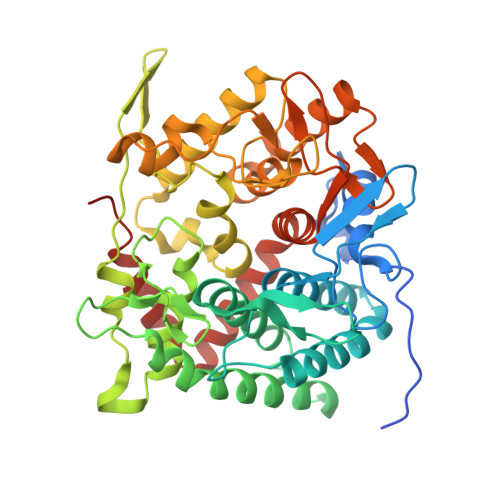
β-1,2-Glucans are natural glucose polymers produced by bacteria and play important physiological roles, including as symbiotic or pathogenic factors and in osmoregulation. Glycoside hydrolase (GH) families related to β-1,2-glucan metabolism (GH144, GH162, and GH189) have recently been created by identification of two β-1,2-glucanases and a β-1,2-glucanotransferase, respectively. In this study, we further found four phylogenetically new groups with unknown functions (Groups 1-4) by sequence database analysis using enzymes from GH144 and GH162 as queries. Biochemical analysis of representative proteins in these groups revealed that the proteins in Groups 1-3 showed hydrolytic activity specific to β-1,2-glucan, while no substrate was found for the Group 4 protein. The kinetic parameters of the enzymes of Groups 1-3 were similar to GH144 and GH162 β-1,2-glucanases, indicating that these enzymes were β-1,2-glucanases. Optical rotation analysis revealed that the β-1,2-glucanases followed an anomer-inverting mechanism. Structural analysis of the proteins in Groups 1-4 revealed that they possess (α/α) 6 -barrel folds similar to those of GH144, GH162, and GH189 enzymes. Comparison of spatial positions of predicted acidic catalytic residues suggested that Groups 1-3 and GH144 had the same reaction mechanism. Overall, phylogenetic, biochemical, and structural analyses revealed that Groups 1-3 are new GH families, GH192, GH193, and GH194, respectively, and that the three families belong to clan GH-S (clan GH, classification based on structural similarity) as GH144 and GH162.
- Department of Applied Biological Science, Faculty of Science and Technology, Tokyo University of Science, Noda, Chiba, Japan.
Organizational Affiliation: