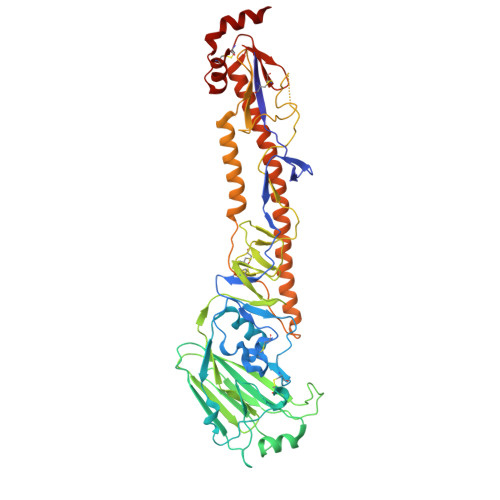
8XRA | pdb_00008xra

Dual receptor-binding, infectivity, and transmissibility of an emerging H2N2 avian influenza virus


Experimental Data Snapshot

  • Method: ELECTRON MICROSCOPY
  • Resolution: 2.31 Å
  • Aggregation State: PARTICLE 
  • Reconstruction Method: SINGLE PARTICLE 

wwPDB Validation 3D Report Full Report

Validation slider image for 8XRA

This is version 1.1 of the entry. See complete history

Literature

Dual receptor-binding, infectivity, and transmissibility of an emerging H2N2 low pathogenicity avian influenza virus.

Sun, J.Zheng, T.Jia, M.Wang, Y.Yang, J.Liu, Y.Yang, P.Xie, Y.Sun, H.Tong, Q.Li, J.Yang, J.Fu, G.Shi, Y.Qi, J.Liu, W.Liu, J.Tian, W.X.Gao, G.F.Bi, Y.

(2024) Nat Commun 15: 10012-10012

  • DOI: https://doi.org/10.1038/s41467-024-54374-z
  • Primary Citation Related Structures: 
    8XG1, 8XHE, 8XHF, 8XHG, 8XHH, 8XR7, 8XR8, 8XR9, 8XRA, 8XRB, 8XRC, 8XRD

  • PubMed Abstract: 

    The 1957 H2N2 influenza pandemic virus [A(H2N2)pdm1957] has disappeared from humans since 1968, while H2N2 avian influenza viruses (AIVs) are still circulating in birds. It is necessary to reveal the recurrence risk and potential cross-species infection of these AIVs from avian to mammals. We find that H2 AIVs circulating in domestic poultry in China have genetic and antigenic differences compared to the A(H2N2)pdm1957. One H2N2 AIV has a dual receptor-binding property similar to that of the A(H2N2)pdm1957. Molecular and structural studies reveal that the N144S, and N144E or R137M substitutions in hemagglutinin (HA) enable H2N2 avian or human viruses to bind or preferentially bind human-type receptor. The H2N2 AIV rapidly adapts to mice (female) and acquires mammalian-adapted mutations that facilitated transmission in guinea pigs and ferrets (female). These findings on the receptor-binding, infectivity, transmission, and mammalian-adaptation characteristics of H2N2 AIVs provide a reference for early-warning and prevention for this subtype.


  • Organizational Affiliation
    • College of Veterinary Medicine, Shanxi Agricultural University, Jinzhong, 030801, China.

Macromolecule Content 

  • Total Structure Weight: 171.85 kDa 
  • Atom Count: 11,881 
  • Modeled Residue Count: 1,470 
  • Deposited Residue Count: 1,491 
  • Unique protein chains: 1

Macromolecules

Find similar proteins by:|  3D Structure
Entity ID: 1
MoleculeChains  Sequence LengthOrganismDetailsImage
Hemagglutinin
A, B, C
497Influenza A virusMutation(s): 0 
Gene Names: HA
UniProt
Find proteins for Q67333 (Influenza A virus (strain A/Singapore/1/1957 H2N2))
Explore Q67333 
Go to UniProtKB:  Q67333
Entity Groups
Sequence Clusters30% Identity50% Identity70% Identity90% Identity95% Identity100% Identity
UniProt GroupQ67333
Glycosylation
Glycosylation Sites: 3
Sequence Annotations
Expand
Reference Sequence

Oligosaccharides

Help  
Entity ID: 2
MoleculeChains Length2D Diagram GlycosylationD Interactions
N-acetyl-alpha-neuraminic acid-(2-3)-beta-D-galactopyranoseD,
E [auth F]
2N/A
Glycosylation Resources
GlyTouCan: G30207PZ
GlyCosmos: G30207PZ
GlyGen: G30207PZ

Small Molecules

Ligands 2 Unique
IDChains Name / Formula / InChI Key2D Diagram3D Interactions
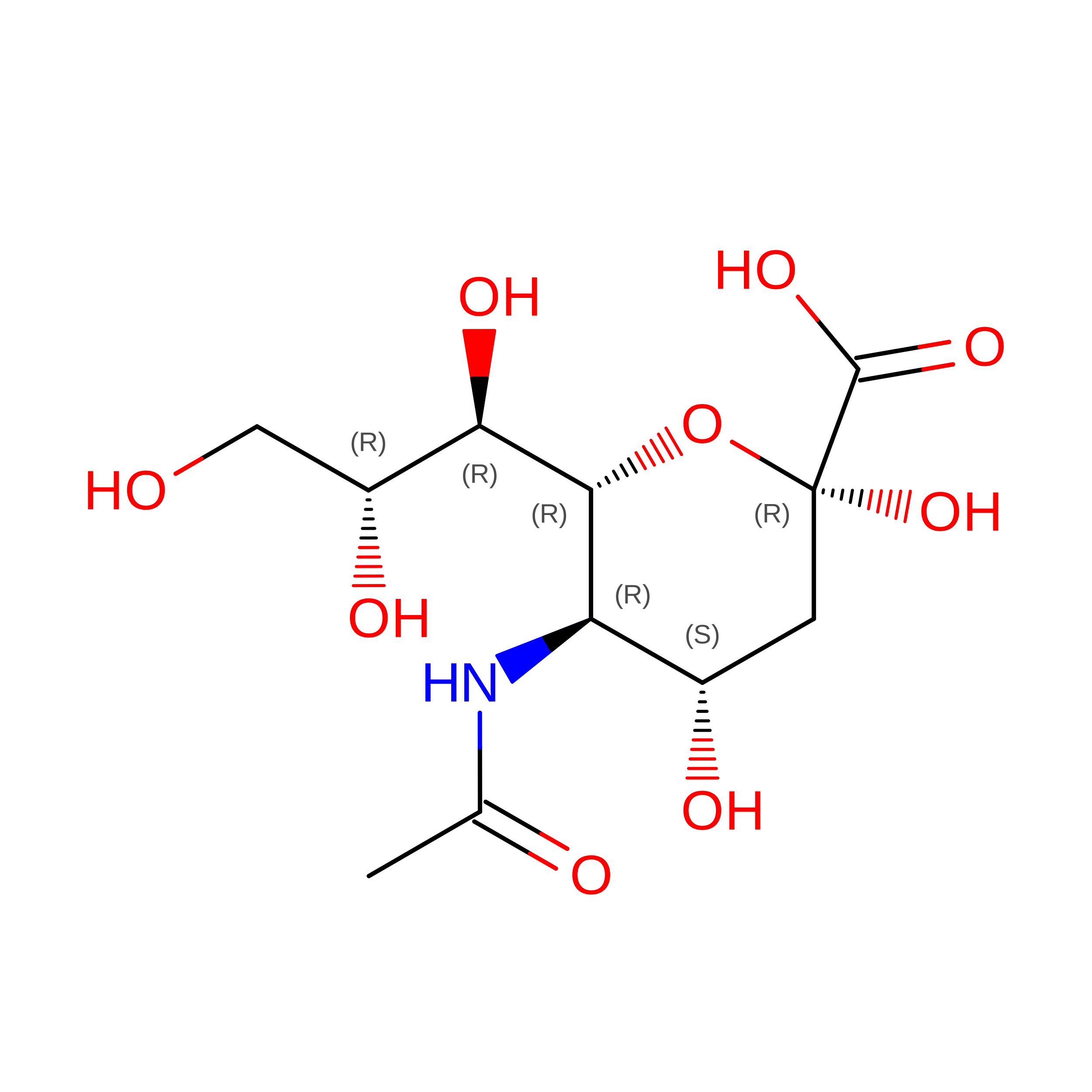
SIA
(Subject of Investigation/LOI)

Query on SIA


Download:Ideal Coordinates CCD File
L [auth B]N-acetyl-alpha-neuraminic acid
C11 H19 N O9
SQVRNKJHWKZAKO-YRMXFSIDSA-N
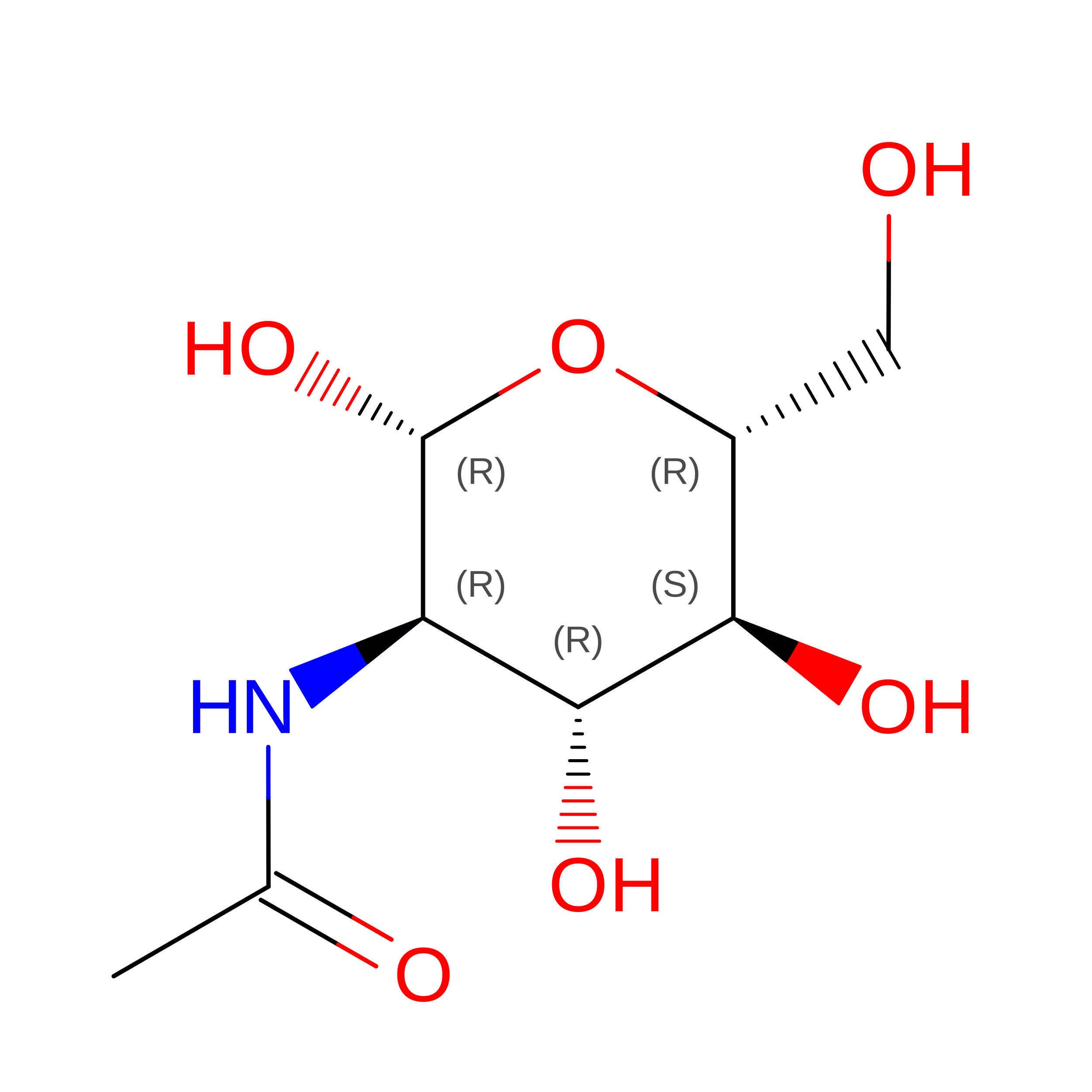
NAG

Query on NAG


Download:Ideal Coordinates CCD File
F [auth A]
G [auth A]
H [auth A]
I [auth B]
J [auth B]
F [auth A],
G [auth A],
H [auth A],
I [auth B],
J [auth B],
K [auth B],
M [auth C],
N [auth C],
O [auth C]
2-acetamido-2-deoxy-beta-D-glucopyranose
C8 H15 N O6
OVRNDRQMDRJTHS-FMDGEEDCSA-N

Experimental Data & Validation

Experimental Data

  • Method: ELECTRON MICROSCOPY
  • Resolution: 2.31 Å
  • Aggregation State: PARTICLE 
  • Reconstruction Method: SINGLE PARTICLE 
EM Software:
TaskSoftware PackageVersion
MODEL REFINEMENTPHENIX

Structure Validation

View Full Validation Report


Entry History 

& Funding Information

Deposition Data


Funding OrganizationLocationGrant Number
Chinese Academy of SciencesChina151C53KYSB20210023
Chinese Academy of SciencesChinaYSBR-086

Revision History  (Full details and data files)

  • Version 1.0: 2025-01-15
    Type: Initial release
  • Version 1.1: 2025-07-02
    Changes: Data collection