8XBA | pdb_00008xba

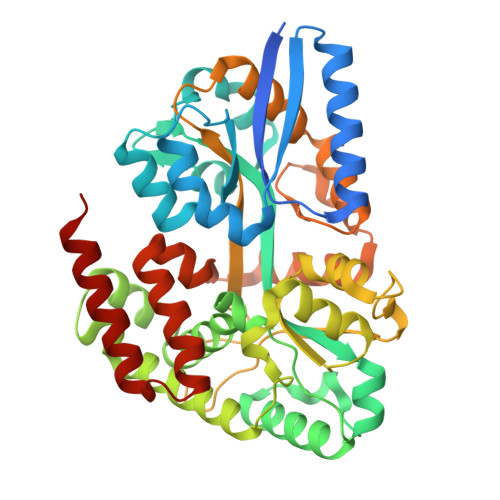
The substrate binding protein of an ABC transporter in complex with beta-1,4-xylobiose


Experimental Data Snapshot

  • Method: X-RAY DIFFRACTION
  • Resolution: 1.48 Å
  • R-Value Free: 
    0.188 (Depositor), 0.194 (DCC) 
  • R-Value Work: 
    0.170 (Depositor), 0.177 (DCC) 
  • R-Value Observed: 
    0.171 (Depositor) 

Starting Model: in silico
View more details

wwPDB Validation 3D Report Full Report

Validation slider image for 8XBA

This is version 1.1 of the entry. See complete history

Literature

Complete xylan utilization pathway and regulation mechanisms involved in marine algae degradation by cosmopolitan marine and human gut microbiota.

Sun, H.N.Chen, X.L.Wang, Y.Zhu, Y.P.Teng, Z.J.Cao, H.Y.Xu, T.T.Chen, Y.Zhang, Y.Z.Zhao, F.

(2025) ISME J 19

  • DOI: https://doi.org/10.1093/ismejo/wraf085
  • Primary Citation Related Structures: 
    8XBA, 8XBB, 8XBC

  • PubMed Abstract: 

    β-1,3-xylan, typically found in marine algae as a major cell wall polysaccharide, represents an overlooked pool of organic carbon in global oceans. Whilst our understanding of microbial catabolism of xylans has improved significantly, particularly from biotransformations of terrestrial plant biomass that are typically composed of β-1,4-xylans, knowledge on how microbes utilize β-1,3-xylan remains limited. Here, we describe the discovery of a complete pathway for β-1,3-xylan catabolism and its regulation in a marine bacterium, Vibrio sp. EA2. The pathway starts with the extracellular decomposition of β-1,3-xylan by two β-1,3-xylanases into β-1,3-xylooligomers, which are mainly internalized by an ATP-binding cassette transporter. The substrate binding protein of this transporter has an L-shaped substrate binding pocket to preferentially bind β-1,3-xylooligomers. Subsequently, two intracellular β-1,3-xylosidases degrade β-1,3-xylooligomers into fermentable xylose. The pathway is activated by a unique regulator with xylose being the effector. This β-1,3-xylan catabolic pathway differs from that of β-1,4-xylan catabolism in enzymes, transporters, and regulators. Bioinformatic analysis suggests that the β-1,3-xylan catabolism pathway is not only prevalent in diverse marine bacteria and cosmopolitan human gut microbiota, such as Bacteroides, but also likely transferred horizontally from algae-degrading marine bacteria to the human gut.


  • Organizational Affiliation
    • State Key Laboratory of Microbial Technology, Shandong University, Qingdao 266237, Shandong Province, China.

Macromolecule Content 

  • Total Structure Weight: 47.37 kDa 
  • Atom Count: 3,371 
  • Modeled Residue Count: 400 
  • Deposited Residue Count: 429 
  • Unique protein chains: 1

Macromolecules

Find similar proteins by:|  3D Structure
Entity ID: 1
MoleculeChains  Sequence LengthOrganismDetailsImage
XylA429Vibrio sp. EA2Mutation(s): 0 
UniProt
Find proteins for A0A090T8V4 (Vibrio maritimus)
Explore A0A090T8V4 
Go to UniProtKB:  A0A090T8V4
Entity Groups
Sequence Clusters30% Identity50% Identity70% Identity90% Identity95% Identity100% Identity
UniProt GroupA0A090T8V4
Sequence Annotations
Expand
Reference Sequence

Oligosaccharides

Help  
Entity ID: 2
MoleculeChains Length2D Diagram GlycosylationD Interactions
beta-D-xylopyranose-(1-4)-alpha-D-xylopyranose
B
2N/A
Glycosylation Resources
GlyTouCan: G73335RX
GlyCosmos: G73335RX

Small Molecules

Ligands 1 Unique
IDChains Name / Formula / InChI Key2D Diagram3D Interactions
GOL

Query on GOL


Download:Ideal Coordinates CCD File
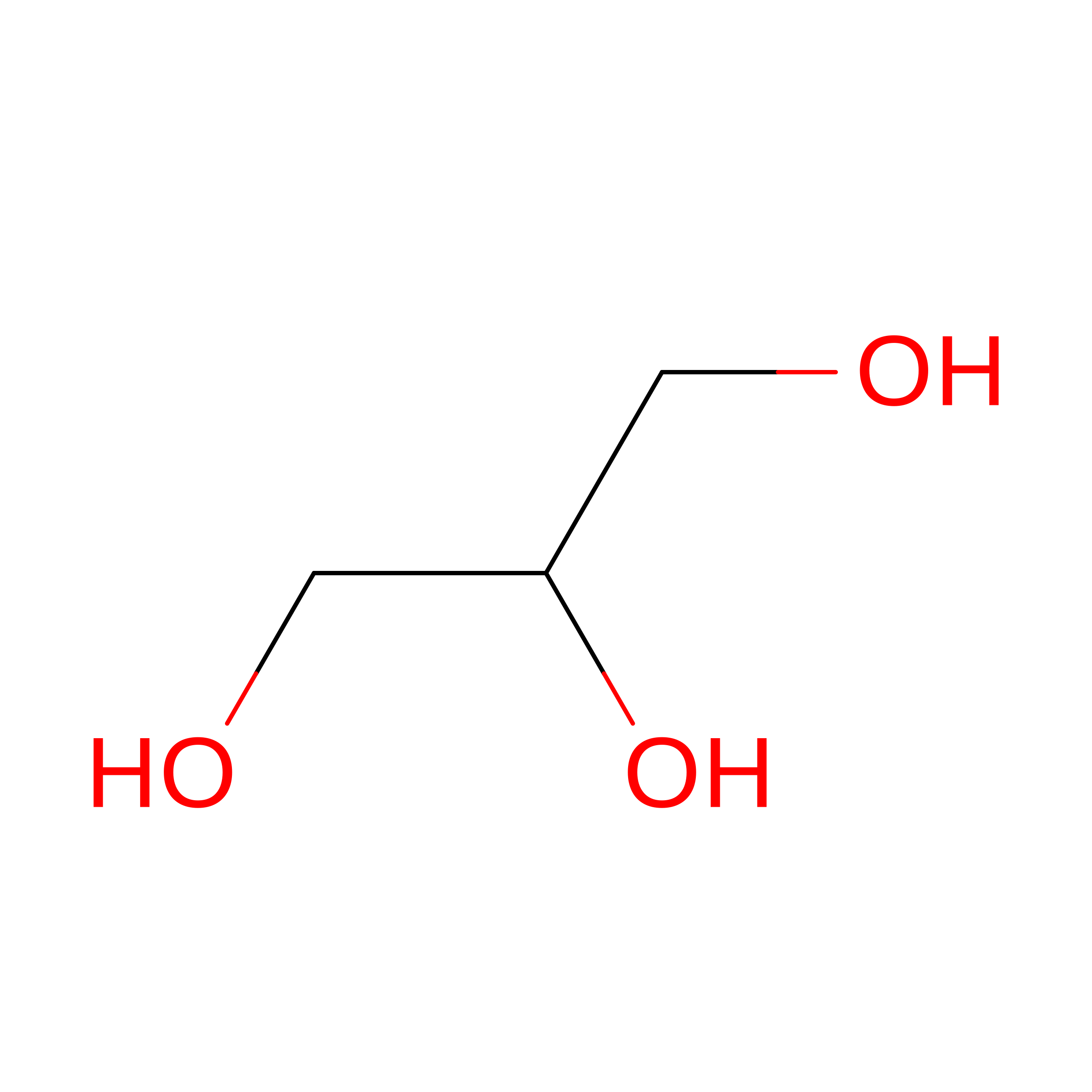
C [auth A]GLYCEROL
C3 H8 O3
PEDCQBHIVMGVHV-UHFFFAOYSA-N

Experimental Data & Validation

Experimental Data

  • Method: X-RAY DIFFRACTION
  • Resolution: 1.48 Å
  • R-Value Free:  0.188 (Depositor), 0.194 (DCC) 
  • R-Value Work:  0.170 (Depositor), 0.177 (DCC) 
  • R-Value Observed: 0.171 (Depositor) 
Space Group: P 21 21 21
Unit Cell:
Length ( Å )Angle ( ˚ )
a = 45.26α = 90
b = 84.738β = 90
c = 100.119γ = 90
Software Package:
Software NamePurpose
PHENIXrefinement
XDSdata reduction
XDSdata scaling
PHASERphasing

Structure Validation

View Full Validation Report


Entry History 

& Funding Information

Deposition Data


Funding OrganizationLocationGrant Number
National Natural Science Foundation of China (NSFC)China--

Revision History  (Full details and data files)

  • Version 1.0: 2024-12-11
    Type: Initial release
  • Version 1.1: 2025-07-02
    Changes: Database references